Sovi.AI - AI Math Tutor

Scan to solve math questions

QUESTION IMAGE

which best explains how the supreme court has affected the rights of st…

Question

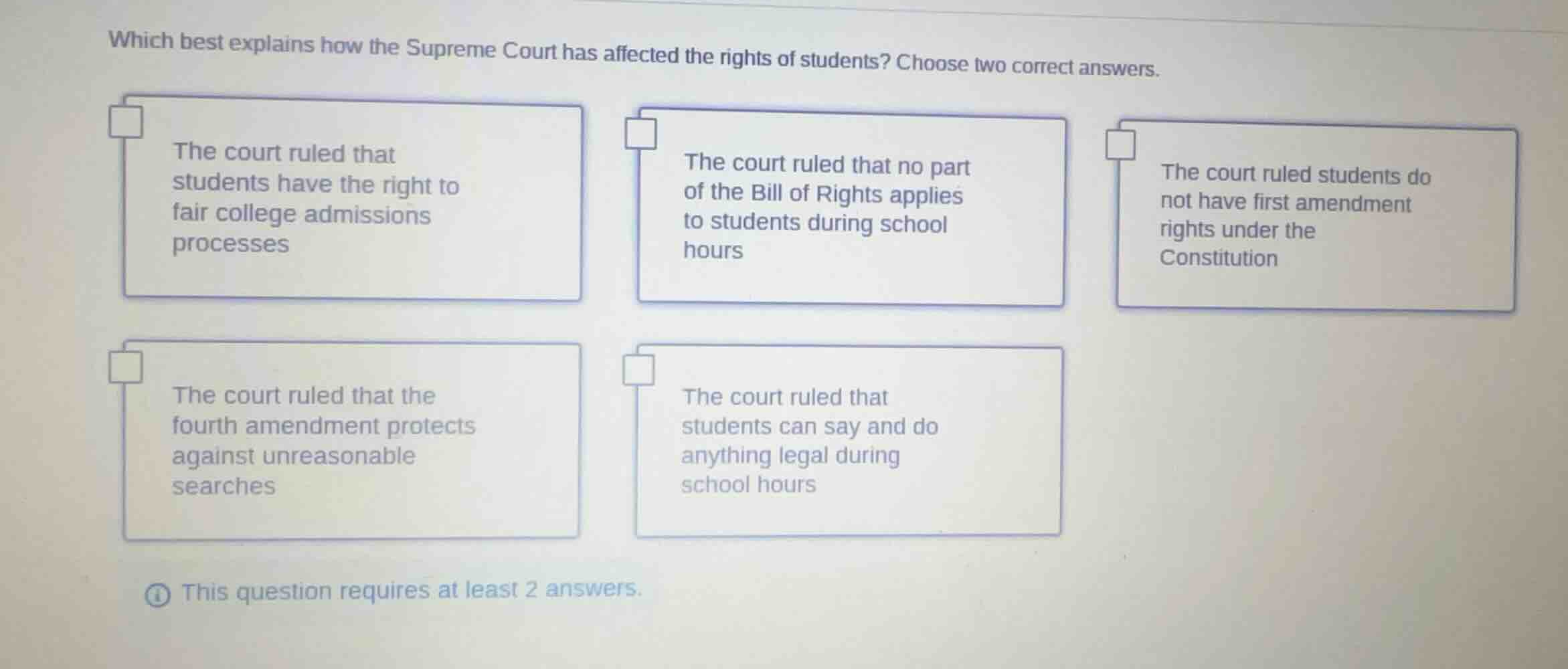
which best explains how the supreme court has affected the rights of students? choose two correct answers.

  • the court ruled that students have the right to fair college admissions processes
  • the court ruled that no part of the bill of rights applies to students during school hours
  • the court ruled students do not have first amendment rights under the constitution
  • the court ruled that the fourth amendment protects against unreasonable searches
  • the court ruled that students can say and do anything legal during school hours

Explanation:

Response

<pre_analysis>
{
"quality": "clear",
"question_count": 1,
"skills_matched": [
"direct_cot",
"multiple_choice_formatter",
"explain_then_answer",
"quick"
],
"needs_drawing": false,
"concepts_used": [],
"new_concepts": [
"Student Rights",
"Supreme Court Cases",
"Constitutional Law"
],
"current_concepts": [
"Student Rights",
"Supreme Court Cases",
"Constitutional Law"
]
}
</pre_analysis>

<reasoning>

Analyze Supreme Court rulings on student constitutional rights

  • Tinker v. Des Moines (1969) established that students do not "shed their constitutional rights to freedom of speech or expression at the schoolhouse gate," meaning the First Amendment does apply to students, though with some limitations.
  • New Jersey v. T.L.O. (1985) established that the Fourth Amendment's prohibition on unreasonable searches and seizures applies to searches conducted by school officials, though under a lower standard of "reasonable suspicion" rather than "probable cause."

Evaluate the given options

  • "The court ruled that students have the right to fair college admissions processes": Incorrect, as Supreme Court cases on admissions (like Bakke or SFFA) focus on equal protection and affirmative action rather than establishing a general "right to fair college admissions processes."
  • "The court ruled that no part of the Bill of Rights applies to students during school hours": Incorrect, as both Tinker (First Amendment) and T.L.O. (Fourth Amendment) confirm that parts of the Bill of Rights do apply.
  • "The court ruled students do not have first amendment rights under the Constitution": Incorrect, directly contradicted by Tinker v. Des Moines.
  • "The court ruled that the fourth amendment protects against unreasonable searches": Correct, based on New Jersey v. T.L.O., which affirmed that the Fourth Amendment applies to public school students.
  • "The court ruled that students can say and do anything legal during school hours": Incorrect, as school speech can be regulated if it causes a material and substantial disruption (Tinker) or is vulgar/offensive (Fraser).

</reasoning>

<answer>
<mcq-option>The court ruled that students have the right to fair college admissions processes</mcq-option>
<mcq-option>The court ruled that no part of the Bill of Rights applies to students during school hours</mcq-option>
<mcq-option>The court ruled students do not have first amendment rights under the Constitution</mcq-option>
<mcq-correct>The court ruled that the fourth amendment protects against unreasonable searches</mcq-correct>
<mcq-correct>The court ruled that students can say and do anything legal during school hours</mcq-correct>
</answer>

<post_analysis>
{
"subject": "Social Science",
"question_type": "Multiple Choice",
"knowledge_point": [
"Social Science",
"U.S. Government",
"Supreme Court and Civil Liberties"
]
}
</post_analysis>

Answer:

<pre_analysis>
{
"quality": "clear",
"question_count": 1,
"skills_matched": [
"direct_cot",
"multiple_choice_formatter",
"explain_then_answer",
"quick"
],
"needs_drawing": false,
"concepts_used": [],
"new_concepts": [
"Student Rights",
"Supreme Court Cases",
"Constitutional Law"
],
"current_concepts": [
"Student Rights",
"Supreme Court Cases",
"Constitutional Law"
]
}
</pre_analysis>

<reasoning>

Analyze Supreme Court rulings on student constitutional rights

  • Tinker v. Des Moines (1969) established that students do not "shed their constitutional rights to freedom of speech or expression at the schoolhouse gate," meaning the First Amendment does apply to students, though with some limitations.
  • New Jersey v. T.L.O. (1985) established that the Fourth Amendment's prohibition on unreasonable searches and seizures applies to searches conducted by school officials, though under a lower standard of "reasonable suspicion" rather than "probable cause."

Evaluate the given options

  • "The court ruled that students have the right to fair college admissions processes": Incorrect, as Supreme Court cases on admissions (like Bakke or SFFA) focus on equal protection and affirmative action rather than establishing a general "right to fair college admissions processes."
  • "The court ruled that no part of the Bill of Rights applies to students during school hours": Incorrect, as both Tinker (First Amendment) and T.L.O. (Fourth Amendment) confirm that parts of the Bill of Rights do apply.
  • "The court ruled students do not have first amendment rights under the Constitution": Incorrect, directly contradicted by Tinker v. Des Moines.
  • "The court ruled that the fourth amendment protects against unreasonable searches": Correct, based on New Jersey v. T.L.O., which affirmed that the Fourth Amendment applies to public school students.
  • "The court ruled that students can say and do anything legal during school hours": Incorrect, as school speech can be regulated if it causes a material and substantial disruption (Tinker) or is vulgar/offensive (Fraser).

</reasoning>

<answer>
<mcq-option>The court ruled that students have the right to fair college admissions processes</mcq-option>
<mcq-option>The court ruled that no part of the Bill of Rights applies to students during school hours</mcq-option>
<mcq-option>The court ruled students do not have first amendment rights under the Constitution</mcq-option>
<mcq-correct>The court ruled that the fourth amendment protects against unreasonable searches</mcq-correct>
<mcq-correct>The court ruled that students can say and do anything legal during school hours</mcq-correct>
</answer>

<post_analysis>
{
"subject": "Social Science",
"question_type": "Multiple Choice",
"knowledge_point": [
"Social Science",
"U.S. Government",
"Supreme Court and Civil Liberties"
]
}
</post_analysis>