QUESTION IMAGE
Question
what do you notice? what types of details?
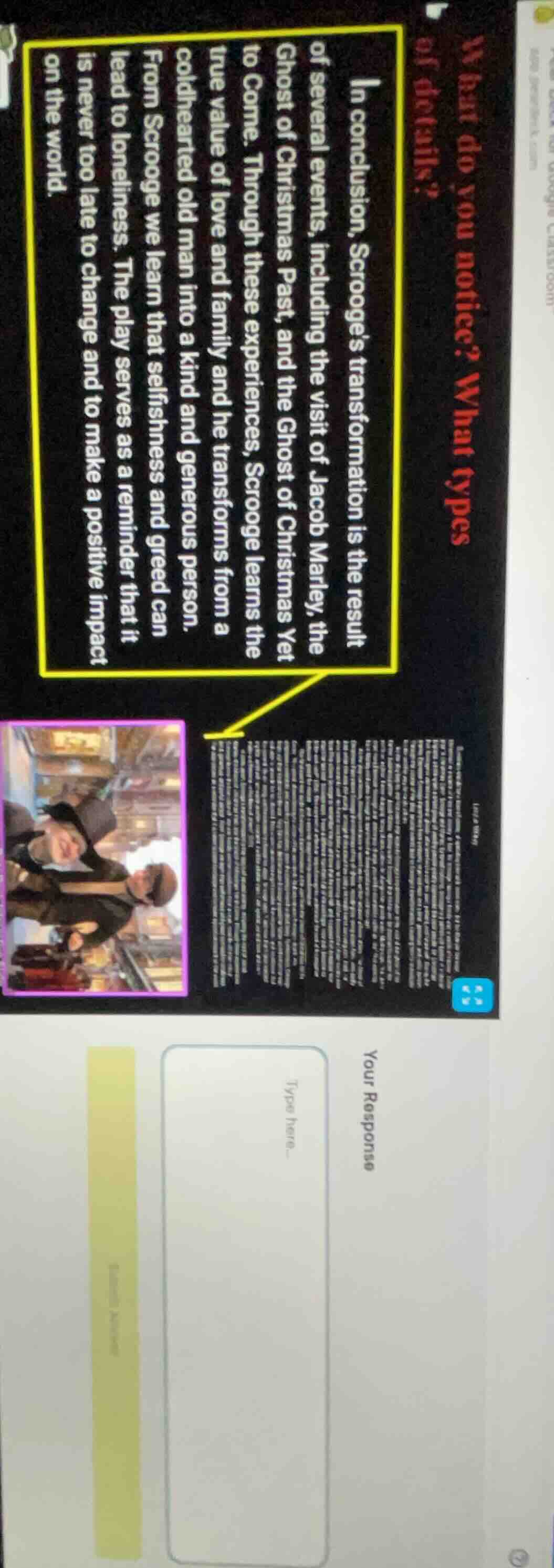
in conclusion, scrooges transformation is the result of several events, including the visit of jacob marley, the ghost of christmas past, and the ghost of christmas yet to come. through these experiences, scrooge learns the true value of love and family and he transforms from a coldhearted old man into a kind and generous person. from scrooge we learn that selfishness and greed can lead to loneliness. the play serves as a reminder that it is never too late to change and to make a positive impact on the world.
The highlighted text is a concluding paragraph (a thematic wrap-up) that uses a deductive structure: it first states Scrooge's transformation as the core claim, then lists the inciting events (ghost visits), explains the lesson he learns, and ends with a universal takeaway. The details are thematic, narrative, and moral in type—they tie the story's plot events to its core message about redemption and kindness. The visual detail (the image of Scrooge) is a contextual, illustrative detail that aligns with the text's focus on his character change.

Snap & solve any problem in the app
Get step-by-step solutions on Sovi AI
Photo-based solutions with guided steps
Explore more problems and detailed explanations
- Notable observations: The highlighted section is a concise conclusion that distills the entire narrative arc of A Christmas Carol; it directly links plot events (the ghostly visits) to character growth and thematic meaning. It also pairs with a visual of Scrooge that contextualizes the character being discussed.
- Types of details:
- Narrative plot details (the visits of Jacob Marley and the three Christmas ghosts)
- Character transformation details (Scrooge's shift from cold to kind)
- Thematic/moral details (lessons about love, family, redemption, and the possibility of change)
- Illustrative visual detail (the image of Scrooge, which supports the textual discussion of his character)