QUESTION IMAGE
Question
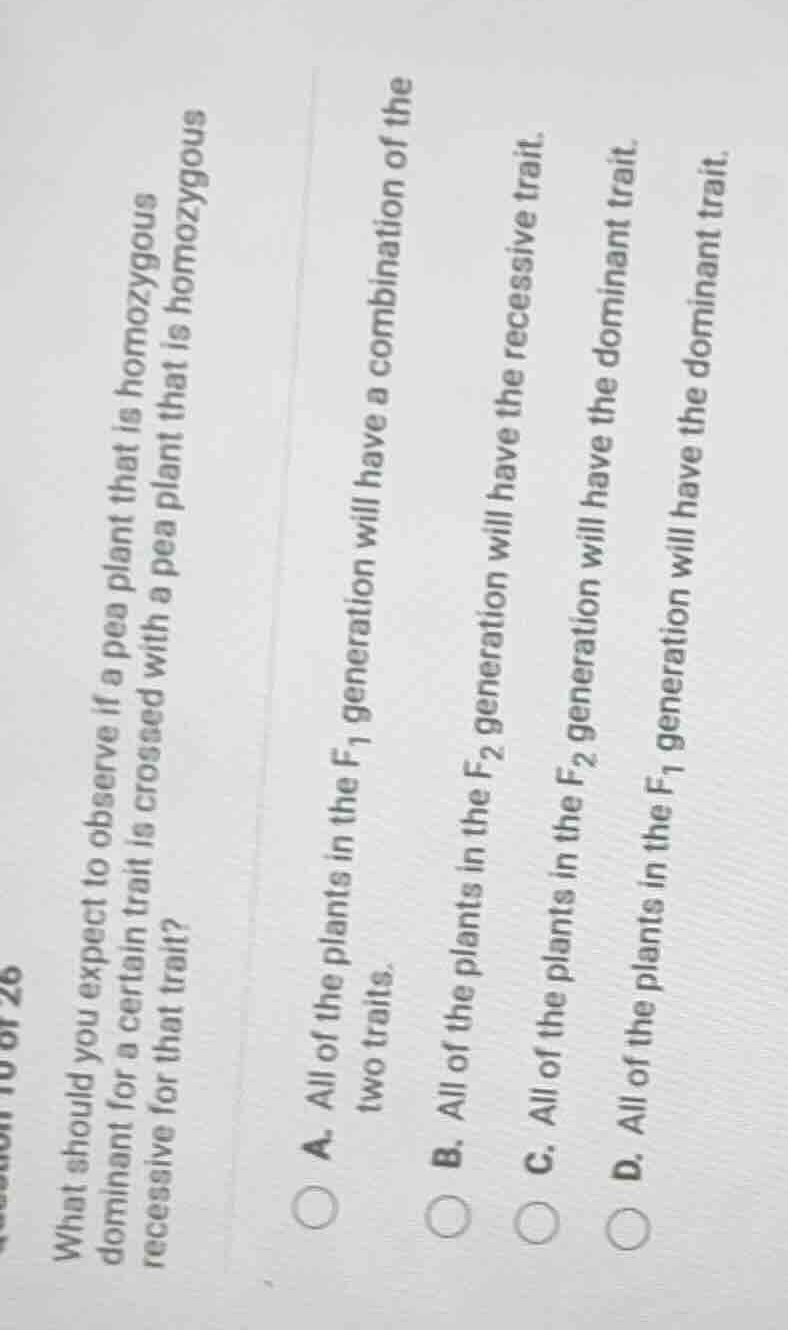
what should you expect to observe if a pea plant that is homozygous dominant for a certain trait is crossed with a pea plant that is homozygous recessive for that trait?
a. all of the plants in the \\(f_1\\) generation will have a combination of the two traits.
b. all of the plants in the \\(f_2\\) generation will have the recessive trait.
c. all of the plants in the \\(f_2\\) generation will have the dominant trait.
d. all of the plants in the \\(f_1\\) generation will have the dominant trait.
Analyze the parental genotypes
The problem describes a cross between a pea plant that is homozygous dominant for a certain trait and a pea plant that is homozygous recessive for that trait. Let the dominant allele be represented by \(T\) and the recessive allele by \(t\).
- Homozygous dominant parent: \(TT\)
- Homozygous recessive parent: \(tt\)
Determine the F1 generation genotype
When these two parents are crossed (\(TT \times tt\)), each parent can only pass on one type of allele to the offspring.
- The homozygous dominant parent passes on the \(T\) allele.
- The homozygous recessive parent passes on the \(t\) allele.
- Therefore, all offspring in the first filial (\(F_1\)) generation will have the heterozygous genotype: \(Tt\).
Determine the F1 generation phenotype
Using the principles of Mendelian Genetics, specifically the law of dominance, the dominant allele \(T\) completely masks the expression of the recessive allele \(t\) in a heterozygous individual.
- Because all \(F_1\) plants have the heterozygous Genotype \(Tt\), they will all express the dominant Phenotype.
- Thus, all of the plants in the \(F_1\) generation will have the dominant trait.
Evaluate the given options
Let's evaluate each option based on our genetic analysis:
- Option A: "All of the plants in the \(F_1\) generation will have a combination of the two traits." This is incorrect because dominance results in only the dominant phenotype being expressed, not a blend or combination.
- Option B: "All of the plants in the \(F_2\) generation will have the recessive trait." This is incorrect; self-crossing \(F_1\) (\(Tt \times Tt\)) yields a \(3:1\) ratio of dominant to recessive phenotypes in the \(F_2\) generation.
- Option C: "All of the plants in the \(F_2\) generation will have the dominant trait." This is incorrect because about \(25\%\) (\(tt\)) will show the recessive trait.
- Option D: "All of the plants in the \(F_1\) generation will have the dominant trait." This matches our analysis perfectly.

Snap & solve any problem in the app
Get step-by-step solutions on Sovi AI
Photo-based solutions with guided steps
Explore more problems and detailed explanations
- (A) All of the plants in the \(F_1\) generation will have a combination of the two traits.
- (B) All of the plants in the \(F_2\) generation will have the recessive trait.
- (C) All of the plants in the \(F_2\) generation will have the dominant trait.
- (D) All of the plants in the \(F_1\) generation will have the dominant trait. (Correct answer)