QUESTION IMAGE
Question
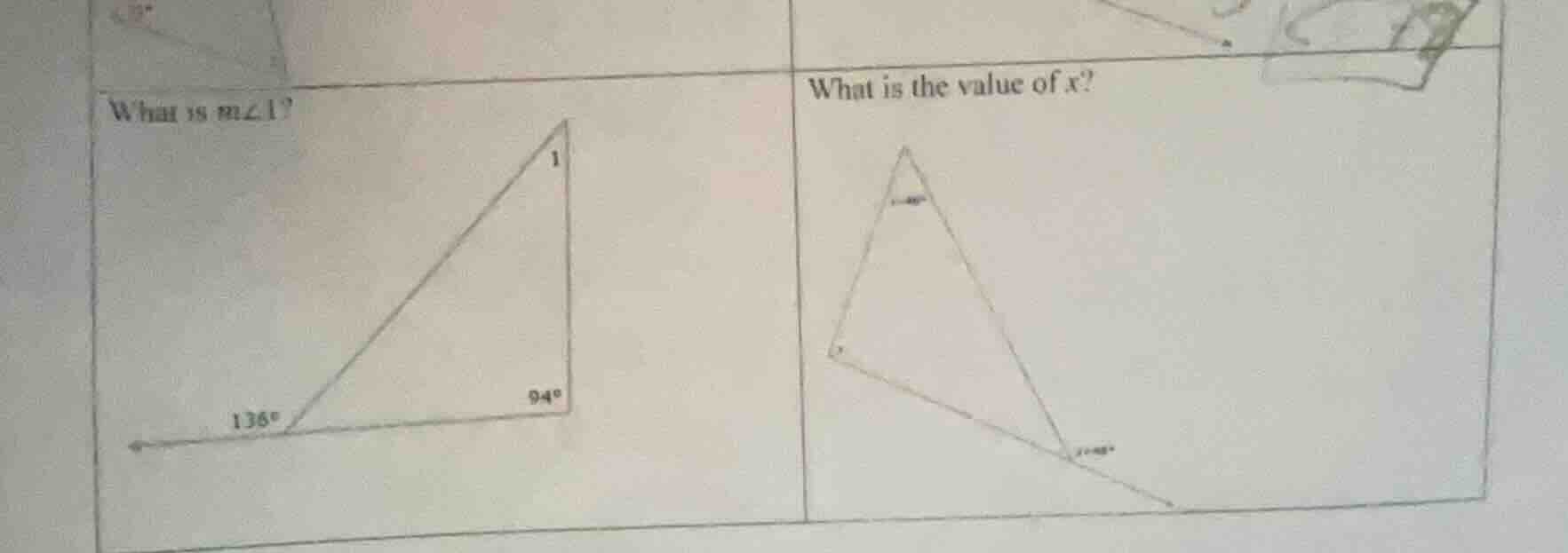
what is \\(m\angle 1\\)?
what is the value of \\(x\\)?
Find the measure of angle 1
Using the Exterior Angle Theorem knowledge point
Find the value of x
Using the Exterior Angle Theorem knowledge point
Since this is an identity, let's re-examine the labels in the second triangle. The top angle is labeled \(x + 48\), the left angle is labeled \(x\), and the exterior angle is labeled \(2x + 48\). By the exterior angle theorem, the exterior angle equals the sum of the two opposite interior angles:
This holds true for any valid triangle where the angles are positive. To find a specific value for \(x\), we look at the straight angle on the bottom line. The interior angle adjacent to the exterior angle \(2x + 48\) and the exterior angle itself lie on a straight line, but without further information, \(x\) is constrained by the fact that all interior angles must be positive:
Thus, \(0 < x < 66\). However, in standard high school geometry worksheets of this type, the exterior angle is typically supplementary to the adjacent interior angle, or there is a geometric relationship. Let's re-verify if the exterior angle is indeed \(2x + 48\). If the exterior angle is \(2x + 48\), the adjacent interior angle is \(180 - (2x + 48) = 132 - 2x\). The sum of the interior angles is:
This is always true. Let's look closer at the image. The exterior angle is labeled \(2x + 48\) (or possibly \(3x - \dots\)). If we assume the worksheet has a unique solution intended by a specific relation, let's check if the exterior angle is supplementary to another angle, or if there is a right angle. Since no other markings are present, any value of \(x\) in the interval \((0, 66)\) mathematically satisfies the diagram.

Snap & solve any problem in the app
Get step-by-step solutions on Sovi AI
Photo-based solutions with guided steps
Explore more problems and detailed explanations
Question 1
\(\text{m}\angle 1 = 42^\circ\)
Question 2
Any value of \(x\) in the interval \((0, 66)\) satisfies the geometric constraints of the triangle, as the given angle measures set up the identity \(2x + 48 = x + (x + 48)\).