Sovi.AI - AI Math Tutor

Scan to solve math questions

QUESTION IMAGE

what types of cell life cycle do humans have? * an alteration of genera…

Question

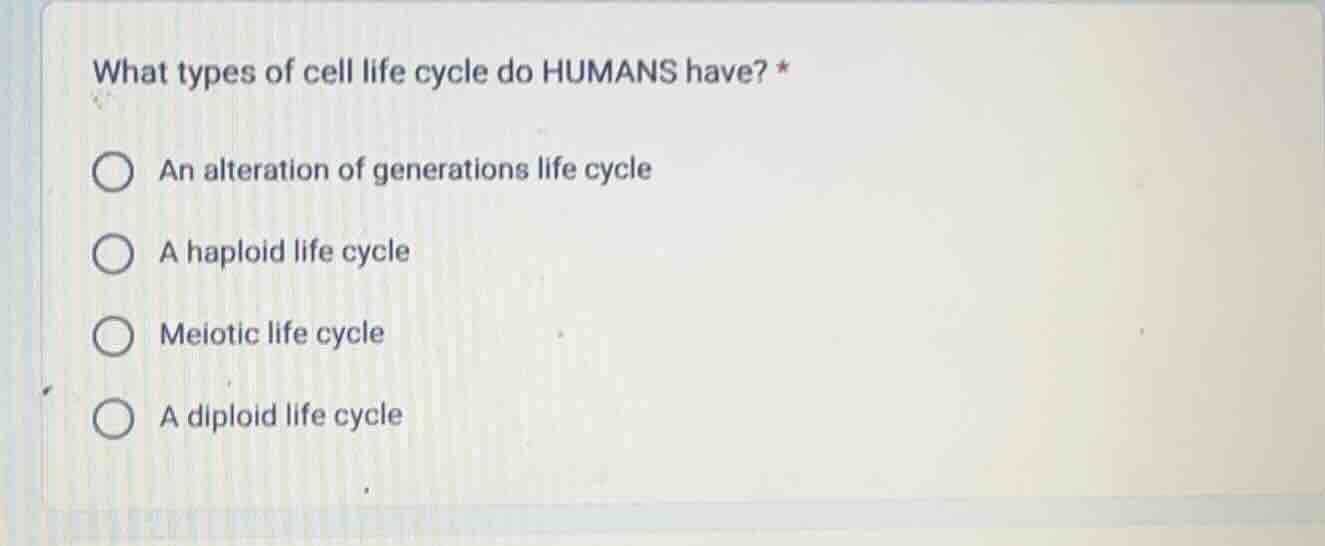
what types of cell life cycle do humans have? *

an alteration of generations life cycle
a haploid life cycle
meiotic life cycle
a diploid life cycle

Explanation:

Response

<pre_analysis>
{
"quality": "clear",
"question_count": 1,
"skills_matched": [
"direct_cot",
"multiple_choice_formatter",
"explain_then_answer",
"quick"
],
"needs_drawing": false,
"concepts_used": [],
"new_concepts": [
"Diploid Life Cycle"
],
"current_concepts": [
"Eukaryotic Life Cycles",
"Haploid and Diploid",
"Diploid Life Cycle"
]
}
</pre_analysis>

<reasoning>

Identify the dominant multicellular stage in humans

Humans are multicellular organisms whose body cells (somatic cells) are diploid, containing two sets of chromosomes (\(2n\)). The only haploid cells (\(n\)) in the human life cycle are the gametes (sperm and egg), which are unicellular and do not undergo mitosis.

Classify the eukaryotic life cycle type

Eukaryotic life cycles are classified based on which stage is multicellular:

  • Haploid life cycle: The multicellular stage is haploid (common in fungi and some algae).
  • Alternation of generations: Both multicellular haploid and multicellular diploid stages occur (common in plants).
  • Diploid life cycle: The multicellular stage is diploid, and gametes are the only haploid stage (characteristic of humans and other animals).

Select the correct option

Since the multicellular, dominant phase of the human life cycle is diploid, humans have a diploid life cycle.
</reasoning>

<answer>
<mcq-option>(A) An alteration of generations life cycle</mcq-option>
<mcq-option>(B) A haploid life cycle</mcq-option>
<mcq-option>(C) Meiotic life cycle</mcq-option>
<mcq-correct>(D) A diploid life cycle</mcq-correct>
</answer>

<post_analysis>
{
"subject": "Natural Science",
"question_type": "Multiple Choice",
"knowledge_point": [
"Natural Science",
"Biology",
"Eukaryotic Life Cycles"
]
}
</post_analysis>

Answer:

<pre_analysis>
{
"quality": "clear",
"question_count": 1,
"skills_matched": [
"direct_cot",
"multiple_choice_formatter",
"explain_then_answer",
"quick"
],
"needs_drawing": false,
"concepts_used": [],
"new_concepts": [
"Diploid Life Cycle"
],
"current_concepts": [
"Eukaryotic Life Cycles",
"Haploid and Diploid",
"Diploid Life Cycle"
]
}
</pre_analysis>

<reasoning>

Identify the dominant multicellular stage in humans

Humans are multicellular organisms whose body cells (somatic cells) are diploid, containing two sets of chromosomes (\(2n\)). The only haploid cells (\(n\)) in the human life cycle are the gametes (sperm and egg), which are unicellular and do not undergo mitosis.

Classify the eukaryotic life cycle type

Eukaryotic life cycles are classified based on which stage is multicellular:

  • Haploid life cycle: The multicellular stage is haploid (common in fungi and some algae).
  • Alternation of generations: Both multicellular haploid and multicellular diploid stages occur (common in plants).
  • Diploid life cycle: The multicellular stage is diploid, and gametes are the only haploid stage (characteristic of humans and other animals).

Select the correct option

Since the multicellular, dominant phase of the human life cycle is diploid, humans have a diploid life cycle.
</reasoning>

<answer>
<mcq-option>(A) An alteration of generations life cycle</mcq-option>
<mcq-option>(B) A haploid life cycle</mcq-option>
<mcq-option>(C) Meiotic life cycle</mcq-option>
<mcq-correct>(D) A diploid life cycle</mcq-correct>
</answer>

<post_analysis>
{
"subject": "Natural Science",
"question_type": "Multiple Choice",
"knowledge_point": [
"Natural Science",
"Biology",
"Eukaryotic Life Cycles"
]
}
</post_analysis>