QUESTION IMAGE
Question
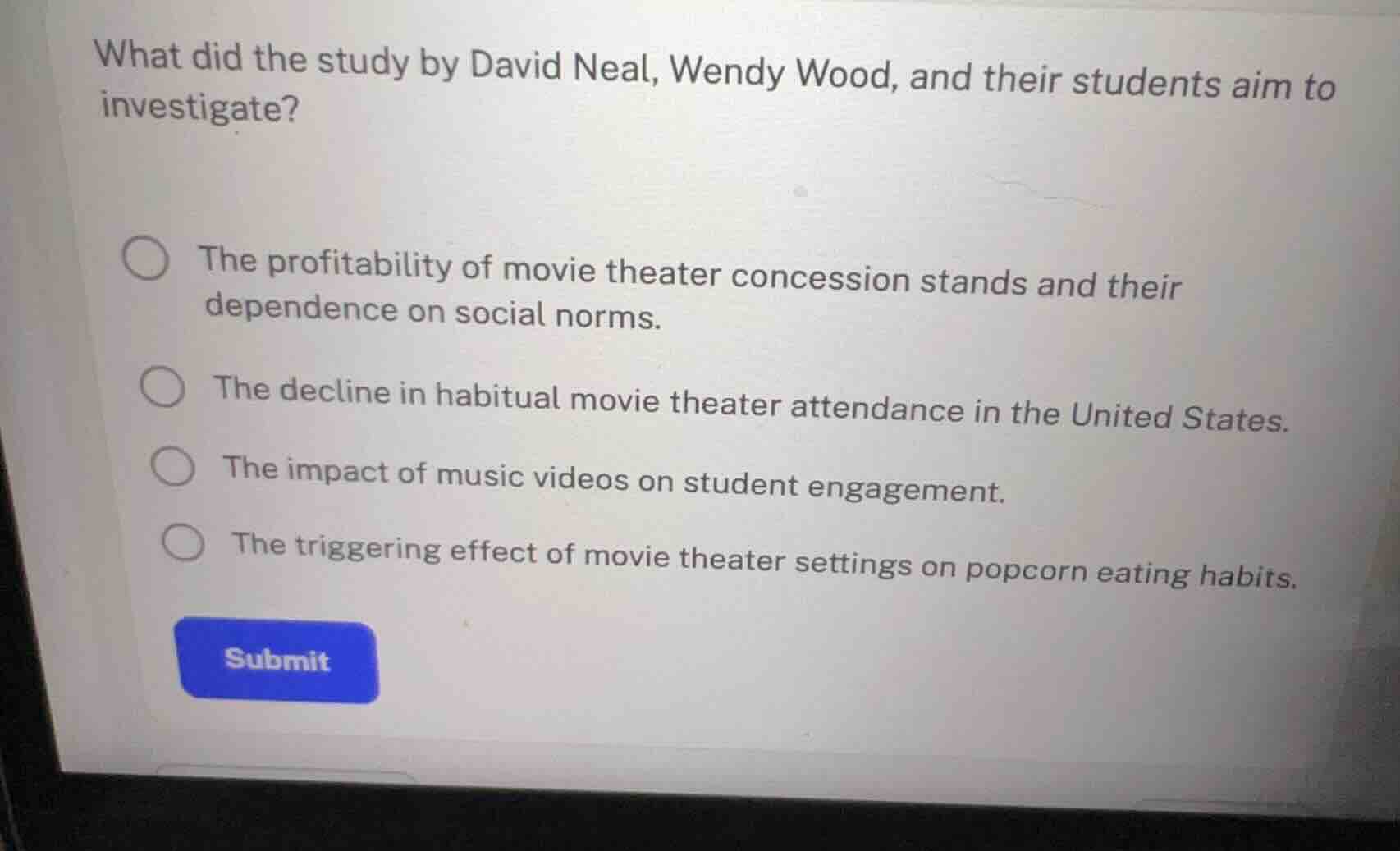
what did the study by david neal, wendy wood, and their students aim to investigate?
the profitability of movie theater concession stands and their dependence on social norms.
the decline in habitual movie theater attendance in the united states.
the impact of music videos on student engagement.
the triggering effect of movie theater settings on popcorn eating habits.
<pre_analysis>
{
"quality": "clear",
"question_count": 1,
"skills_matched": [
"direct_cot",
"multiple_choice_formatter",
"explain_then_answer",
"tutor",
"mastery_adaptive_brevity"
],
"needs_drawing": false,
"concepts_used": [
"Positive Habits"
],
"new_concepts": [
"Habit Cues",
"Environmental Triggers"
],
"current_concepts": [
"Positive Habits",
"Habit Cues",
"Environmental Triggers"
]
}
</pre_analysis>
<reasoning>
Identify the core research of Neal and Wood
Using the Positive Habits knowledge point, we analyze the famous 2011 study by David Neal, Wendy Wood, and colleagues. This research investigated how environmental cues automatically trigger established habits, specifically examining popcorn consumption in a movie theater setting.
Analyze the experimental design and findings
The researchers gave participants either fresh or stale popcorn before they watched movie clips. They found that participants with strong popcorn-eating habits ate the same amount of popcorn regardless of whether it was fresh or stale, but only when they were in a movie theater setting (the cue-rich environment). When watching in a meeting room (a novel environment), the habit was not triggered, and they ate significantly less stale popcorn.
Evaluate the given options
- Option 1 focuses on concession profitability and social norms, which is incorrect.
- Option 2 focuses on movie theater attendance decline, which is incorrect.
- Option 3 mentions music videos, which is unrelated to the popcorn study.
- Option 4 correctly identifies the investigation of how movie theater settings act as environmental triggers for popcorn-eating habits.
</reasoning>
<answer>
<mcq-option>(A) The profitability of movie theater concession stands and their dependence on social norms.</mcq-option>
<mcq-option>(B) The decline in habitual movie theater attendance in the United States.</mcq-option>
<mcq-option>(C) The impact of music videos on student engagement.</mcq-option>
<mcq-correct>(D) The triggering effect of movie theater settings on popcorn eating habits.</mcq-correct>
</answer>
<post_analysis>
{
"subject": "Social Science",
"question_type": "Multiple Choice",
"knowledge_point": [
"Social Science",
"Psychology",
"Habit Formation and Behavioral Conditioning"
]
}
</post_analysis>
Snap & solve any problem in the app
Get step-by-step solutions on Sovi AI
Photo-based solutions with guided steps
Explore more problems and detailed explanations
<pre_analysis>
{
"quality": "clear",
"question_count": 1,
"skills_matched": [
"direct_cot",
"multiple_choice_formatter",
"explain_then_answer",
"tutor",
"mastery_adaptive_brevity"
],
"needs_drawing": false,
"concepts_used": [
"Positive Habits"
],
"new_concepts": [
"Habit Cues",
"Environmental Triggers"
],
"current_concepts": [
"Positive Habits",
"Habit Cues",
"Environmental Triggers"
]
}
</pre_analysis>
<reasoning>
Identify the core research of Neal and Wood
Using the Positive Habits knowledge point, we analyze the famous 2011 study by David Neal, Wendy Wood, and colleagues. This research investigated how environmental cues automatically trigger established habits, specifically examining popcorn consumption in a movie theater setting.
Analyze the experimental design and findings
The researchers gave participants either fresh or stale popcorn before they watched movie clips. They found that participants with strong popcorn-eating habits ate the same amount of popcorn regardless of whether it was fresh or stale, but only when they were in a movie theater setting (the cue-rich environment). When watching in a meeting room (a novel environment), the habit was not triggered, and they ate significantly less stale popcorn.
Evaluate the given options
- Option 1 focuses on concession profitability and social norms, which is incorrect.
- Option 2 focuses on movie theater attendance decline, which is incorrect.
- Option 3 mentions music videos, which is unrelated to the popcorn study.
- Option 4 correctly identifies the investigation of how movie theater settings act as environmental triggers for popcorn-eating habits.
</reasoning>
<answer>
<mcq-option>(A) The profitability of movie theater concession stands and their dependence on social norms.</mcq-option>
<mcq-option>(B) The decline in habitual movie theater attendance in the United States.</mcq-option>
<mcq-option>(C) The impact of music videos on student engagement.</mcq-option>
<mcq-correct>(D) The triggering effect of movie theater settings on popcorn eating habits.</mcq-correct>
</answer>
<post_analysis>
{
"subject": "Social Science",
"question_type": "Multiple Choice",
"knowledge_point": [
"Social Science",
"Psychology",
"Habit Formation and Behavioral Conditioning"
]
}
</post_analysis>