QUESTION IMAGE
Question
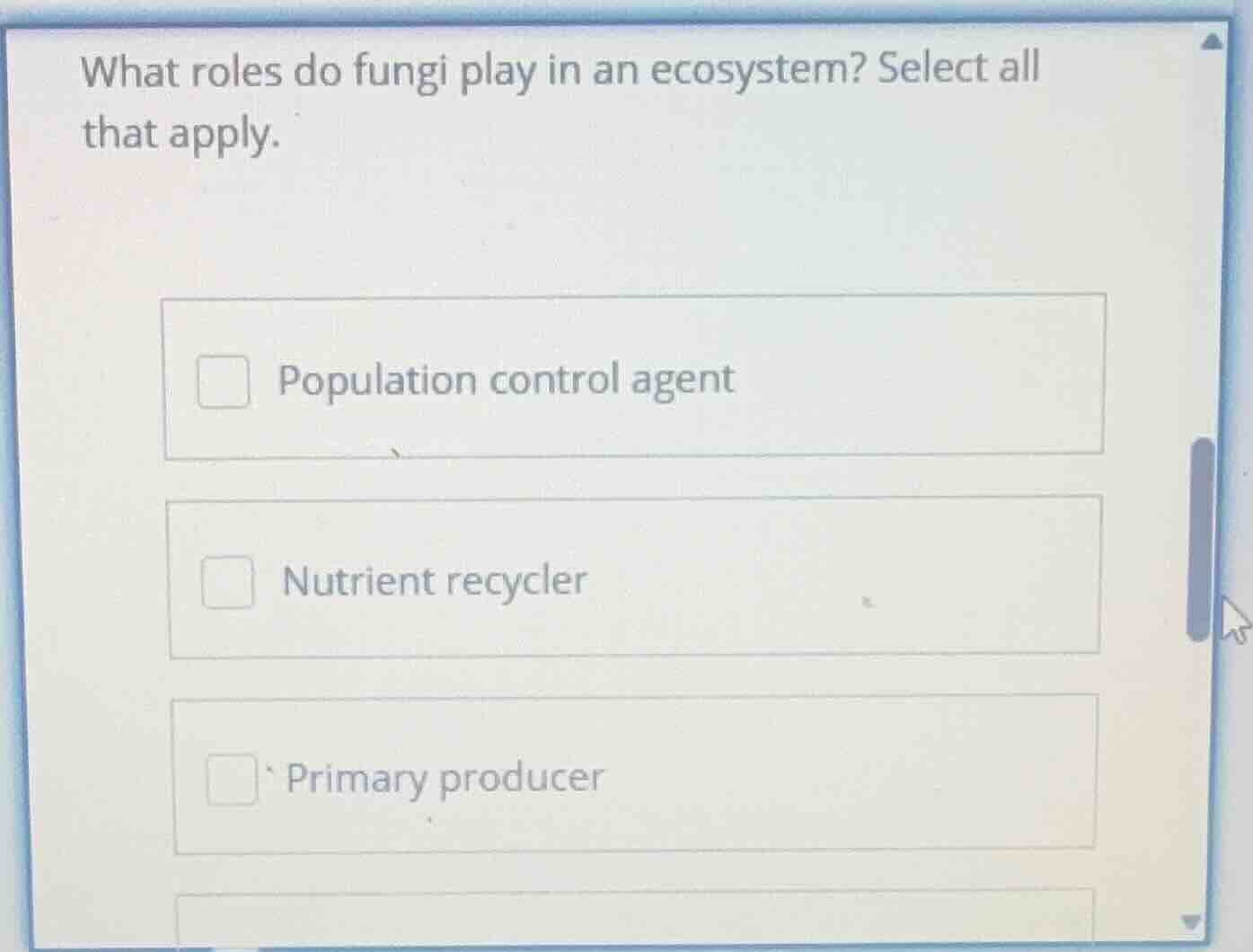
what roles do fungi play in an ecosystem? select all that apply.
population control agent
nutrient recycler
primary producer
Analyze the ecological roles of fungi
Fungi are heterotrophic organisms that acquire nutrients through absorption, a key aspect of Fungal Nutrition. They cannot perform photosynthesis, meaning they are never primary producers. Instead, they release powerful enzymes to break down complex organic matter, making them vital nutrient recyclers (decomposers) in ecosystems.
Evaluate the role as a population control agent
Many fungi act as pathogens or parasites of plants, animals, and other fungi. By infecting hosts and causing diseases, parasitic fungi regulate host populations, thereby acting as population control agents within their ecological communities.
Evaluate the role as a nutrient recycler
Fungi are primary decomposers in most terrestrial ecosystems. They break down tough organic materials like cellulose and lignin from dead wood and leaf litter, releasing essential elements back into the soil for plants to use. Thus, they are crucial nutrient recyclers.
Evaluate the role as a primary producer
Primary producers are autotrophs (like plants and algae) that synthesize organic compounds from inorganic carbon sources using light or chemical energy. Because fungi are strictly heterotrophic, they cannot produce their own food and do not act as primary producers.

Snap & solve any problem in the app
Get step-by-step solutions on Sovi AI
Photo-based solutions with guided steps
Explore more problems and detailed explanations
- Population control agent (Correct answer)
- Nutrient recycler (Correct answer)
- Primary producer