QUESTION IMAGE
Question
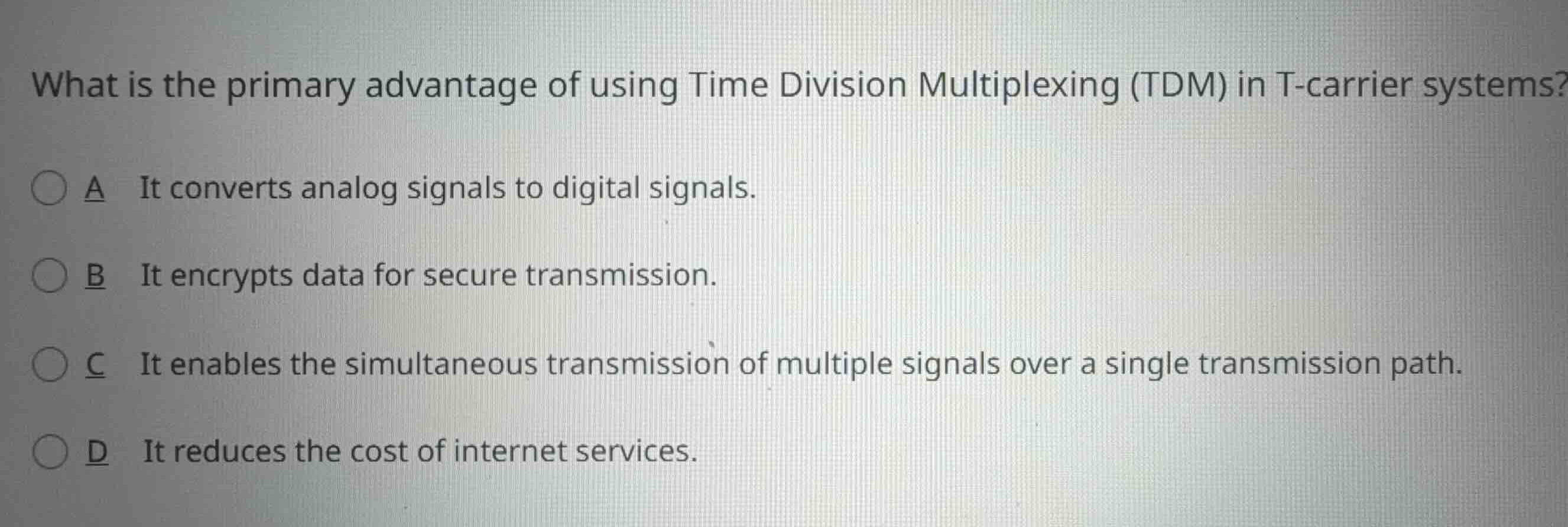
what is the primary advantage of using time division multiplexing (tdm) in t-carrier systems?
a it converts analog signals to digital signals.
b it encrypts data for secure transmission.
c it enables the simultaneous transmission of multiple signals over a single transmission path.
d it reduces the cost of internet services.
Define Time Division Multiplexing (TDM)
TDM is a communications process that transmits two or more digital signals over a single common channel by dividing the bandwidth into distinct, non-overlapping time slots allocated to each signal.
Analyze T-carrier systems integration
T-carrier systems (such as T1 lines) use TDM to combine multiple voice channels (typically 24 channels for T1) into a single high-speed digital stream, allowing them to share the same physical transmission medium simultaneously.
Evaluate the given options
- Option A describes analog-to-digital conversion (PCM), not multiplexing.
- Option B describes encryption, which is a security function.
- Option C describes the core purpose of TDM: enabling simultaneous transmission of multiple signals over a single path.
- Option D is a broad economic consequence, not the primary technical advantage.

Snap & solve any problem in the app
Get step-by-step solutions on Sovi AI
Photo-based solutions with guided steps
Explore more problems and detailed explanations
- (A) It converts analog signals to digital signals.
- (B) It encrypts data for secure transmission.
- (C) It enables the simultaneous transmission of multiple signals over a single transmission path. (Correct answer)
- (D) It reduces the cost of internet services.