QUESTION IMAGE
Question
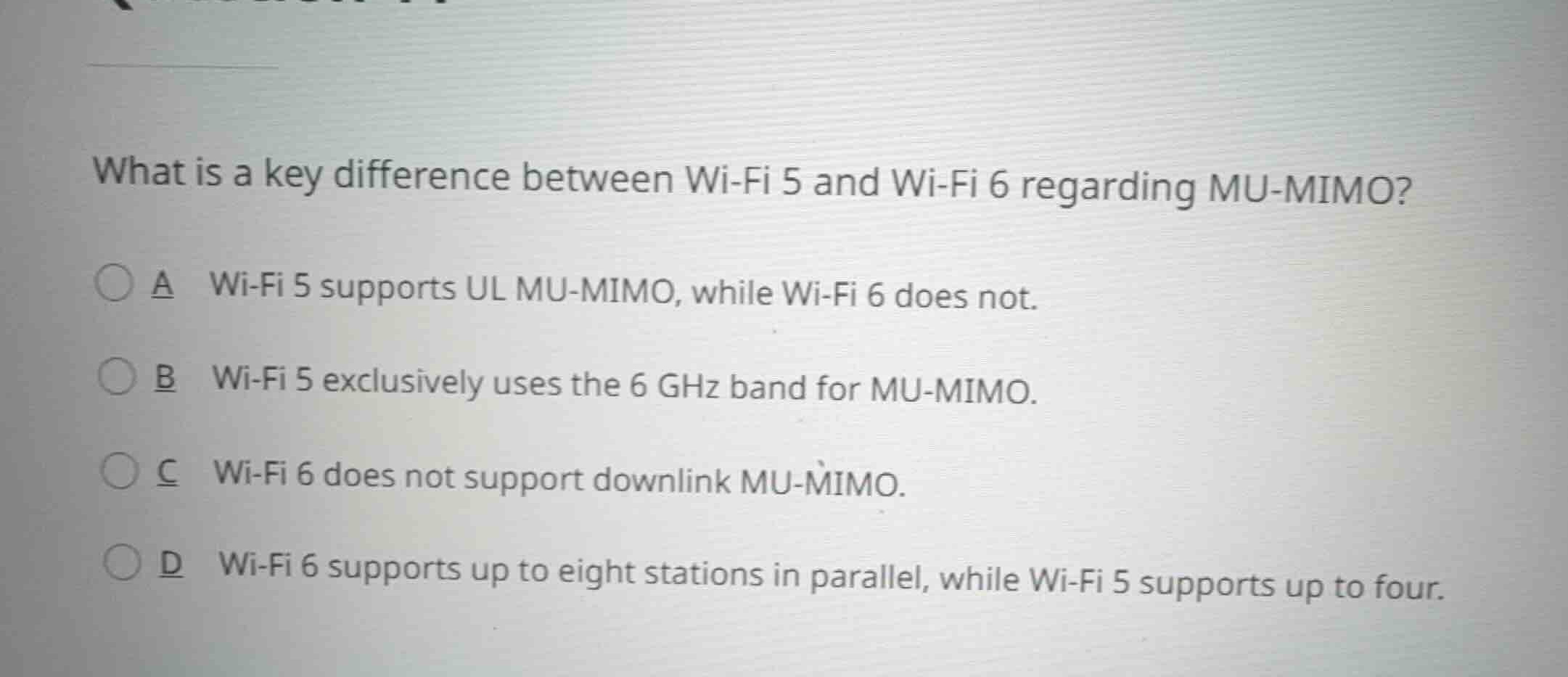
what is a key difference between wi-fi 5 and wi-fi 6 regarding mu-mimo?
a wi-fi 5 supports ul mu-mimo, while wi-fi 6 does not.
b wi-fi 5 exclusively uses the 6 ghz band for mu-mimo.
c wi-fi 6 does not support downlink mu-mimo.
d wi-fi 6 supports up to eight stations in parallel, while wi-fi 5 supports up to four.
Analyze MU-MIMO capabilities in Wi-Fi 5 (802.11ac)
Wi-Fi 5 (802.11ac Wave 2) introduced downlink Multi-User Multiple-Input Multiple-Output (DL MU-MIMO), allowing an access point to transmit data to up to four client devices simultaneously. However, it does not support uplink (UL) MU-MIMO.
Analyze MU-MIMO capabilities in Wi-Fi 6 (802.11ax)
Wi-Fi 6 (802.11ax) enhances MU-MIMO by supporting both downlink (DL) and uplink (UL) MU-MIMO. Additionally, it increases the maximum number of simultaneous spatial streams/stations from four to eight.
Evaluate the given options
- Option A is incorrect because Wi-Fi 6 supports UL MU-MIMO, whereas Wi-Fi 5 does not.
- Option B is incorrect because Wi-Fi 5 operates in the 5 GHz band, not the 6 GHz band (which was introduced with Wi-Fi 6E).
- Option C is incorrect because Wi-Fi 6 supports both downlink and uplink MU-MIMO.
- Option D is correct because Wi-Fi 6 supports up to eight simultaneous streams/stations in parallel, while Wi-Fi 5 supports up to four.

Snap & solve any problem in the app
Get step-by-step solutions on Sovi AI
Photo-based solutions with guided steps
Explore more problems and detailed explanations
- (A) Wi-Fi 5 supports UL MU-MIMO, while Wi-Fi 6 does not.
- (B) Wi-Fi 5 exclusively uses the 6 GHz band for MU-MIMO.
- (C) Wi-Fi 6 does not support downlink MU-MIMO.
- (D) Wi-Fi 6 supports up to eight stations in parallel, while Wi-Fi 5 supports up to four. (Correct answer)