Sovi.AI - AI Math Tutor

Scan to solve math questions

QUESTION IMAGE

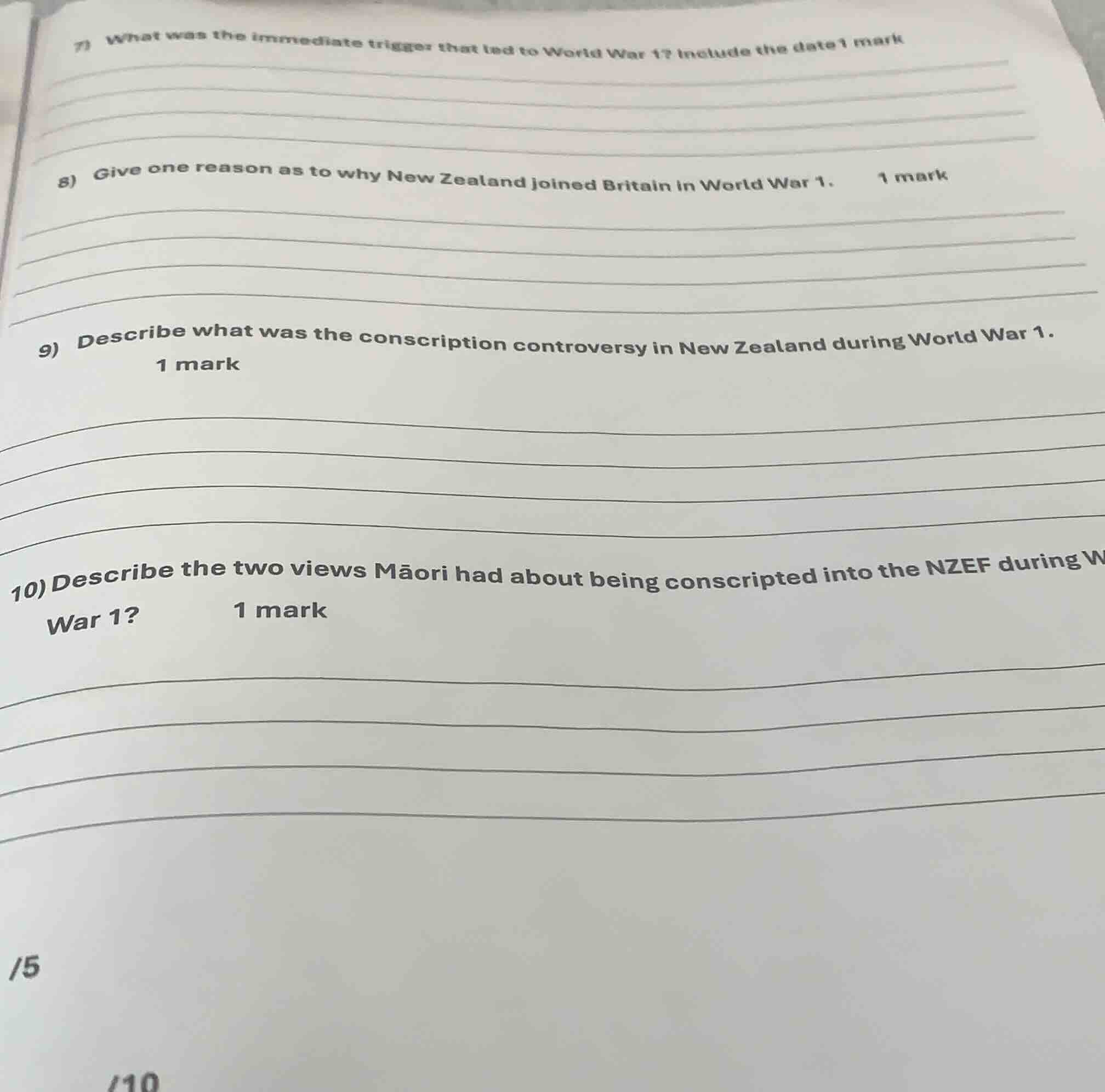
7) what was the immediate trigger that led to world war 1? include the …

Question

  1. what was the immediate trigger that led to world war 1? include the date 1 mark
  1. give one reason as to why new zealand joined britain in world war 1. 1 mark
  1. describe what was the conscription controversy in new zealand during world war 1. 1 mark
  1. describe the two views māori had about being conscripted into the nzef during world war 1? 1 mark

Explanation:

Response

<pre_analysis>
{
"quality": "clear",
"question_count": 4,
"skills_matched": [
"direct_cot",
"explain_then_answer",
"tutor"
],
"needs_drawing": false,
"concepts_used": [
"Outbreak of WWI"
],
"new_concepts": [
"New Zealand WWI Conscription",
"Maori WWI Conscription Views"
],
"current_concepts": [
"Outbreak of WWI",
"New Zealand WWI Conscription",
"Maori WWI Conscription Views"
]
}
</pre_analysis>

<reasoning>

Identify the trigger and date of World War 1

The immediate trigger of World War I was the assassination of Archduke Franz Ferdinand of Austria, the heir to the Austro-Hungarian throne, and his wife Sophie. This event occurred in Sarajevo on June 28, 1914, which set off the July Crisis and led to the Outbreak of WWI.

Analyze New Zealand's entry into World War 1

New Zealand joined Great Britain in World War I primarily due to its deep constitutional, economic, and cultural ties as a dominion of the British Empire. When Britain declared war on Germany on August 4, 1914, New Zealand automatically considered itself at war as well, driven by a strong sense of imperial loyalty and the belief that New Zealand's security depended on the strength of the British Empire.

Examine the conscription controversy in New Zealand

Conscription (compulsory military service) was introduced in New Zealand in 1916 through the Military Service Act to maintain the strength of the New Zealand Expeditionary Force (NZEF). It sparked significant controversy, dividing the public. Opponents included conscientious objectors, religious groups, and the labor movement, who argued that forcing men to fight was a violation of civil liberties and that wealth, not just lives, should be conscripted.

Evaluate Māori perspectives on conscription

Māori held contrasting views regarding conscription into the NZEF:

  1. Support/Cooperation: Some iwi (tribes), particularly those from regions like the East Coast (Ngāti Porou) led by politicians like Apirana Ngata, supported voluntary enlistment and conscription. They believed that serving the Empire would demonstrate citizenship, secure equal rights, and help reclaim lost land or status.
  2. Opposition/Resistance: Other iwi, particularly in the Waikato and Taranaki regions, strongly opposed conscription. Having suffered devastating land confiscations (raupatu) during the New Zealand Wars, leaders like Princess Te Puea Hērangi argued that Māori should not fight for a government that had stolen their land and violated their sovereignty.

</reasoning>

<answer>

Question 7

The immediate trigger was the assassination of Archduke Franz Ferdinand of Austria on June 28, 1914.

Question 8

New Zealand joined Britain due to its strong imperial loyalty and constitutional ties, viewing itself as an integral part of the British Empire whose security depended on British naval supremacy.

Question 9

The conscription controversy centered on the introduction of compulsory military service in 1916, which was opposed by conscientious objectors, labor activists, and certain religious groups who argued it violated individual liberty and unfairly forced working-class men to fight.

Question 10

  1. Support: Some Māori (such as Ngāti Porou) supported service to prove their loyalty, secure equal citizenship rights, and gain political leverage.
  2. Opposition: Other Māori (especially Waikato-Tainui) resisted conscription, refusing to fight for a British Crown that had confiscated their ancestral lands during the New Zealand Wars.

</answer>

<post_analysis>
{…

Answer:

<pre_analysis>
{
"quality": "clear",
"question_count": 4,
"skills_matched": [
"direct_cot",
"explain_then_answer",
"tutor"
],
"needs_drawing": false,
"concepts_used": [
"Outbreak of WWI"
],
"new_concepts": [
"New Zealand WWI Conscription",
"Maori WWI Conscription Views"
],
"current_concepts": [
"Outbreak of WWI",
"New Zealand WWI Conscription",
"Maori WWI Conscription Views"
]
}
</pre_analysis>

<reasoning>

Identify the trigger and date of World War 1

The immediate trigger of World War I was the assassination of Archduke Franz Ferdinand of Austria, the heir to the Austro-Hungarian throne, and his wife Sophie. This event occurred in Sarajevo on June 28, 1914, which set off the July Crisis and led to the Outbreak of WWI.

Analyze New Zealand's entry into World War 1

New Zealand joined Great Britain in World War I primarily due to its deep constitutional, economic, and cultural ties as a dominion of the British Empire. When Britain declared war on Germany on August 4, 1914, New Zealand automatically considered itself at war as well, driven by a strong sense of imperial loyalty and the belief that New Zealand's security depended on the strength of the British Empire.

Examine the conscription controversy in New Zealand

Conscription (compulsory military service) was introduced in New Zealand in 1916 through the Military Service Act to maintain the strength of the New Zealand Expeditionary Force (NZEF). It sparked significant controversy, dividing the public. Opponents included conscientious objectors, religious groups, and the labor movement, who argued that forcing men to fight was a violation of civil liberties and that wealth, not just lives, should be conscripted.

Evaluate Māori perspectives on conscription

Māori held contrasting views regarding conscription into the NZEF:

  1. Support/Cooperation: Some iwi (tribes), particularly those from regions like the East Coast (Ngāti Porou) led by politicians like Apirana Ngata, supported voluntary enlistment and conscription. They believed that serving the Empire would demonstrate citizenship, secure equal rights, and help reclaim lost land or status.
  2. Opposition/Resistance: Other iwi, particularly in the Waikato and Taranaki regions, strongly opposed conscription. Having suffered devastating land confiscations (raupatu) during the New Zealand Wars, leaders like Princess Te Puea Hērangi argued that Māori should not fight for a government that had stolen their land and violated their sovereignty.

</reasoning>

<answer>

Question 7

The immediate trigger was the assassination of Archduke Franz Ferdinand of Austria on June 28, 1914.

Question 8

New Zealand joined Britain due to its strong imperial loyalty and constitutional ties, viewing itself as an integral part of the British Empire whose security depended on British naval supremacy.

Question 9

The conscription controversy centered on the introduction of compulsory military service in 1916, which was opposed by conscientious objectors, labor activists, and certain religious groups who argued it violated individual liberty and unfairly forced working-class men to fight.

Question 10

  1. Support: Some Māori (such as Ngāti Porou) supported service to prove their loyalty, secure equal citizenship rights, and gain political leverage.
  2. Opposition: Other Māori (especially Waikato-Tainui) resisted conscription, refusing to fight for a British Crown that had confiscated their ancestral lands during the New Zealand Wars.

</answer>

<post_analysis>
{
"subject": "Social Science",
"question_type": "Multi-part",
"knowledge_point": [
"Social Science",
"History",
"New Zealand History"
]
}
</post_analysis>