QUESTION IMAGE
Question
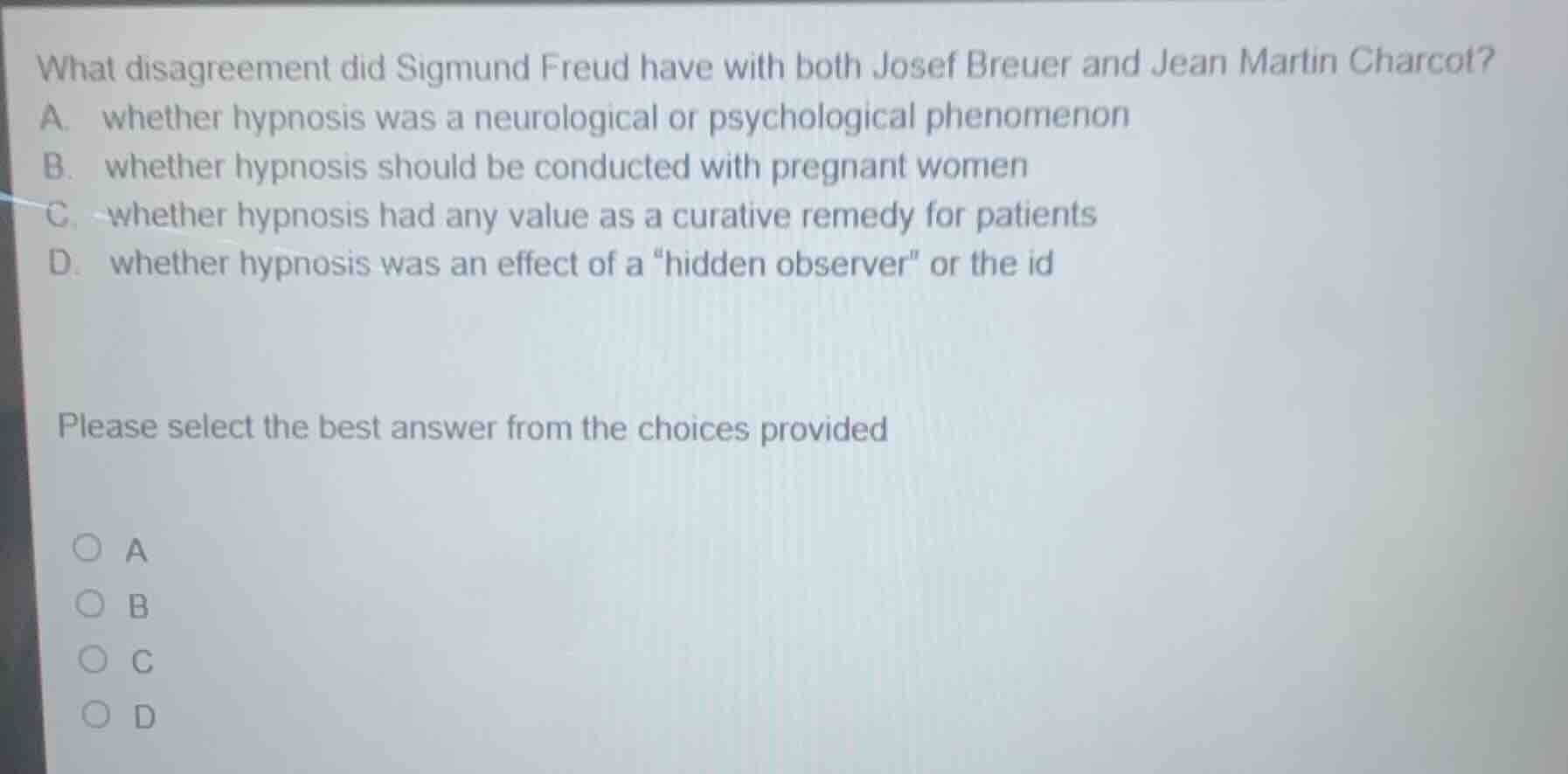
what disagreement did sigmund freud have with both josef breuer and jean martin charcot?
a. whether hypnosis was a neurological or psychological phenomenon
b. whether hypnosis should be conducted with pregnant women
c. whether hypnosis had any value as a curative remedy for patients
d. whether hypnosis was an effect of a \hidden observer\ or the id
please select the best answer from the choices provided
a
b
c
d
<pre_analysis>
{
"quality": "clear",
"question_count": 1,
"skills_matched": [
"direct_cot",
"multiple_choice_formatter",
"explain_then_answer",
"quick"
],
"needs_drawing": false,
"concepts_used": [],
"new_concepts": [
"History of Hypnosis",
"Freudian Psychology Origins"
],
"current_concepts": [
"History of Hypnosis",
"Freudian Psychology Origins"
]
}
</pre_analysis>
<reasoning>
Analyze the historical positions on hypnosis
Jean-Martin Charcot viewed hypnosis as a physiological, neurological state linked to hysteria, whereas Josef Breuer and Sigmund Freud initially explored it as a psychological tool to access unconscious memories.
Identify Freud's disagreement with both figures
Freud eventually disagreed with Charcot's purely neurological explanation and also moved away from Breuer's hypnotic catharsis, arguing that hypnosis was a psychological phenomenon driven by suggestion and transference rather than a physical neurological condition.
Evaluate the given multiple-choice options
Option A correctly identifies this core debate: whether hypnosis was a neurological (Charcot's view) or psychological (Freud's view) phenomenon.
</reasoning>
<answer>
<mcq-correct>(A) whether hypnosis was a neurological or psychological phenomenon</mcq-correct>
<mcq-option>(B) whether hypnosis should be conducted with pregnant women</mcq-option>
<mcq-option>(C) whether hypnosis had any value as a curative remedy for patients</mcq-option>
<mcq-option>(D) whether hypnosis was an effect of a "hidden observer" or the id</mcq-option>
</answer>
<post_analysis>
{
"subject": "Social Science",
"question_type": "Multiple Choice",
"knowledge_point": [
"Social Science",
"Psychology",
"History of Hypnosis"
]
}
</post_analysis>
Snap & solve any problem in the app
Get step-by-step solutions on Sovi AI
Photo-based solutions with guided steps
Explore more problems and detailed explanations
<pre_analysis>
{
"quality": "clear",
"question_count": 1,
"skills_matched": [
"direct_cot",
"multiple_choice_formatter",
"explain_then_answer",
"quick"
],
"needs_drawing": false,
"concepts_used": [],
"new_concepts": [
"History of Hypnosis",
"Freudian Psychology Origins"
],
"current_concepts": [
"History of Hypnosis",
"Freudian Psychology Origins"
]
}
</pre_analysis>
<reasoning>
Analyze the historical positions on hypnosis
Jean-Martin Charcot viewed hypnosis as a physiological, neurological state linked to hysteria, whereas Josef Breuer and Sigmund Freud initially explored it as a psychological tool to access unconscious memories.
Identify Freud's disagreement with both figures
Freud eventually disagreed with Charcot's purely neurological explanation and also moved away from Breuer's hypnotic catharsis, arguing that hypnosis was a psychological phenomenon driven by suggestion and transference rather than a physical neurological condition.
Evaluate the given multiple-choice options
Option A correctly identifies this core debate: whether hypnosis was a neurological (Charcot's view) or psychological (Freud's view) phenomenon.
</reasoning>
<answer>
<mcq-correct>(A) whether hypnosis was a neurological or psychological phenomenon</mcq-correct>
<mcq-option>(B) whether hypnosis should be conducted with pregnant women</mcq-option>
<mcq-option>(C) whether hypnosis had any value as a curative remedy for patients</mcq-option>
<mcq-option>(D) whether hypnosis was an effect of a "hidden observer" or the id</mcq-option>
</answer>
<post_analysis>
{
"subject": "Social Science",
"question_type": "Multiple Choice",
"knowledge_point": [
"Social Science",
"Psychology",
"History of Hypnosis"
]
}
</post_analysis>