QUESTION IMAGE
Question
- what is the difference between a circulating and local hormone?
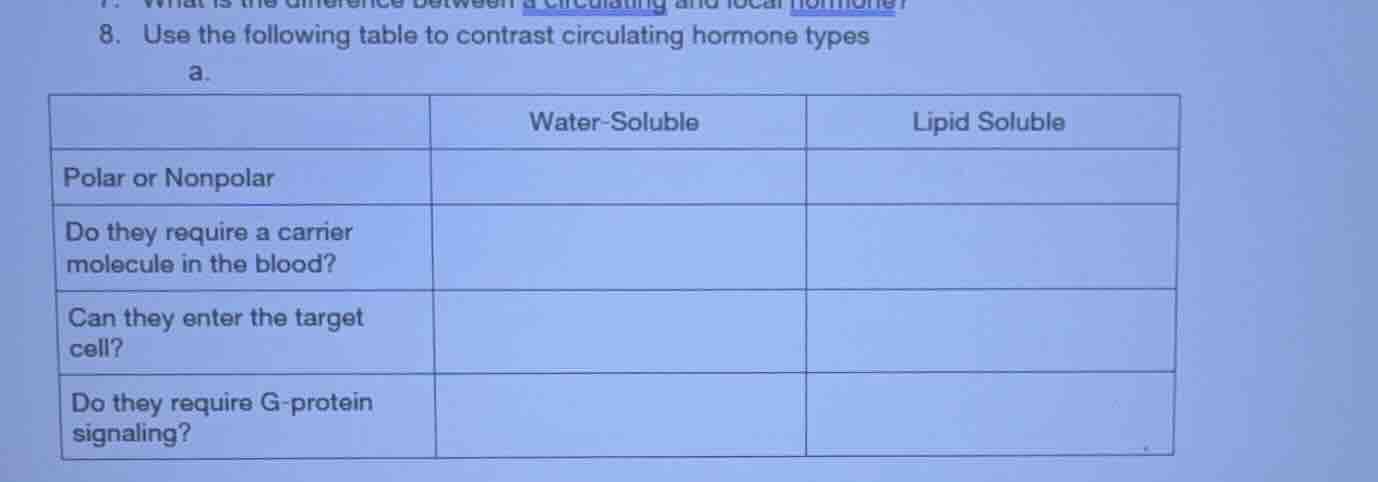
- use the following table to contrast circulating hormone types
a.
\
$$\begin{tabular}{|l|l|l|}
\\hline
& water-soluble & lipid soluble \\\\
\\hline
polar or nonpolar & & \\\\
\\hline
do they require a carrier molecule in the blood? & & \\\\
\\hline
can they enter the target cell? & & \\\\
\\hline
do they require g-protein signaling? & & \\\\
\\hline
\\end{tabular}$$
Analyze chemical polarity
Using the Hormone Classification and Endocrine System knowledge points
- Water-soluble hormones are polar molecules that dissolve easily in aqueous environments.
- Lipid-soluble hormones are nonpolar molecules that are hydrophobic.
Determine blood transport requirements
Using the Hormone Classification and Endocrine System knowledge points
- Water-soluble hormones travel freely in the blood plasma without carrier proteins.
- Lipid-soluble hormones require transport/carrier proteins to remain dissolved in the bloodstream.
Evaluate target cell entry
Using the Hormone Classification and Endocrine System knowledge points
- Water-soluble hormones cannot cross the phospholipid bilayer of the plasma membrane.
- Lipid-soluble hormones easily diffuse directly through the plasma membrane into the cell.
Identify signaling mechanism requirements
Using the Hormone Classification and Endocrine System knowledge points
- Water-soluble hormones bind to extracellular receptors, often activating G-protein signaling pathways.
- Lipid-soluble hormones bind to intracellular receptors, acting directly as transcription factors without G-proteins.

Snap & solve any problem in the app
Get step-by-step solutions on Sovi AI
Photo-based solutions with guided steps
Explore more problems and detailed explanations
| Water-Soluble | Lipid-Soluble | |
|---|---|---|
| Do they require a carrier molecule in the blood? | No | Yes |
| Can they enter the target cell? | No | Yes |
| Do they require G-protein signaling? | Yes (typically) | No |