QUESTION IMAGE
Question
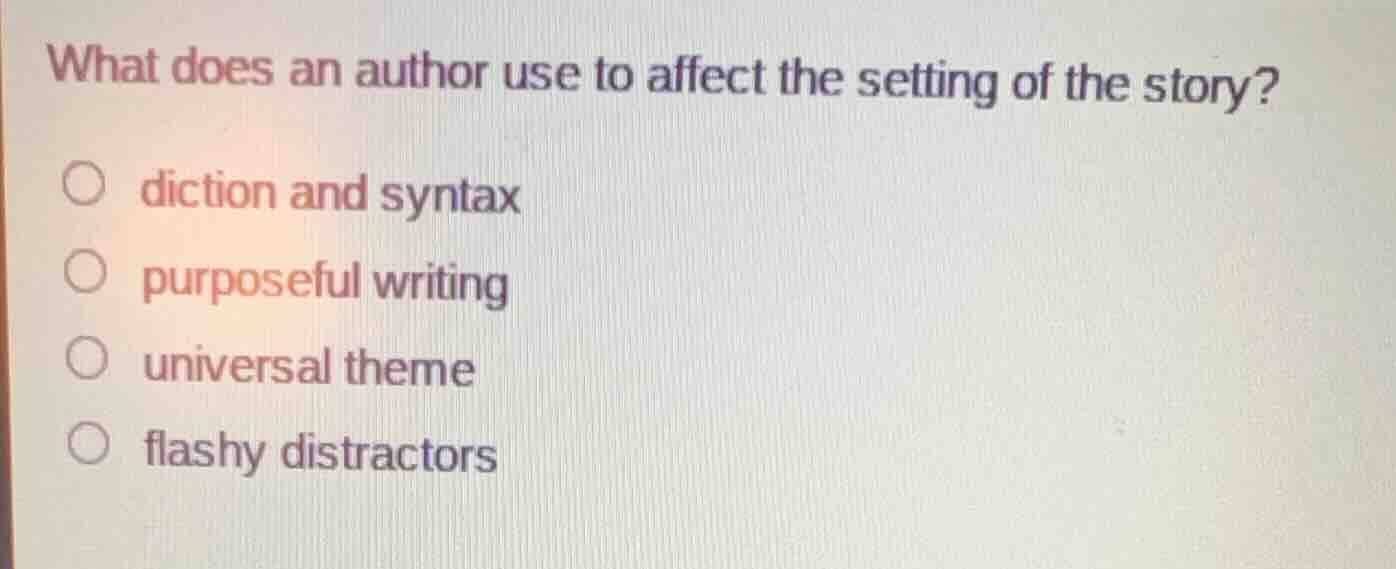
what does an author use to affect the setting of the story?
diction and syntax
purposeful writing
universal theme
flashy distractors
<pre_analysis>
{
"quality": "clear",
"question_count": 1,
"skills_matched": [
"direct_cot",
"multiple_choice_formatter",
"explain_then_answer",
"tutor",
"mastery_adaptive_brevity"
],
"needs_drawing": false,
"concepts_used": [
"Diction",
"Setting Analysis",
"Syntax Analysis"
],
"new_concepts": [],
"current_concepts": [
"Diction",
"Setting Analysis",
"Syntax Analysis"
]
}
</pre_analysis>
<reasoning>
Analyze the components of setting
Using the Setting Analysis knowledge point
The setting of a story establishes the time, place, and social environment. To construct and affect this atmosphere, an author relies on specific linguistic tools to paint a vivid picture for the reader.
Evaluate the role of language choices
Using the Diction and Syntax Analysis knowledge points
An author manipulates Diction (word choice) and Syntax (sentence structure) to establish the mood, tone, and sensory details of a setting. For example, using archaic vocabulary and long, complex sentences can make a setting feel historical and formal, while short, punchy sentences with modern slang can make it feel contemporary and urgent.
Assess the remaining options
The other options do not directly serve as the primary stylistic tools for constructing a setting:
- "Purposeful writing" is a general characteristic of deliberate composition rather than a specific literary tool.
- "Universal theme" refers to the overarching message or lesson of a work.
- "Flashy distractors" is a meta-term unrelated to literary construction.
</reasoning>
<answer>
<mcq-correct>(A) diction and syntax</mcq-correct>
<mcq-option>(B) purposeful writing</mcq-option>
<mcq-option>(C) universal theme</mcq-option>
<mcq-option>(D) flashy distractors</mcq-option>
</answer>
<post_analysis>
{
"subject": "Arts",
"question_type": "Multiple Choice",
"knowledge_point": [
"Arts",
"Literary Analysis",
"Setting Analysis"
]
}
</post_analysis>
Snap & solve any problem in the app
Get step-by-step solutions on Sovi AI
Photo-based solutions with guided steps
Explore more problems and detailed explanations
<pre_analysis>
{
"quality": "clear",
"question_count": 1,
"skills_matched": [
"direct_cot",
"multiple_choice_formatter",
"explain_then_answer",
"tutor",
"mastery_adaptive_brevity"
],
"needs_drawing": false,
"concepts_used": [
"Diction",
"Setting Analysis",
"Syntax Analysis"
],
"new_concepts": [],
"current_concepts": [
"Diction",
"Setting Analysis",
"Syntax Analysis"
]
}
</pre_analysis>
<reasoning>
Analyze the components of setting
Using the Setting Analysis knowledge point
The setting of a story establishes the time, place, and social environment. To construct and affect this atmosphere, an author relies on specific linguistic tools to paint a vivid picture for the reader.
Evaluate the role of language choices
Using the Diction and Syntax Analysis knowledge points
An author manipulates Diction (word choice) and Syntax (sentence structure) to establish the mood, tone, and sensory details of a setting. For example, using archaic vocabulary and long, complex sentences can make a setting feel historical and formal, while short, punchy sentences with modern slang can make it feel contemporary and urgent.
Assess the remaining options
The other options do not directly serve as the primary stylistic tools for constructing a setting:
- "Purposeful writing" is a general characteristic of deliberate composition rather than a specific literary tool.
- "Universal theme" refers to the overarching message or lesson of a work.
- "Flashy distractors" is a meta-term unrelated to literary construction.
</reasoning>
<answer>
<mcq-correct>(A) diction and syntax</mcq-correct>
<mcq-option>(B) purposeful writing</mcq-option>
<mcq-option>(C) universal theme</mcq-option>
<mcq-option>(D) flashy distractors</mcq-option>
</answer>
<post_analysis>
{
"subject": "Arts",
"question_type": "Multiple Choice",
"knowledge_point": [
"Arts",
"Literary Analysis",
"Setting Analysis"
]
}
</post_analysis>