QUESTION IMAGE
Question
warm-up
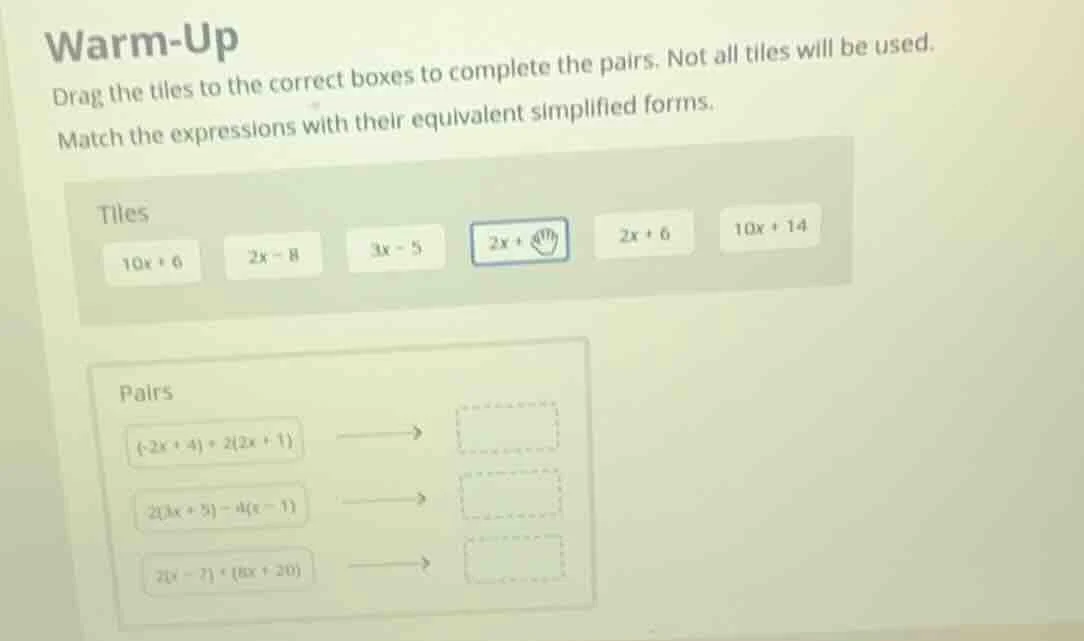
drag the tiles to the correct boxes to complete the pairs. not all tiles will be used.
match the expressions with their equivalent simplified forms.
tiles
10x + 6 2x - 8 3x - 5 2x + (hand icon) 2x + 6 10x + 14
pairs
(-2x + 4) + 2(2x + 1)
2(3x + 5) - 4(x - 1)
2(x - 7) + (8x + 20)
Step1: Simplify \((-2x + 4)+2(2x + 1)\)
First, distribute the 2 in \(2(2x + 1)\): \(2\times2x=4x\) and \(2\times1 = 2\). Then combine like terms: \(-2x+4 + 4x+2=(-2x + 4x)+(4 + 2)=2x+6\).
Step2: Simplify \(2(3x + 5)-4(x - 1)\)
Distribute the 2 and -4: \(2\times3x = 6x\), \(2\times5=10\), \(-4\times x=-4x\), \(-4\times(-1)=4\). Combine like terms: \(6x + 10-4x + 4=(6x-4x)+(10 + 4)=2x+14\)? Wait, no, wait, let's recalculate. Wait, the tile has \(10x + 14\)? Wait, no, wait, \(2(3x + 5)=6x + 10\), \(-4(x - 1)=-4x + 4\). Then \(6x+10-4x + 4=(6x-4x)+(10 + 4)=2x + 14\)? But the tiles have \(10x + 14\)? Wait, maybe I made a mistake. Wait, maybe the second expression is \(2(3x + 5)-4(x - 1)\)? Wait, no, maybe the original problem's second expression is \(2(3x + 5)-4(x - 1)\)? Wait, no, let's check again. Wait, the third expression: \(2(x - 7)+(8x + 20)\). Let's simplify that: \(2x-14 + 8x + 20=(2x + 8x)+(-14 + 20)=10x + 6\). Wait, let's redo each:
- \((-2x + 4)+2(2x + 1)\):
- Distribute: \(-2x + 4 + 4x + 2\)
- Combine like terms: \((-2x + 4x)+(4 + 2)=2x + 6\)
- \(2(3x + 5)-4(x - 1)\):
- Distribute: \(6x + 10-4x + 4\)
- Combine like terms: \((6x-4x)+(10 + 4)=2x + 14\)? But the tiles have \(10x + 14\)? Wait, maybe the second expression is \(2(3x + 5)-4(x - 1)\)? Wait, no, maybe I misread the expression. Wait, maybe the second expression is \(2(3x + 5)-4(x - 1)\)? Wait, no, let's check the third: \(2(x - 7)+(8x + 20)=2x-14 + 8x + 20=10x + 6\). Then the second expression: let's see the tiles, there is \(10x + 14\). Let's check another way. Wait, maybe the second expression is \(2(3x + 5)-4(x - 1)\)? Wait, no, let's compute \(2(3x + 5)=6x + 10\), \(-4(x - 1)=-4x + 4\), so \(6x + 10-4x + 4=2x + 14\). But the tile is \(2x + 14\)? Wait, the tiles are \(10x + 6\), \(2x - 8\), \(3x - 5\), \(2x + 14\) (wait, the hand is covering, but the tile is \(2x + 14\)?), \(2x + 6\), \(10x + 14\). Wait, maybe the second expression is \(2(3x + 5)-4(x - 1)\) gives \(2x + 14\), the third is \(2(x - 7)+(8x + 20)=10x + 6\), and the first is \((-2x + 4)+2(2x + 1)=2x + 6\).
So:
- \((-2x + 4)+2(2x + 1)\) matches \(2x + 6\)
- \(2(3x + 5)-4(x - 1)\) matches \(2x + 14\) (wait, but the tile is \(2x + 14\) or \(10x + 14\)? Wait, no, let's recalculate \(2(3x + 5)-4(x - 1)\) again. Wait, maybe the expression is \(2(3x + 5)-4(x - 1)\)? Wait, no, maybe the original problem's second expression is \(2(3x + 5)-4(x - 1)\)? Wait, no, let's check the third expression: \(2(x - 7)+(8x + 20)=2x-14 + 8x + 20=10x + 6\), which matches the tile \(10x + 6\). Then the first expression: \((-2x + 4)+2(2x + 1)=-2x + 4 + 4x + 2=2x + 6\), which matches \(2x + 6\). Then the second expression: let's see, if we have \(2(3x + 5)-4(x - 1)\), but that gives \(2x + 14\), but the tile is \(2x + 14\) (the one with the hand). Wait, maybe the second expression is \(2(3x + 5)-4(x - 1)\) gives \(2x + 14\), and the third is \(10x + 6\), first is \(2x + 6\).
So the pairs are:
- \((-2x + 4)+2(2x + 1)\) → \(2x + 6\)
- \(2(3x + 5)-4(x - 1)\) → \(2x + 14\)
- \(2(x - 7)+(8x + 20)\) → \(10x + 6\)

Snap & solve any problem in the app
Get step-by-step solutions on Sovi AI
Photo-based solutions with guided steps
Explore more problems and detailed explanations
- \((-2x + 4) + 2(2x + 1)\) → \(2x + 6\)
- \(2(3x + 5) - 4(x - 1)\) → \(2x + 14\)
- \(2(x - 7) + (8x + 20)\) → \(10x + 6\)