QUESTION IMAGE
Question
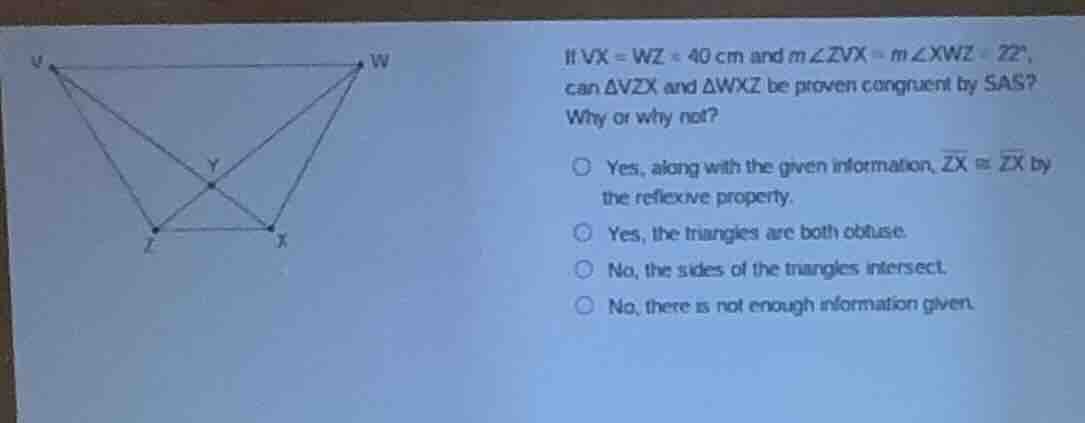
if ( vx = wz = 40 ) cm and ( mangle zvx = mangle xwz = 22^circ ), can ( \triangle vzx ) and ( \triangle wxz ) be proven congruent by sas? why or why not?
- yes, along with the given information, ( overline{zx} cong overline{zx} ) by the reflexive property.
- yes, the triangles are both obtuse.
- no, the sides of the triangles intersect.
- no, there is not enough information given.
Brief Explanations
The SAS (Side-Angle-Side) congruence rule requires two pairs of corresponding sides to be congruent, and the included angle (the angle between those two sides) to be congruent. For $\triangle VZX$ and $\triangle WXZ$:
- We know $VX = WZ = 40$ cm, so one pair of sides is congruent: $\overline{VX} \cong \overline{WZ}$.
- We know $m\angle ZVX = m\angle XWZ = 22^\circ$, but this angle is not the included angle for the sides we have. The included angle for $\triangle VZX$ would be the angle between $\overline{VZ}$ and $\overline{VX}$, and for $\triangle WXZ$ it would be the angle between $\overline{WX}$ and $\overline{WZ}$, which are not given as congruent.
- The shared side $\overline{ZX} \cong \overline{ZX}$ by the reflexive property, but this side does not form the included angle with the given congruent sides and angles. There is no information confirming the second pair of sides (forming the included angle) are congruent.

Snap & solve any problem in the app
Get step-by-step solutions on Sovi AI
Photo-based solutions with guided steps
Explore more problems and detailed explanations
No, there is not enough information given.