QUESTION IMAGE
Question
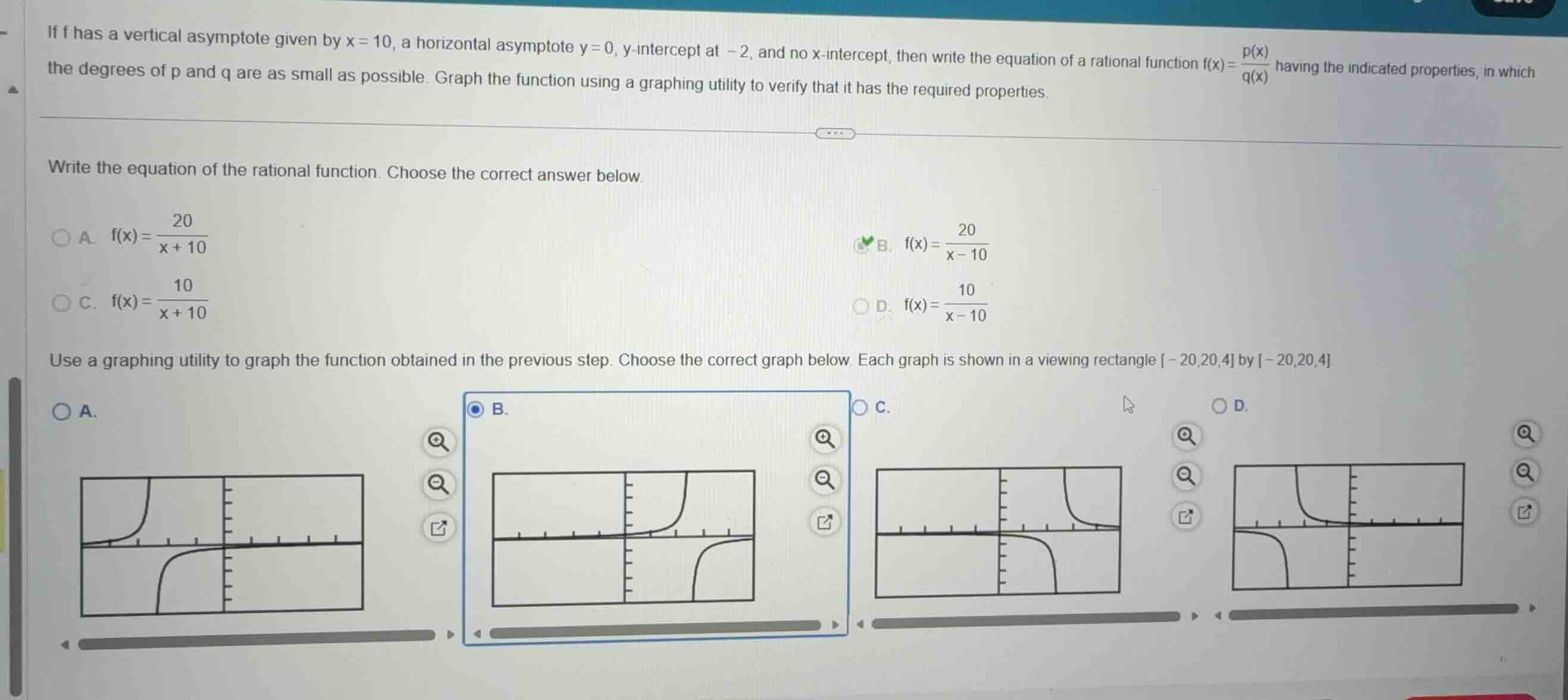
if f has a vertical asymptote given by x = 10, a horizontal asymptote y = 0, y-intercept at -2, and no x-intercept, then write the equation of a rational function f(x) = \frac{p(x)}{q(x)} having the indicated properties, in which the degrees of p and q are as small as possible. graph the function using a graphing utility to verify that it has the required properties.
write the equation of the rational function. choose the correct answer below.
a. f(x) = \frac{20}{x + 10}
b. f(x) = \frac{20}{x - 10}
c. f(x) = \frac{10}{x + 10}
d. f(x) = \frac{10}{x - 10}
use a graphing utility to graph the function obtained in the previous step. choose the correct graph below. each graph is shown in a viewing rectangle -20,20,4 by -20,20,4
Determine the denominator from the vertical asymptote
Using the Vertical Asymptotes Determination knowledge point
Determine the numerator from the horizontal asymptote and intercepts
Using the Horizontal Asymptotes and X-Intercept of Rational Function knowledge points
Solve for the constant using the y-intercept
Using the Y-Intercept of Rational Function knowledge point
Identify the correct graph
Using the Vertical Asymptotes Determination and Y-Intercept of Rational Function knowledge points
Comparing the options, Graph B shows the vertical asymptote at \(x = 10\), the y-intercept at \((0, -2)\), and the branches in the correct quadrants.

Snap & solve any problem in the app
Get step-by-step solutions on Sovi AI
Photo-based solutions with guided steps
Explore more problems and detailed explanations
Question 1
- (A) \(f(x) = \frac{20}{x + 10}\)
- (B) \(f(x) = \frac{20}{x - 10}\) (Correct answer)
- (C) \(f(x) = \frac{10}{x + 10}\)
- (D) \(f(x) = \frac{10}{x - 10}\)
Question 2
- (A) branch in upper-left and lower-right, asymptote at x = -10
- (B) branch in upper-right and lower-left, asymptote at x = 10 (Correct answer)
- (C) branch in upper-left and lower-right, asymptote at x = 10
- (D) branch in upper-right and lower-left, asymptote at x = -10