QUESTION IMAGE
Question
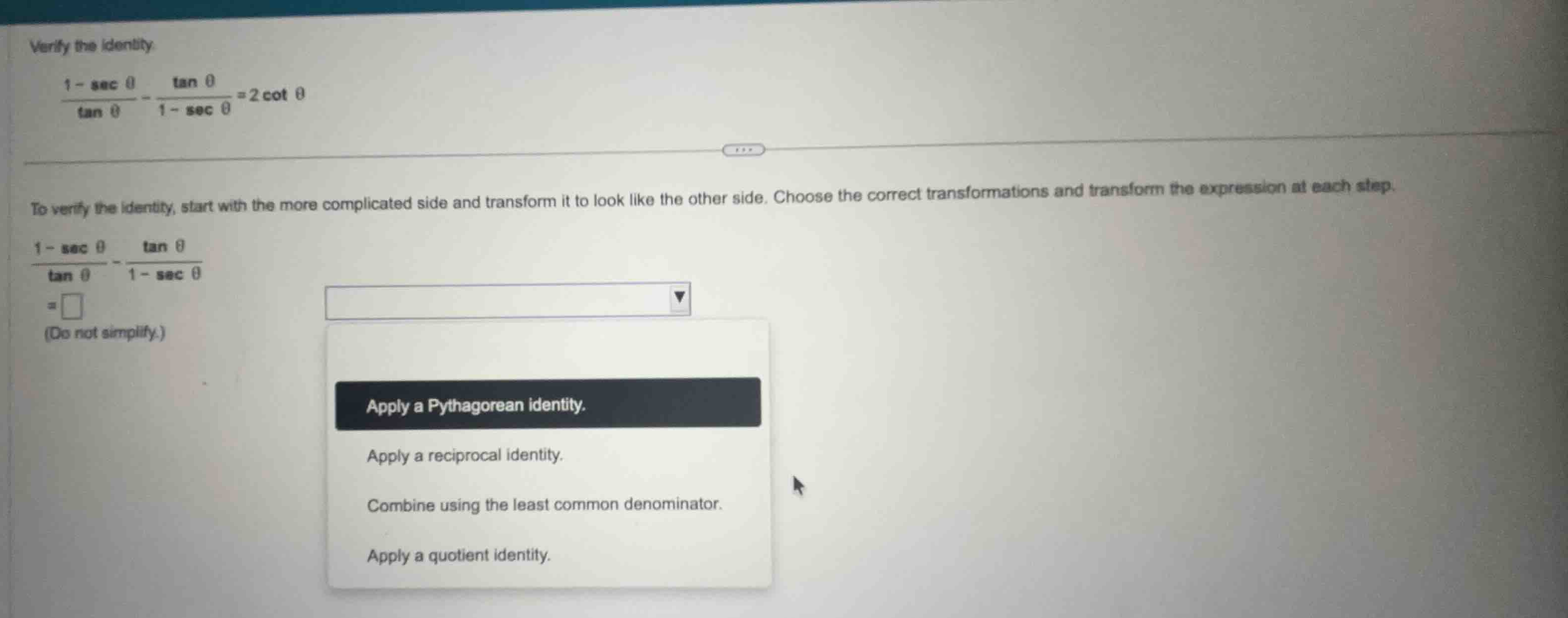
verify the identity.
\\\frac{1 - \sec \theta}{\tan \theta} - \frac{\tan \theta}{1 - \sec \theta} = 2 \cot \theta\\
to verify the identity, start with the more complicated side and transform it to look like the other side. choose the correct transformations and transform the expression at each step.
\\\frac{1 - \sec \theta}{\tan \theta} - \frac{\tan \theta}{1 - \sec \theta}\\
=
(do not simplify.)
options:
- apply a pythagorean identity.
- apply a reciprocal identity.
- combine using the least common denominator.
- apply a quotient identity.
Identify the first step
To verify the identity, we start with the left-hand side:
To simplify this subtraction of two fractions, we need to find a common denominator. The least common denominator (LCD) is \(\tan \theta (1 - \sec \theta)\). Therefore, the first logical transformation is to combine the terms using this least common denominator.
Perform the algebraic combination
Using the LCD \(\tan \theta (1 - \sec \theta)\), we rewrite the expression:
The prompt specifies "Do not simplify" for the resulting expression in the box, which means we write the combined fraction directly without expanding or simplifying the numerator.

Snap & solve any problem in the app
Get step-by-step solutions on Sovi AI
Photo-based solutions with guided steps
Explore more problems and detailed explanations
To verify the identity, start with the more complicated side and transform it to look like the other side. Choose the correct transformations and transform the expression at each step.
Choose the transformation: <blank>Combine using the least common denominator.</blank>
<blank>\(\frac{(1 - \sec \theta)^2 - \tan^2 \theta}{\tan \theta (1 - \sec \theta)}\)</blank>
(Do not simplify.)