QUESTION IMAGE
Question
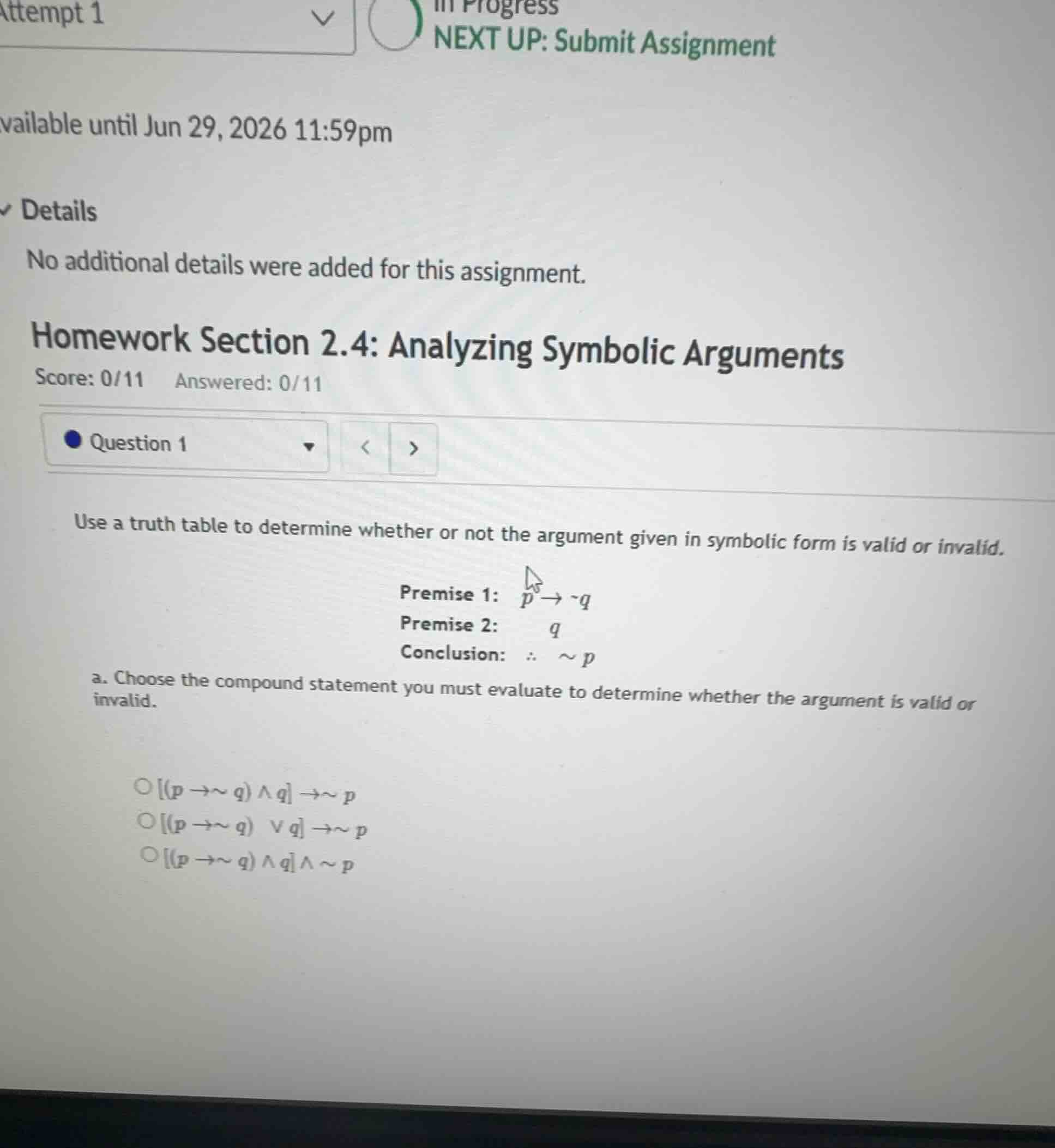
use a truth table to determine whether or not the argument given in symbolic form is valid or invalid.
premise 1: \\(p \
ightarrow \sim q\\)
premise 2: \\(q\\)
conclusion: \\(\therefore \sim p\\)
a. choose the compound statement you must evaluate to determine whether the argument is valid or invalid.
\\(\bigcirc (p \
ightarrow \sim q) \wedge q \
ightarrow \sim p\\)
\\(\bigcirc (p \
ightarrow \sim q) \vee q \
ightarrow \sim p\\)
\\(\bigcirc (p \
ightarrow \sim q) \wedge q \wedge \sim p\\)
Identify premises and conclusion
Formulate the conditional statement for argument validity
Substitute the symbolic expressions

Snap & solve any problem in the app
Get step-by-step solutions on Sovi AI
Photo-based solutions with guided steps
Explore more problems and detailed explanations
- **(A) \([(p
ightarrow \sim q) \wedge q]
ightarrow \sim p\) (Correct answer)**
- (B) \([(p
ightarrow \sim q) \vee q]
ightarrow \sim p\)
- (C) \([(p
ightarrow \sim q) \wedge q] \wedge \sim p\)