QUESTION IMAGE
Question
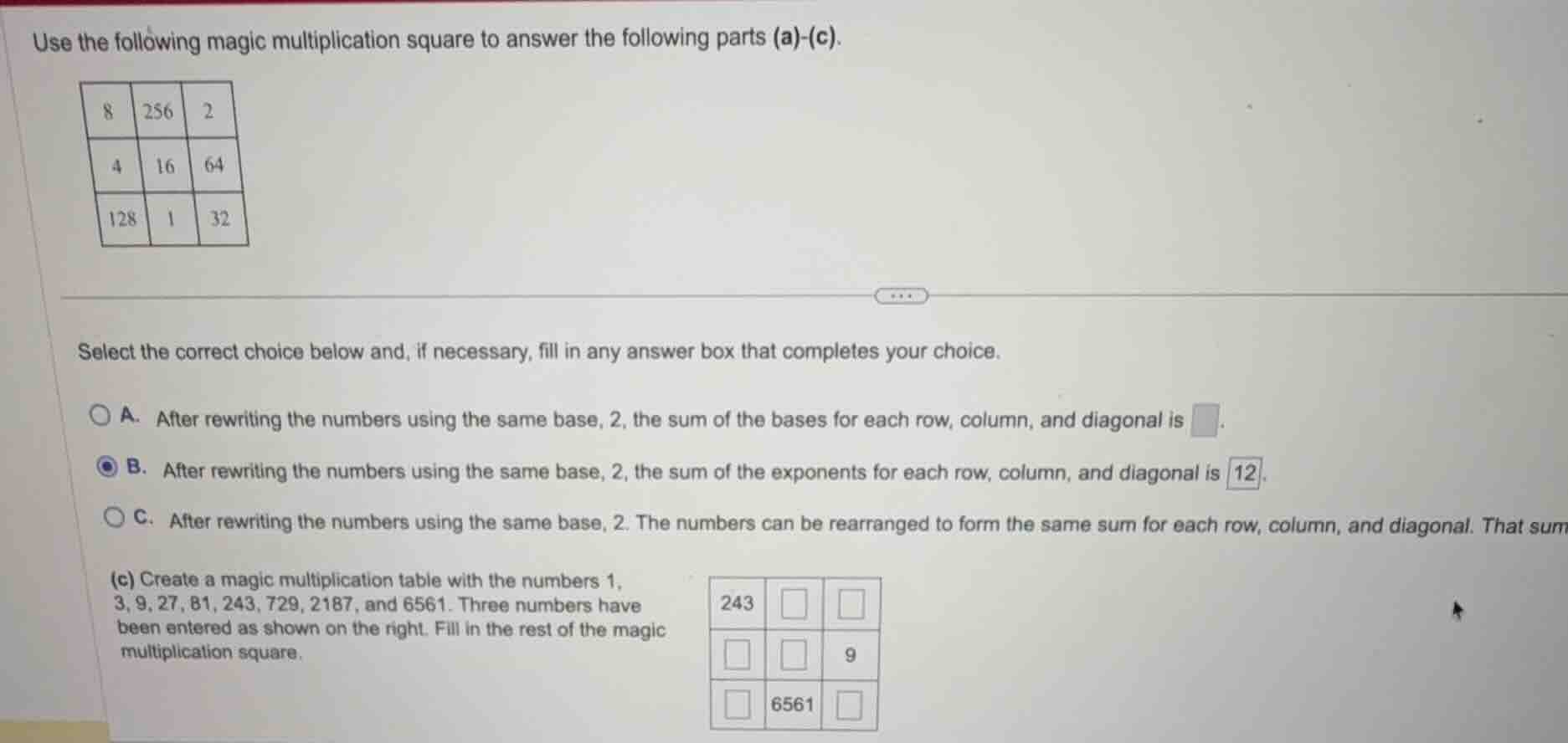
use the following magic multiplication square to answer the following parts (a)-(c).
select the correct choice below and, if necessary, fill in any answer box that completes your choice.
a. after rewriting the numbers using the same base, 2, the sum of the bases for each row, column, and diagonal is .
b. after rewriting the numbers using the same base, 2, the sum of the exponents for each row, column, and diagonal is 12.
c. after rewriting the numbers using the same base, 2. the numbers can be rearranged to form the same sum for each row, column, and diagonal. that sum
(c) create a magic multiplication table with the numbers 1, 3, 9, 27, 81, 243, 729, 2187, and 6561. three numbers have been entered as shown on the right. fill in the rest of the magic multiplication square.
Analyze the first question
Using the Magic Multiplication Square and Exponential Magic Square knowledge points.
We rewrite the numbers in the first magic square using base 2:
- Row 1: \(8 = 2^3\), \(256 = 2^8\), \(2 = 2^1\)
- Row 2: \(4 = 2^2\), \(16 = 2^4\), \(64 = 2^6\)
- Row 3: \(128 = 2^7\), \(1 = 2^0\), \(32 = 2^5\)
The exponents form an additive magic square:
Row 1: \(3, 8, 1\) (sum = 12)
Row 2: \(2, 4, 6\) (sum = 12)
Row 3: \(7, 0, 5\) (sum = 12)
Thus, option B is correct, and the sum of the exponents is 12.
Solve the second question (part c)
Using the Magic Multiplication Square and Exponential Magic Square knowledge points.
The numbers are powers of 3: \(3^0, 3^1, 3^2, 3^3, 3^4, 3^5, 3^6, 3^7, 3^8\).
The exponents are \(0, 1, 2, 3, 4, 5, 6, 7, 8\).
The sum of these exponents is 36.
In a \(3 \times 3\) additive magic square, the magic constant for exponents is \(36 / 3 = 12\).
The center exponent must be \(12 / 3 = 4\), so the center number is \(3^4 = 81\).
Let the exponent grid be:
Given values in the grid:
- Top-left: \(243 = 3^5 \implies a = 5\)
- Middle-right: \(9 = 3^2 \implies f = 2\)
- Bottom-middle: \(6561 = 3^8 \implies h = 8\)
We know \(e = 4\) (center exponent).
Let's find the remaining exponents:
- Row 2 sum: \(d + e + f = 12 \implies d + 4 + 2 = 12 \implies d = 6\)
- Column 2 sum: \(b + e + h = 12 \implies b + 4 + 8 = 12 \implies b = 0\)
- Row 1 sum: \(a + b + c = 12 \implies 5 + 0 + c = 12 \implies c = 7\)
- Column 1 sum: \(a + d + g = 12 \implies 5 + 6 + g = 12 \implies g = 1\)
- Column 3 sum: \(c + f + i = 12 \implies 7 + 2 + i = 12 \implies i = 3\)
The exponent grid is:
Converting back to powers of 3:
- Row 1: \(3^5 = 243\), \(3^0 = 1\), \(3^7 = 2187\)
- Row 2: \(3^6 = 729\), \(3^4 = 81\), \(3^2 = 9\)
- Row 3: \(3^1 = 3\), \(3^8 = 6561\), \(3^3 = 27\)

Snap & solve any problem in the app
Get step-by-step solutions on Sovi AI
Photo-based solutions with guided steps
Explore more problems and detailed explanations
Question 1
- A. After rewriting the numbers using the same base, 2, the sum of the bases for each row, column, and diagonal is [ ].
- B. After rewriting the numbers using the same base, 2, the sum of the exponents for each row, column, and diagonal is 12. (Correct answer)
- C. After rewriting the numbers using the same base, 2. The numbers can be rearranged to form the same sum for each row, column, and diagonal. That sum is [ ].
Question 2
The completed magic multiplication square is:
| 243 | 1 | 2187 |
|---|---|---|
| 3 | 6561 | 27 |