QUESTION IMAGE
Question
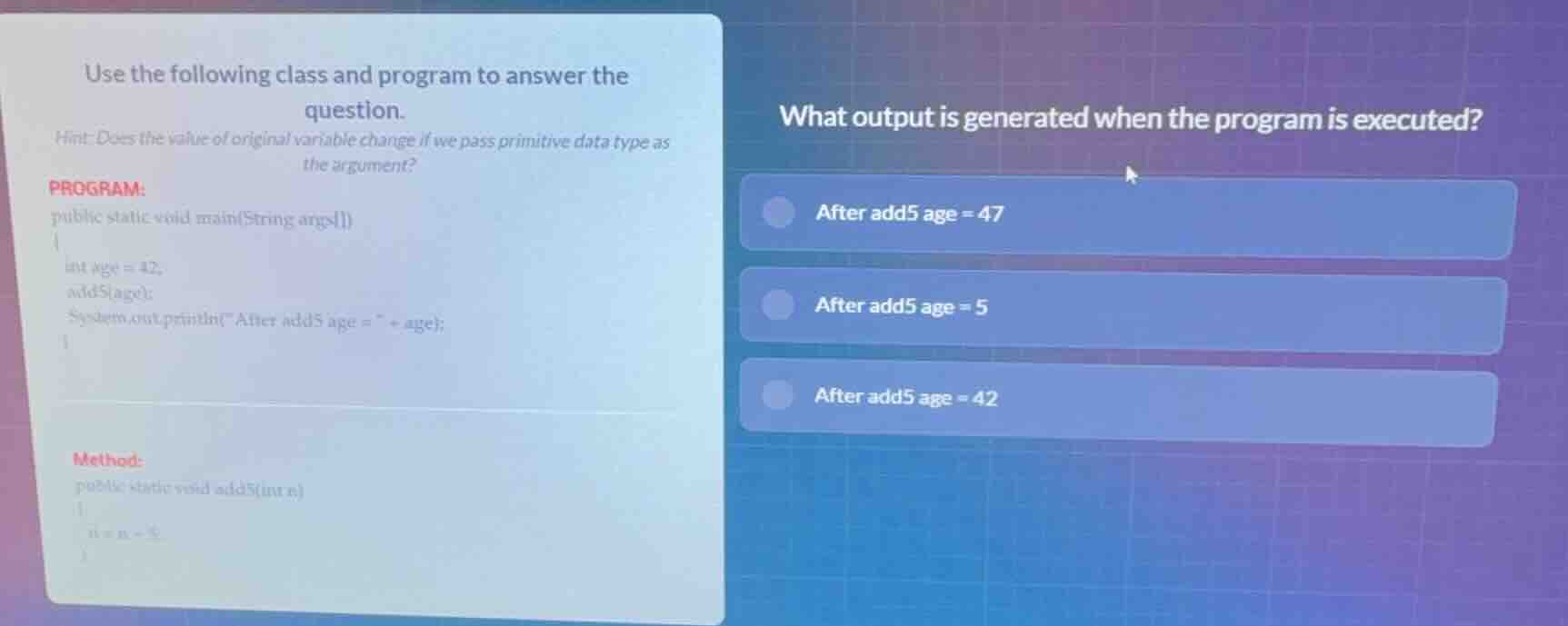
use the following class and program to answer the question.
hint: does the value of original variable change if we pass primitive data type as the argument?
program:
public static void main(string args)
{
int age = 42;
add5(age);
system.out.println(\after add5 age = \ + age);
}
method:
public static void add5(int n) {
    n = n + 5;
}
what output is generated when the program is executed?
- after add5 age = 47
- after add5 age = 5
- after add5 age = 42
🆕 New Concept Discovered: Pass-by-Value in Java
How values are copied when passed to methods.
Step 1: Analyze the main method execution
In the main method, an integer variable named age is declared and initialized:
int age = 42;This creates a variable in memory holding the primitive integer value 42.
Step 2: Analyze the method call behavior
The program then calls the method add5(age).
In Java, all arguments are passed by value. This means that when you pass a primitive variable (like an int) to a method, Java makes a copy of the value (42) and passes that copy to the method.
Inside the add5 method:
public static void add5(int n) {
n = n + 5;
}- The parameter
nis a local variable that receives the copied value42. - The operation
n = n + 5changes the value of the local variablento47. - This change only affects the local variable
ninside the scope ofadd5. It has absolutely no effect on the originalagevariable in themainmethod.
Step 3: Determine the final printed output
After the add5(age) method finishes executing, control returns to the main method. The original variable age remains unchanged:
System.out.println("After add5 age = " + age);Since age is still 42, the printed output is:After add5 age = 42

Snap & solve any problem in the app
Get step-by-step solutions on Sovi AI
Photo-based solutions with guided steps
Explore more problems and detailed explanations
After add5 age = 42