QUESTION IMAGE
Question
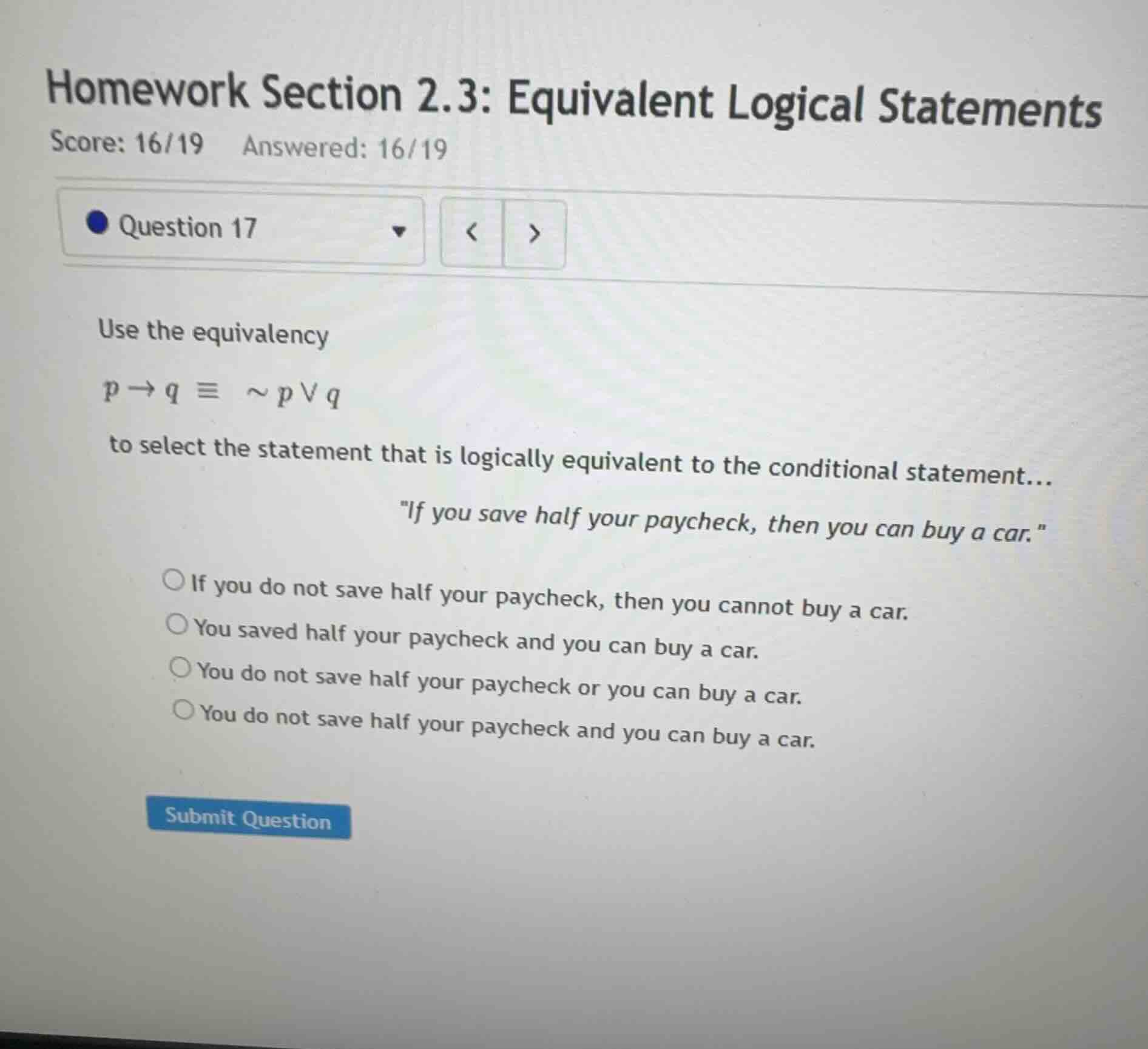
use the equivalency
\\(p \
ightarrow q \equiv \sim p \lor q\\)
to select the statement that is logically equivalent to the conditional statement...
\if you save half your paycheck, then you can buy a car.\
- if you do not save half your paycheck, then you cannot buy a car.
- you saved half your paycheck and you can buy a car.
- you do not save half your paycheck or you can buy a car.
- you do not save half your paycheck and you can buy a car.
Define variables for the component statements
\(p\): "You save half your paycheck."
\(q\): "You can buy a car."
Apply the conditional equivalency
\(\sim p\): "You do not save half your paycheck."
\(q\): "You can buy a car."
\(\sim p \lor q\): "You do not save half your paycheck or you can buy a car."
Match with the given options
Option 1: "If you do not save half your paycheck, then you cannot buy a car." (\(\sim p
ightarrow \sim q\))
Option 2: "You saved half your paycheck and you can buy a car." (\(p \land q\))
Option 3: "You do not save half your paycheck or you can buy a car." (\(\sim p \lor q\))
Option 4: "You do not save half your paycheck and you can buy a car." (\(\sim p \land q\))

Snap & solve any problem in the app
Get step-by-step solutions on Sovi AI
Photo-based solutions with guided steps
Explore more problems and detailed explanations
- If you do not save half your paycheck, then you cannot buy a car.
- You saved half your paycheck and you can buy a car.
- You do not save half your paycheck or you can buy a car. (Correct answer)
- You do not save half your paycheck and you can buy a car.