QUESTION IMAGE
Question
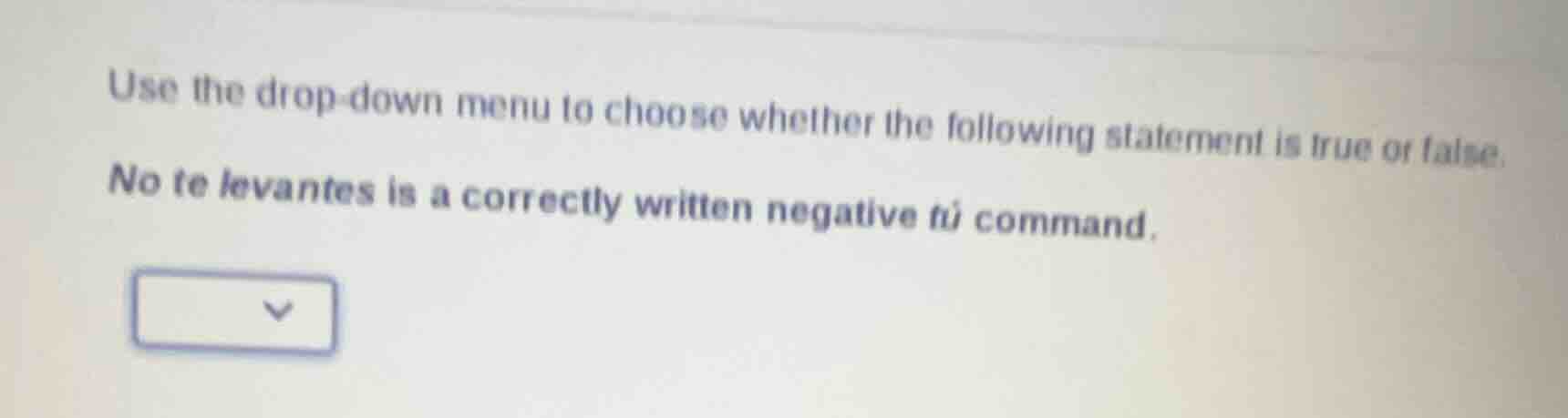
use the drop-down menu to choose whether the following statement is true or false: no te levantes is a correctly written negative tú command.
To determine this, we analyze negative tú commands in Spanish. For -ar verbs (levantar is -ar), the negative tú command is formed by "no + tú form of the present subjunctive"? Wait, no—wait, negative tú commands for regular verbs: for -ar verbs, the negative tú command is "no + stem + -es" (from the present subjunctive tú form? Wait, actually, the negative tú command for regular verbs: for -ar verbs, the negative tú command is "no + verb in present subjunctive tú form". Wait, "levantar" is a regular -ar verb. The present subjunctive tú form of "levantar" is "levantes"? Wait, no: the present subjunctive of -ar verbs: the stem is "levant" (wait, "levantar" has stem "levant-"? Wait, "levantar" is conjugated as: yo levante, tú levantes, él/ella levante, nosotros levantemos, vosotros levanteis, ellos/ellas levanten. Wait, but negative tú commands: the negative tú command for regular verbs uses the present subjunctive tú form. But wait, the positive tú command for -ar verbs is the imperative: "levanta" (tú levanta). The negative tú command is "no levantes" (since the present subjunctive tú form of "levantar" is "levantes"). Wait, but the original statement is "No te levantes"—wait, "levantarse" is a reflexive verb. Oh! Right, "levantarse" is reflexive, so the reflexive pronoun "te" (for tú) is used. So "levantarse" (reflexive, to get up). The negative tú command for the reflexive verb "levantarse": the structure is "no + te + present subjunctive tú form of the verb". The present subjunctive tú form of "levantarse" (reflexive) is "te levantes"? Wait, the verb "levantarse" (reflexive) in present subjunctive tú: the verb is "levantarse", so the conjugation is tú te levantes (since it's reflexive, the pronoun "te" is part of the conjugation). Wait, no: the present subjunctive of "levantarse" (reflexive) for tú is "te levantes"? Wait, let's conjugate "levantarse" (reflexive) in present subjunctive: yo me levante, tú te levantes, él/ella se levante, nosotros nos levantemos, vosotros os levanteis, ellos/ellas se levanten. So the negative tú command for the reflexive verb "levantarse" (tú) is "no te levantes"—because the negative tú command uses the present subjunctive form, and since it's reflexive, we include the reflexive pronoun "te". Wait, but is "No te levantes" a correctly written negative tú command? Wait, but wait: the positive tú command for "levantarse" (reflexive) is "levántate" (tú levántate). The negative tú command is "no te levantes" (using the present subjunctive tú form with the reflexive pronoun). Wait, but the question is whether "No te levantes" is a correctly written negative tú command. Wait, but hold on: the negative tú command for reflexive verbs—wait, maybe I made a mistake. Wait, the negative tú command for regular verbs (including reflexive) uses the present subjunctive tú form. For reflexive verbs, the reflexive pronoun is placed before the verb in negative commands? Wait, no: in negative commands (tú), the structure is "no + reflexive pronoun + verb in present subjunctive tú form". So for "levantarse" (reflexive, tú), the negative command is "no te levantes". But wait, the positive tú command for reflexive verbs is "levántate" (imperative, reflexive, tú: "levántate"). The negative tú command is "no te levantes" (using present subjunctive). But wait, is "No te levantes" a negative tú command? Wait, but the problem is: is "No te levantes" a correctly written negative tú command? Wait, but wait: the negative tú command for the reflexive verb "levantarse"—wait, maybe the confusion is between the non - reflexive and reflex…

Snap & solve any problem in the app
Get step-by-step solutions on Sovi AI
Photo-based solutions with guided steps
Explore more problems and detailed explanations
True