QUESTION IMAGE
Question
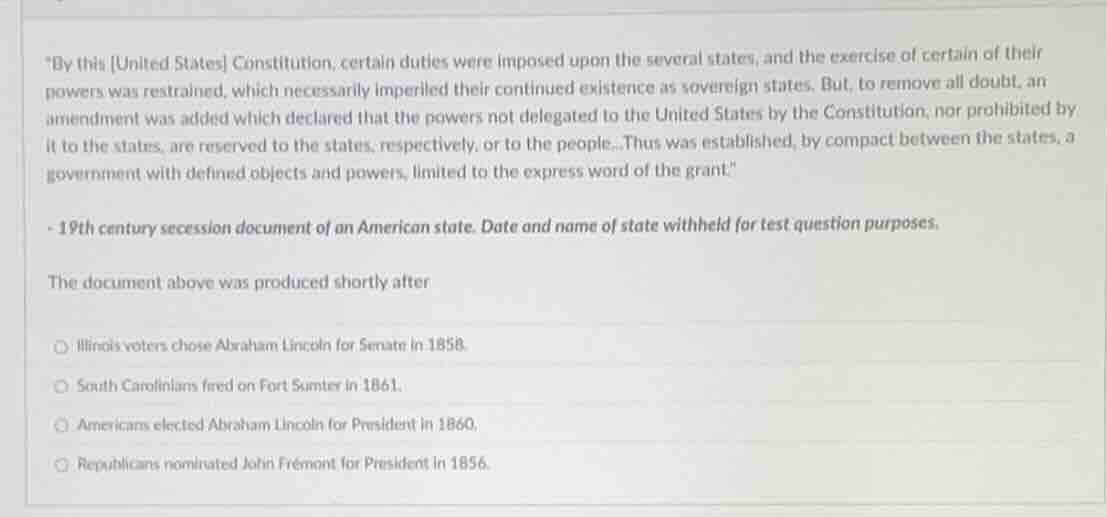
\by this united states constitution, certain duties were imposed upon the several states, and the exercise of certain of their powers was restrained, which necessarily imperiled their continued existence as sovereign states. but, to remove all doubt, an amendment was added which declared that the powers not delegated to the united states by the constitution, nor prohibited by it to the states, are reserved to the states, respectively, or to the people... thus was established, by compact between the states, a government with defined objects and powers, limited to the express word of the grant.\
- 19th century secession document of an american state. date and name of state withheld for test question purposes.
the document above was produced shortly after
illinois voters chose abraham lincoln for senate in 1858.
south carolinians fired on fort sumter in 1861.
americans elected abraham lincoln for president in 1860.
republicans nominated john frémont for president in 1856.
<pre_analysis>
{
"quality": "clear",
"question_count": 1,
"skills_matched": [
"direct_cot",
"multiple_choice_formatter",
"explain_then_answer",
"tutor",
"mastery_adaptive_brevity"
],
"needs_drawing": false,
"concepts_used": [
"Election of 1860",
"Sectionalism"
],
"new_concepts": [
"Secession Documents",
"Compact Theory"
],
"current_concepts": [
"Election of 1860",
"Sectionalism",
"Secession Documents",
"Compact Theory"
]
}
</pre_analysis>
<reasoning>
Analyze the source document
Using the Sectionalism knowledge point, the excerpt is identified as a 19th-century secession document (specifically South Carolina's Declaration of the Immediate Causes Which Induce and Justify the Secession of South Carolina from the Federal Union, adopted in December 1860). The text references the Tenth Amendment and the "compact between the states" to justify leaving the Union.
Determine the historical context
Using the Election of 1860 knowledge point, South Carolina and other Deep South states drafted and adopted their ordinances of secession in late 1860 and early 1861. This wave of secession was directly triggered by the victory of Republican candidate Abraham Lincoln in the presidential election of November 1860, as Southern states feared his administration would threaten the institution of slavery.
Evaluate the answer choices
- Illinois voters chose Abraham Lincoln for Senate in 1858: Incorrect. Lincoln lost the 1858 Senate race to Stephen Douglas.
- South Carolinians fired on Fort Sumter in 1861: Incorrect. The firing on Fort Sumter occurred in April 1861, which was after the initial secession documents were drafted and adopted.
- Americans elected Abraham Lincoln for President in 1860: Correct. The election of Lincoln in November 1860 directly prompted South Carolina to draft this secession document in December 1860.
- Republicans nominated John Frémont for President in 1856: Incorrect. This occurred four years prior to the secession crisis.
</reasoning>
<answer>
<mcq-option>(A) Illinois voters chose Abraham Lincoln for Senate in 1858.</mcq-option>
<mcq-option>(B) South Carolinians fired on Fort Sumter in 1861.</mcq-correct>
<mcq-correct>(C) Americans elected Abraham Lincoln for President in 1860.</mcq-correct>
<mcq-option>(D) Republicans nominated John Frémont for President in 1856.</mcq-option>
</answer>
<post_analysis>
{
"subject": "Social Science",
"question_type": "Multiple Choice",
"knowledge_point": [
"Social Science",
"US History",
"American Civil War"
]
}
</post_analysis>
Snap & solve any problem in the app
Get step-by-step solutions on Sovi AI
Photo-based solutions with guided steps
Explore more problems and detailed explanations
<pre_analysis>
{
"quality": "clear",
"question_count": 1,
"skills_matched": [
"direct_cot",
"multiple_choice_formatter",
"explain_then_answer",
"tutor",
"mastery_adaptive_brevity"
],
"needs_drawing": false,
"concepts_used": [
"Election of 1860",
"Sectionalism"
],
"new_concepts": [
"Secession Documents",
"Compact Theory"
],
"current_concepts": [
"Election of 1860",
"Sectionalism",
"Secession Documents",
"Compact Theory"
]
}
</pre_analysis>
<reasoning>
Analyze the source document
Using the Sectionalism knowledge point, the excerpt is identified as a 19th-century secession document (specifically South Carolina's Declaration of the Immediate Causes Which Induce and Justify the Secession of South Carolina from the Federal Union, adopted in December 1860). The text references the Tenth Amendment and the "compact between the states" to justify leaving the Union.
Determine the historical context
Using the Election of 1860 knowledge point, South Carolina and other Deep South states drafted and adopted their ordinances of secession in late 1860 and early 1861. This wave of secession was directly triggered by the victory of Republican candidate Abraham Lincoln in the presidential election of November 1860, as Southern states feared his administration would threaten the institution of slavery.
Evaluate the answer choices
- Illinois voters chose Abraham Lincoln for Senate in 1858: Incorrect. Lincoln lost the 1858 Senate race to Stephen Douglas.
- South Carolinians fired on Fort Sumter in 1861: Incorrect. The firing on Fort Sumter occurred in April 1861, which was after the initial secession documents were drafted and adopted.
- Americans elected Abraham Lincoln for President in 1860: Correct. The election of Lincoln in November 1860 directly prompted South Carolina to draft this secession document in December 1860.
- Republicans nominated John Frémont for President in 1856: Incorrect. This occurred four years prior to the secession crisis.
</reasoning>
<answer>
<mcq-option>(A) Illinois voters chose Abraham Lincoln for Senate in 1858.</mcq-option>
<mcq-option>(B) South Carolinians fired on Fort Sumter in 1861.</mcq-correct>
<mcq-correct>(C) Americans elected Abraham Lincoln for President in 1860.</mcq-correct>
<mcq-option>(D) Republicans nominated John Frémont for President in 1856.</mcq-option>
</answer>
<post_analysis>
{
"subject": "Social Science",
"question_type": "Multiple Choice",
"knowledge_point": [
"Social Science",
"US History",
"American Civil War"
]
}
</post_analysis>