QUESTION IMAGE
Question
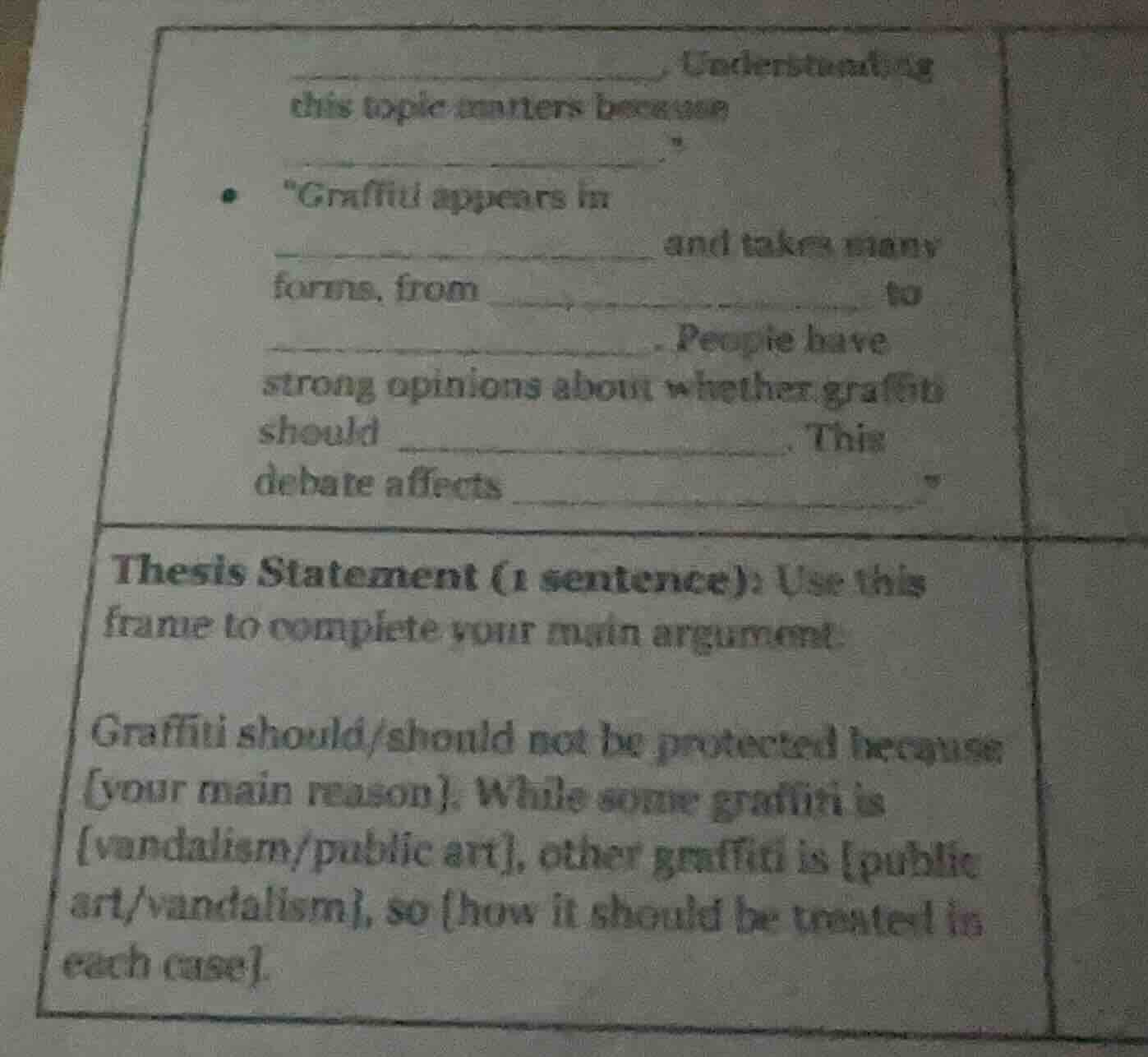
understanding this topic matters because
- \graffiti appears in _______ and takes many forms, from _____ to _____. people have strong opinions about whether graffiti should _____. this debate affects _______.\
thesis statement (1 sentence): use this frame to complete your main argument:
graffiti should/should not be protected because your main reason. while some graffiti is vandalism/public art, other graffiti is public art/vandalism, so how it should be treated in each case.
<pre_analysis>
{
"quality": "clear",
"question_count": 2,
"skills_matched": [
"direct_cot",
"blank_filling_formatter",
"explain_then_answer",
"quick"
],
"needs_drawing": false,
"concepts_used": [
"Essay Introduction Structure",
"Writing Hooks",
"Background Information"
],
"new_concepts": [
"Thesis Statement Construction",
"Argumentative Writing Frames"
],
"current_concepts": [
"Essay Introduction Structure",
"Writing Hooks",
"Background Information",
"Thesis Statement Construction",
"Argumentative Writing Frames"
]
}
</pre_analysis>
<reasoning>
Analyze the background information frame
The first box provides a template for establishing context and background information on graffiti:
- "Understanding this topic matters because..." requires a statement on the cultural or social relevance of graffiti.
- "Graffiti appears in [blank] and takes many forms, from [blank] to [blank]." requires locations (e.g., public spaces/cities) and forms (e.g., simple tags to elaborate murals).
- "People have strong opinions about whether graffiti should [blank]." requires the core debate action (e.g., be protected or banned/penalized).
- "This debate affects [blank]." requires the impacted group (e.g., local communities, property owners, and artists).
Analyze the thesis statement frame
The second box provides a structured, one-sentence thesis frame:
- "Graffiti should/should not be protected because [your main reason]."
- "While some graffiti is [vandalism/public art], other graffiti is [public art/vandalism], so [how it should be treated in each case]."
- Combining these elements into a cohesive, single-sentence argument that balances both perspectives.
</reasoning>
<answer>
Question 1
Understanding this topic matters because <blank>it shapes how we define public space and artistic expression</blank>.
- "Graffiti appears in <blank>urban environments</blank> and takes many forms, from <blank>simple tags</blank> to <blank>elaborate murals</blank>. People have strong opinions about whether graffiti should <blank>be legally protected as art</blank>. This debate affects <blank>artists, property owners, and local communities</blank>."
Question 2
Thesis Statement (1 sentence): Use this frame to complete your main argument:
<blank>Graffiti should be protected because of its cultural value; while some graffiti is vandalism, other graffiti is public art, so illegal tagging should be penalized while commissioned murals should be preserved.</blank>
</answer>
<post_analysis>
{
"subject": "Others",
"question_type": "Fill-in-the-blank",
"knowledge_point": [
"Others",
"Language Arts",
"Argumentative Writing"
]
}
</post_analysis>
Snap & solve any problem in the app
Get step-by-step solutions on Sovi AI
Photo-based solutions with guided steps
Explore more problems and detailed explanations
<pre_analysis>
{
"quality": "clear",
"question_count": 2,
"skills_matched": [
"direct_cot",
"blank_filling_formatter",
"explain_then_answer",
"quick"
],
"needs_drawing": false,
"concepts_used": [
"Essay Introduction Structure",
"Writing Hooks",
"Background Information"
],
"new_concepts": [
"Thesis Statement Construction",
"Argumentative Writing Frames"
],
"current_concepts": [
"Essay Introduction Structure",
"Writing Hooks",
"Background Information",
"Thesis Statement Construction",
"Argumentative Writing Frames"
]
}
</pre_analysis>
<reasoning>
Analyze the background information frame
The first box provides a template for establishing context and background information on graffiti:
- "Understanding this topic matters because..." requires a statement on the cultural or social relevance of graffiti.
- "Graffiti appears in [blank] and takes many forms, from [blank] to [blank]." requires locations (e.g., public spaces/cities) and forms (e.g., simple tags to elaborate murals).
- "People have strong opinions about whether graffiti should [blank]." requires the core debate action (e.g., be protected or banned/penalized).
- "This debate affects [blank]." requires the impacted group (e.g., local communities, property owners, and artists).
Analyze the thesis statement frame
The second box provides a structured, one-sentence thesis frame:
- "Graffiti should/should not be protected because [your main reason]."
- "While some graffiti is [vandalism/public art], other graffiti is [public art/vandalism], so [how it should be treated in each case]."
- Combining these elements into a cohesive, single-sentence argument that balances both perspectives.
</reasoning>
<answer>
Question 1
Understanding this topic matters because <blank>it shapes how we define public space and artistic expression</blank>.
- "Graffiti appears in <blank>urban environments</blank> and takes many forms, from <blank>simple tags</blank> to <blank>elaborate murals</blank>. People have strong opinions about whether graffiti should <blank>be legally protected as art</blank>. This debate affects <blank>artists, property owners, and local communities</blank>."
Question 2
Thesis Statement (1 sentence): Use this frame to complete your main argument:
<blank>Graffiti should be protected because of its cultural value; while some graffiti is vandalism, other graffiti is public art, so illegal tagging should be penalized while commissioned murals should be preserved.</blank>
</answer>
<post_analysis>
{
"subject": "Others",
"question_type": "Fill-in-the-blank",
"knowledge_point": [
"Others",
"Language Arts",
"Argumentative Writing"
]
}
</post_analysis>