QUESTION IMAGE
Question
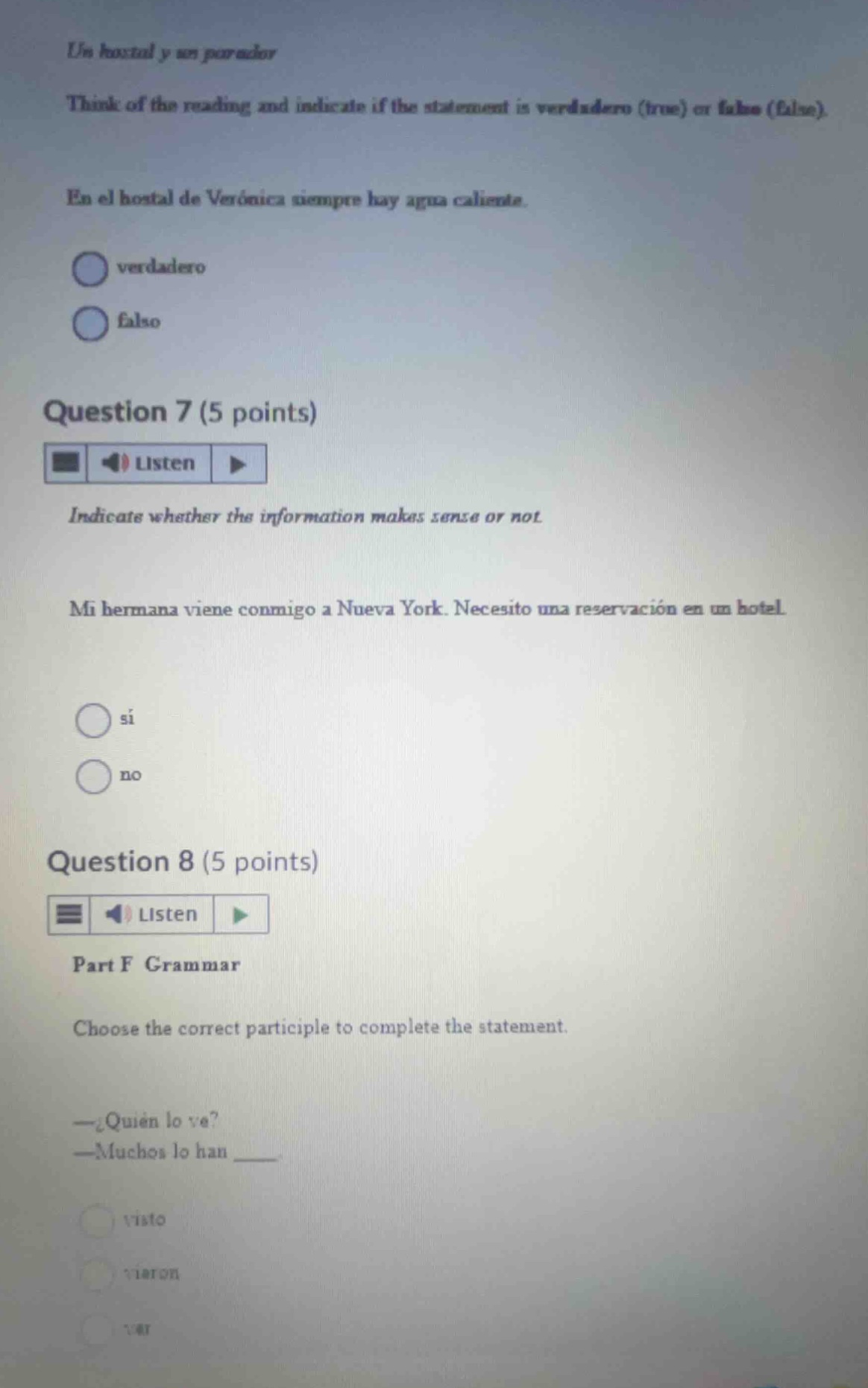
un hostal y un parador
think of the reading and indicate if the statement is verdadero (true) or falso (false).
en el hostal de verónica siempre hay agua caliente.
verdadero
falso
question 7 (5 points)
indicate whether the information makes sense or not.
mi hermana viene conmigo a nueva york. necesito una reservación en un hotel.
sí
no
question 8 (5 points)
part f grammar
choose the correct participle to complete the statement.
-\\u00bfqui\\u00e9n lo ve?
-muchos lo han ______
visto
vieron
ver
<pre_analysis>
{
"quality": "clear",
"question_count": 3,
"skills_matched": [
"direct_cot",
"multiple_choice_formatter",
"explain_then_answer",
"quick"
],
"needs_drawing": false,
"concepts_used": [],
"new_concepts": [
"Spanish Past Participles",
"Spanish Present Perfect"
],
"current_concepts": [
"Spanish Reading Comprehension",
"Spanish Past Participles",
"Spanish Present Perfect"
]
}
</pre_analysis>
<reasoning>
Analyze the first statement
The statement "En el hostal de Verónica siempre hay agua caliente" (In Verónica's hostel there is always hot water) refers to a reading about "Un hostal y un parador". In typical Spanish textbook readings comparing hostales and paradores, hostales (budget hostels) often have limited services, such as hot water only at certain times, making the statement false.
Evaluate Question 7
The sentence is: "Mi hermana viene conmigo a Nueva York. Necesito una reservación en un hotel." (My sister is coming with me to New York. I need a hotel reservation.) This statement makes logical sense ("sí") because traveling with someone to a city requires accommodation.
Solve Question 8
The dialogue is:
—¿Quién lo ve? (Who sees it?)
—Muchos lo han ____ (Many have ____ it)
The auxiliary verb "han" (from haber) requires a past participle to form the present perfect tense. The verb is ver (to see). The past participle of ver is irregular: visto.
- "visto" is the correct past participle.
- "vieron" is the preterite form.
- "ver" is the infinitive.
</reasoning>
<answer>
Question 1
<mcq-option>verdadero</mcq-option>
<mcq-correct>falso</mcq-correct>
Question 7
<mcq-correct>sí</mcq-correct>
<mcq-option>no</mcq-option>
Question 8
<mcq-correct>visto</mcq-correct>
<mcq-option>vieron</mcq-option>
<mcq-option>ver</mcq-option>
</answer>
<post_analysis>
{
"subject": "Others",
"question_type": "Multiple Choice",
"knowledge_point": [
"Others",
"Spanish",
"Spanish Past Participles"
]
}
</post_analysis>
Snap & solve any problem in the app
Get step-by-step solutions on Sovi AI
Photo-based solutions with guided steps
Explore more problems and detailed explanations
<pre_analysis>
{
"quality": "clear",
"question_count": 3,
"skills_matched": [
"direct_cot",
"multiple_choice_formatter",
"explain_then_answer",
"quick"
],
"needs_drawing": false,
"concepts_used": [],
"new_concepts": [
"Spanish Past Participles",
"Spanish Present Perfect"
],
"current_concepts": [
"Spanish Reading Comprehension",
"Spanish Past Participles",
"Spanish Present Perfect"
]
}
</pre_analysis>
<reasoning>
Analyze the first statement
The statement "En el hostal de Verónica siempre hay agua caliente" (In Verónica's hostel there is always hot water) refers to a reading about "Un hostal y un parador". In typical Spanish textbook readings comparing hostales and paradores, hostales (budget hostels) often have limited services, such as hot water only at certain times, making the statement false.
Evaluate Question 7
The sentence is: "Mi hermana viene conmigo a Nueva York. Necesito una reservación en un hotel." (My sister is coming with me to New York. I need a hotel reservation.) This statement makes logical sense ("sí") because traveling with someone to a city requires accommodation.
Solve Question 8
The dialogue is:
—¿Quién lo ve? (Who sees it?)
—Muchos lo han ____ (Many have ____ it)
The auxiliary verb "han" (from haber) requires a past participle to form the present perfect tense. The verb is ver (to see). The past participle of ver is irregular: visto.
- "visto" is the correct past participle.
- "vieron" is the preterite form.
- "ver" is the infinitive.
</reasoning>
<answer>
Question 1
<mcq-option>verdadero</mcq-option>
<mcq-correct>falso</mcq-correct>
Question 7
<mcq-correct>sí</mcq-correct>
<mcq-option>no</mcq-option>
Question 8
<mcq-correct>visto</mcq-correct>
<mcq-option>vieron</mcq-option>
<mcq-option>ver</mcq-option>
</answer>
<post_analysis>
{
"subject": "Others",
"question_type": "Multiple Choice",
"knowledge_point": [
"Others",
"Spanish",
"Spanish Past Participles"
]
}
</post_analysis>