QUESTION IMAGE
Question
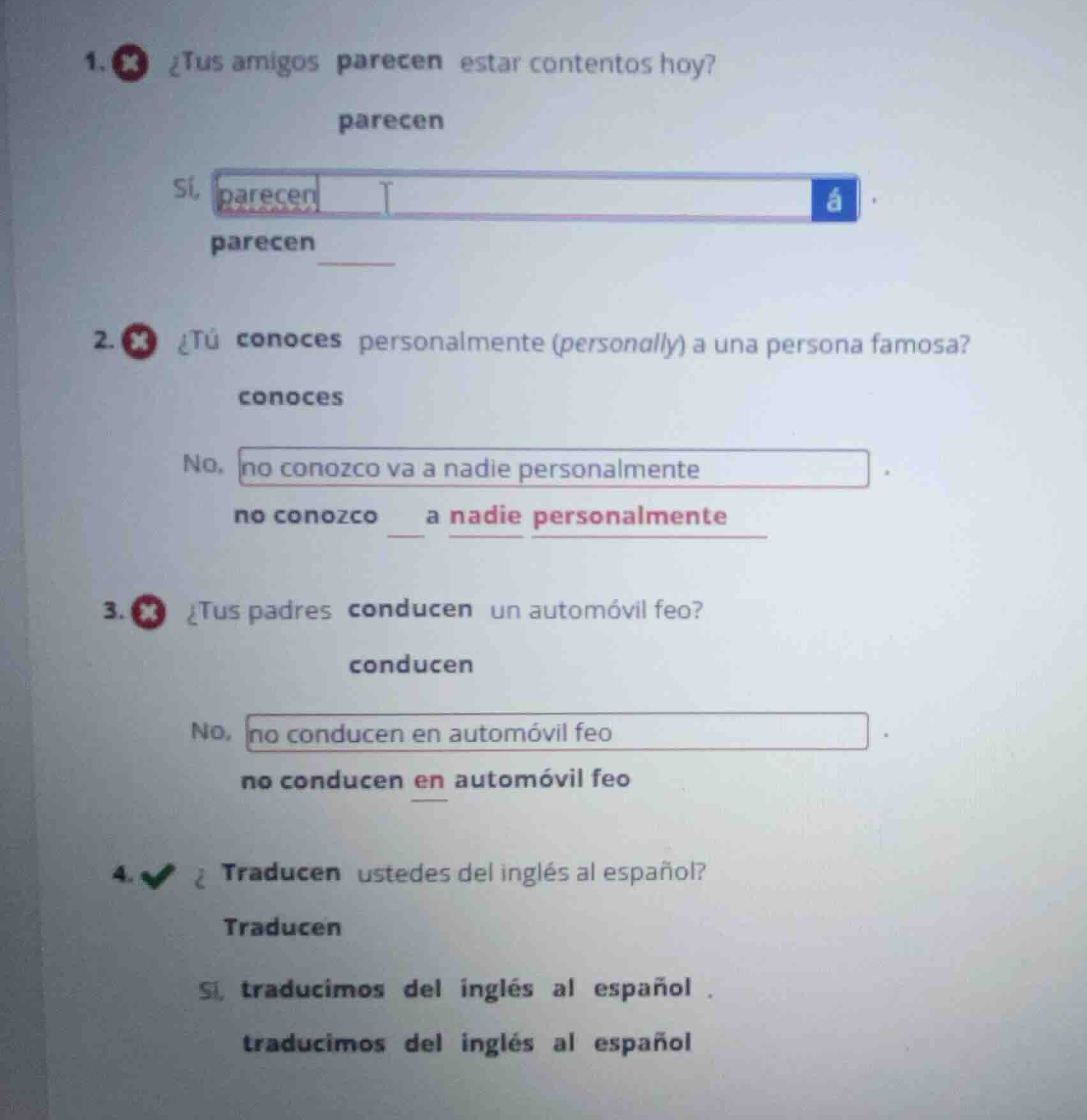
- ¿tus amigos parecen estar contentos hoy?
parecen
sí, parecen
parecen
- ¿tú conoces personalmente (personally) a una persona famosa?
conoces
no, no conozco va a nadie personalmente
no conozco _ a nadie personalmente
- ¿tus padres conducen un automóvil feo?
conducen
no, no conducen en automóvil feo
no conducen en automóvil feo
- ¿traducen ustedes del inglés al español?
traducen
sí, traducimos del inglés al español.
traducimos del inglés al español
Analyze Question 1
The question asks: "¿Tus amigos parecen estar contentos hoy?" (Do your friends seem to be happy today?).
The prompt expects an affirmative response starting with "Sí,".
Using Spanish Verb Parecer, the subject is "tus amigos" (they / ellos), so the verb form is "parecen".
The correct complete response is: "Sí, parecen estar contentos hoy."
The student wrote "parecen", which is correct but needs to complete the sentence structure shown in the correction: "parecen estar contentos hoy".
Analyze Question 2
The question asks: "¿Tú conoces personalmente (personally) a una persona famosa?" (Do you personally know a famous person?).
The response starts with "No,".
Using Saber vs Conocer and Spanish Verbs Ending in -cer and -cir, the first-person singular form of "conocer" is "conozco".
To say "I do not know anyone", Spanish uses double negatives: "No, no conozco a nadie personalmente."
The preposition "a" is required before "nadie" because it refers to a person (the personal "a").
The student incorrectly wrote "no conozco va a nadie...", adding an unnecessary "va". The correct phrase is "no conozco a nadie personalmente".
Analyze Question 3
The question asks: "¿Tus padres conducen un automóvil feo?" (Do your parents drive an ugly car?).
The response starts with "No,".
Using Spanish Verb Conducir, the subject is "mis padres" (they / ellos), so the verb is "conducen".
The direct object is "un automóvil feo". In Spanish, we do not use the preposition "en" for driving a vehicle directly (it is "conducir un automóvil", not "conducir en un automóvil").
Therefore, the negative response is: "No, no conducen un automóvil feo."
The student incorrectly added "en". The correct phrase is "no conducen un automóvil feo".

Snap & solve any problem in the app
Get step-by-step solutions on Sovi AI
Photo-based solutions with guided steps
Explore more problems and detailed explanations
Question 1
¿Tus amigos parecen estar contentos hoy?
Sí, <blank>parecen estar contentos hoy</blank>.
Question 2
¿Tú conoces personalmente (personally) a una persona famosa?
No, <blank>no conozco a nadie personalmente</blank>.
Question 3
¿Tus padres conducen un automóvil feo?
No, <blank>no conducen un automóvil feo</blank>.