QUESTION IMAGE
Question
try it!
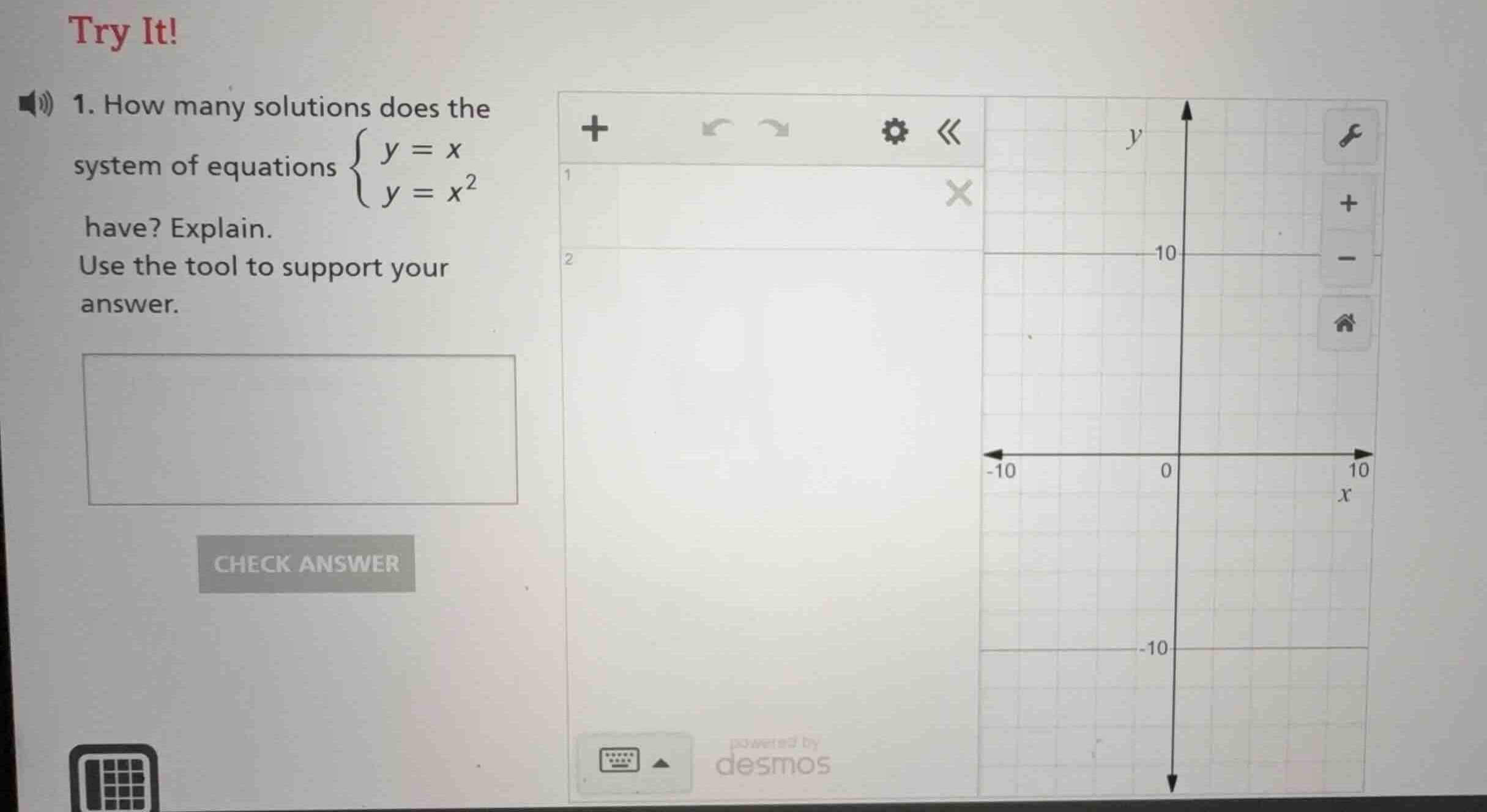
- how many solutions does the system of equations \\(\
\\) have? explain. use the tool to support your answer.
Equate the two functions
To find the intersection points, set the equations equal to each other.
Using the Graphing Quadratic Functions knowledge point
Solve the quadratic equation
Rearrange the equation to solve for \(x\).
Determine the corresponding y-values
Substitute the \(x\)-values back into either original equation to find the \(y\)-coordinates.
For \(x = 0\):
For \(x = 1\):
The intersection points are \((0, 0)\) and \((1, 1)\).
Interpret the graphical representation
The linear function \(y = x\) and the quadratic function \(y = x^2\) intersect at exactly two distinct points on the coordinate plane. Therefore, the system has two real solutions.
By setting the two equations equal to each other, we get \(x^2 = x\), which simplifies to \(x(x - 1) = 0\). This yields two \(x\)-values: \(x = 0\) and \(x = 1\). Substituting these back into the equations gives the intersection points \((0, 0)\) and \((1, 1)\). Graphically, the line \(y = x\) intersects the parabola \(y = x^2\) at exactly these two points, confirming there are 2 solutions.
</answer>

Snap & solve any problem in the app
Get step-by-step solutions on Sovi AI
Photo-based solutions with guided steps
Explore more problems and detailed explanations
The system of equations has 2 solutions.
Explanation:
By setting the two equations equal to each other, we get \(x^2 = x\), which simplifies to \(x(x - 1) = 0\). This yields two \(x\)-values: \(x = 0\) and \(x = 1\). Substituting these back into the equations gives the intersection points \((0, 0)\) and \((1, 1)\). Graphically, the line \(y = x\) intersects the parabola \(y = x^2\) at exactly these two points, confirming there are 2 solutions.