QUESTION IMAGE
Question
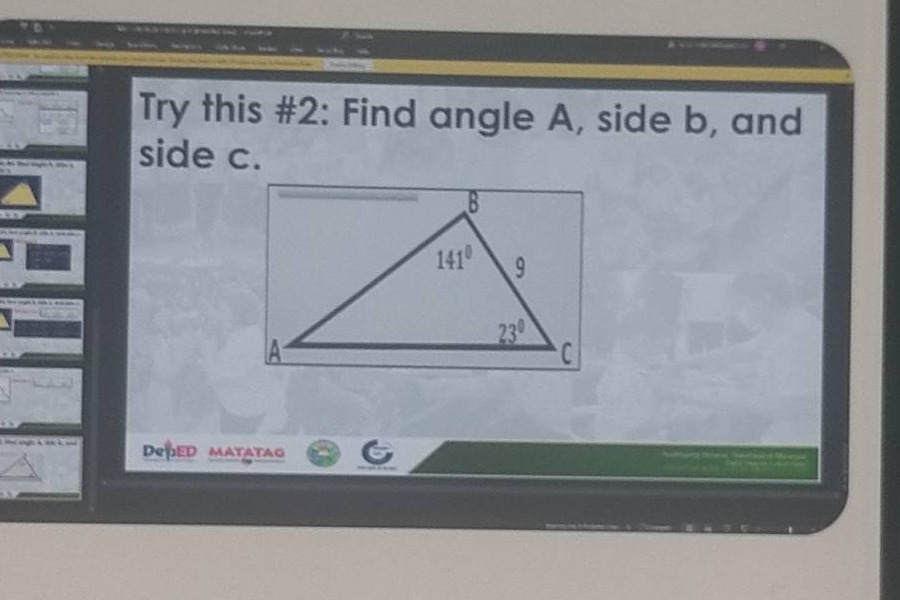
try this #2: find angle a, side b, and side c.
🆕 New Concept Discovered: Law of Sines
Using ratios to solve non-right triangles[Client Connection Error]
Step 1: Find Angle A
The sum of angles in any triangle is always \( 180^\circ \). We can find the missing angle \( A \) by subtracting the two known angles from \( 180^\circ \).
Step 2: Find Side b
Because this is not a right-angled triangle, we cannot use basic SOH CAH TOA. Instead, we use the Law of Sines, which states that the ratio of the length of a side to the sine of its opposite angle is constant for all three sides:
From the given triangle:
- Side \( a \) (opposite to angle \( A \)) is unknown.
- Side \( b \) (opposite to angle \( B \)) is unknown.
- Side \( c \) (opposite to angle \( C \)) is the side \( AB \), which is unknown.
- We are given side \( BC = 9 \), which is opposite to angle \( A \). Therefore, \( a = 9 \).
Using the ratio for \( a \) and \( b \):
Now, solve for \( b \):
Step 3: Find Side c
Using the Law of Sines ratio for \( a \) and \( c \):
Now, solve for \( c \):

Snap & solve any problem in the app
Get step-by-step solutions on Sovi AI
Photo-based solutions with guided steps
Explore more problems and detailed explanations
- Angle A = \( 16^\circ \)
- Side b \approx \( 20.55 \)
- Side c \approx \( 12.76 \)