QUESTION IMAGE
Question
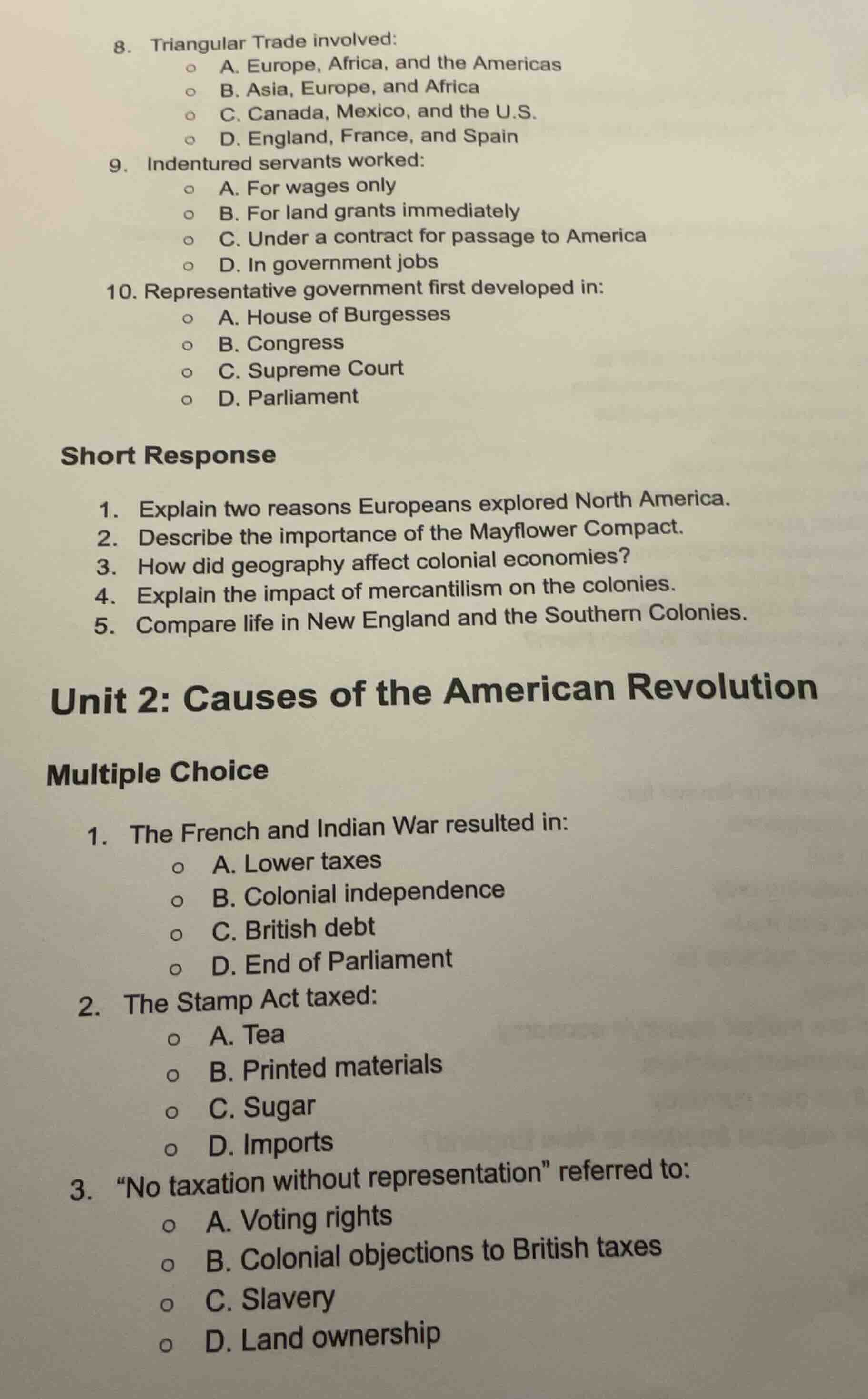
- triangular trade involved:
- a. europe, africa, and the americas
- b. asia, europe, and africa
- c. canada, mexico, and the u.s.
- d. england, france, and spain
- indentured servants worked:
- a. for wages only
- b. for land grants immediately
- c. under a contract for passage to america
- d. in government jobs
- representative government first developed in:
- a. house of burgesses
- b. congress
- c. supreme court
- d. parliament
short response
- explain two reasons europeans explored north america.
- describe the importance of the mayflower compact.
- how did geography affect colonial economies?
- explain the impact of mercantilism on the colonies.
- compare life in new england and the southern colonies.
unit 2: causes of the american revolution
multiple choice
- the french and indian war resulted in:
- a. lower taxes
- b. colonial independence
- c. british debt
- d. end of parliament
- the stamp act taxed:
- a. tea
- b. printed materials
- c. sugar
- d. imports
3.
o taxation without representation\ referred to:
- a. voting rights
- b. colonial objections to british taxes
- c. slavery
- d. land ownership
Analyze Unit 1 Multiple Choice Questions
- Question 8: Triangular Trade connected Europe, Africa, and the Americas.
- Question 9: Indentured servants worked under a contract for passage to America.
- Question 10: Representative government first developed in the House of Burgesses.
Analyze Unit 1 Short Response Questions
- Question 1: Europeans explored North America to find wealth (gold) and spread Christianity.
- Question 2: The Mayflower Compact established self-government and majority rule in Plymouth.
- Question 3: Geography determined resources, such as rocky soil leading to trade in New England and fertile soil leading to farming in the South.
- Question 4: Mercantilism restricted colonial trade to benefit Great Britain's wealth.
- Question 5: New England focused on small farms, fishing, and trade, while the Southern Colonies relied on large plantations and slave labor.
Analyze Unit 2 Multiple Choice Questions
- Question 1: The French and Indian War resulted in massive British debt.
- Question 2: The Stamp Act taxed printed materials.
- Question 3: "No taxation without representation" referred to colonial objections to British taxes.

Snap & solve any problem in the app
Get step-by-step solutions on Sovi AI
Photo-based solutions with guided steps
Explore more problems and detailed explanations
Unit 1: Multiple Choice
Question 8
(A) Europe, Africa, and the Americas
Question 9
(C) Under a contract for passage to America
Question 10
(A) House of Burgesses
---
Unit 1: Short Response
Question 1
Europeans explored North America to find new trade routes and wealth (gold), and to spread Christianity.
Question 2
The Mayflower Compact was important because it established the first framework for self-government and majority rule in the colonies.
Question 3
Geography determined the resources available; the rocky soil of New England led to shipbuilding and trade, while the fertile soil of the South led to plantation agriculture.
Question 4
Mercantilism forced the colonies to trade primarily with Great Britain, limiting their economic independence to enrich the mother country.
Question 5
Life in New England centered on close-knit town communities, fishing, and commerce, whereas life in the Southern Colonies was rural and dominated by large agricultural plantations using enslaved labor.
---
Unit 2: Causes of the American Revolution - Multiple Choice
Question 1
(C) British debt
Question 2
(B) Printed materials
Question 3
(B) Colonial objections to British taxes