QUESTION IMAGE
Question
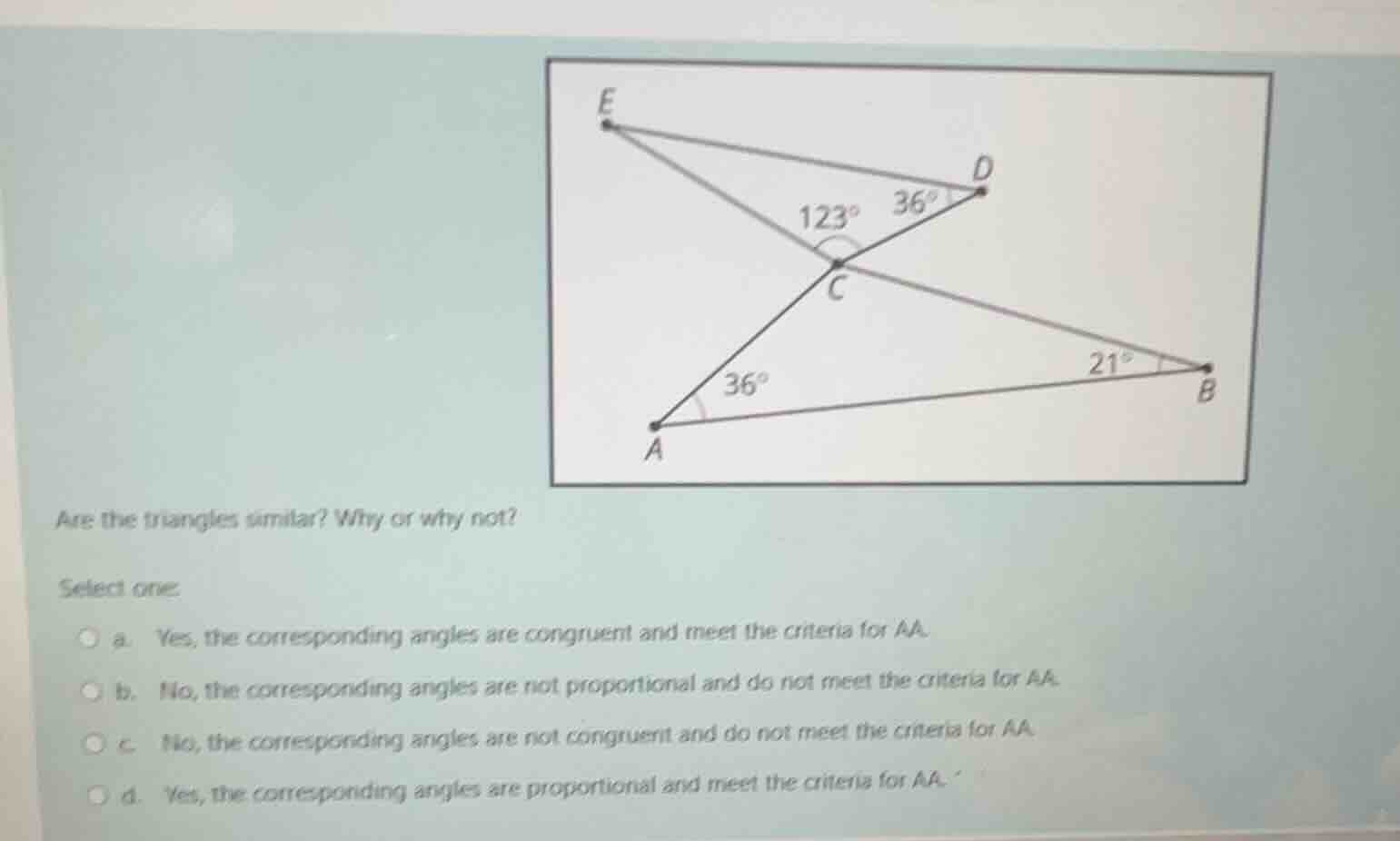
are the triangles similar? why or why not?
select one:
a. yes, the corresponding angles are congruent and meet the criteria for aa.
b. no, the corresponding angles are not proportional and do not meet the criteria for aa.
c. no, the corresponding angles are not congruent and do not meet the criteria for aa.
d. yes, the corresponding angles are proportional and meet the criteria for aa.
🆕 New Concept Discovered: Similarity Criteria for Triangles (AA)
Triangles are similar if they share two equal angles.
Step 1: Find the angles of the bottom triangle
We are given two angles in \(\triangle ABC\):
- \(\angle A = 36^\circ\)
- \(\angle B = 21^\circ\)
Since the sum of angles in any triangle is always \(180^\circ\), we can find the third angle, \(\angle ACB\):
Step 2: Find the angles of the top triangle
We are given two angles in \(\triangle CDE\):
- \(\angle ECD = 123^\circ\)
- \(\angle D = 36^\circ\)
We find the third angle, \(\angle E\):
Step 3: Compare the angles of both triangles
Let's list and pair the interior angles of \(\triangle ABC\) and \(\triangle EDC\):
- \(\angle A = 36^\circ\) and \(\angle D = 36^\circ\) (Congruent)
- \(\angle B = 21^\circ\) and \(\angle E = 21^\circ\) (Congruent)
- \(\angle ACB = 123^\circ\) and \(\angle ECD = 123^\circ\) (Congruent)
Since all three corresponding angles are equal (congruent), the triangles are similar by the Angle-Angle (AA) similarity criterion. Note that angles are "congruent" (equal in measure), whereas side lengths are "proportional". Therefore, the correct statement is that the corresponding angles are congruent.

Snap & solve any problem in the app
Get step-by-step solutions on Sovi AI
Photo-based solutions with guided steps
Explore more problems and detailed explanations
a. Yes, the corresponding angles are congruent and meet the criteria for AA.