QUESTION IMAGE
Question
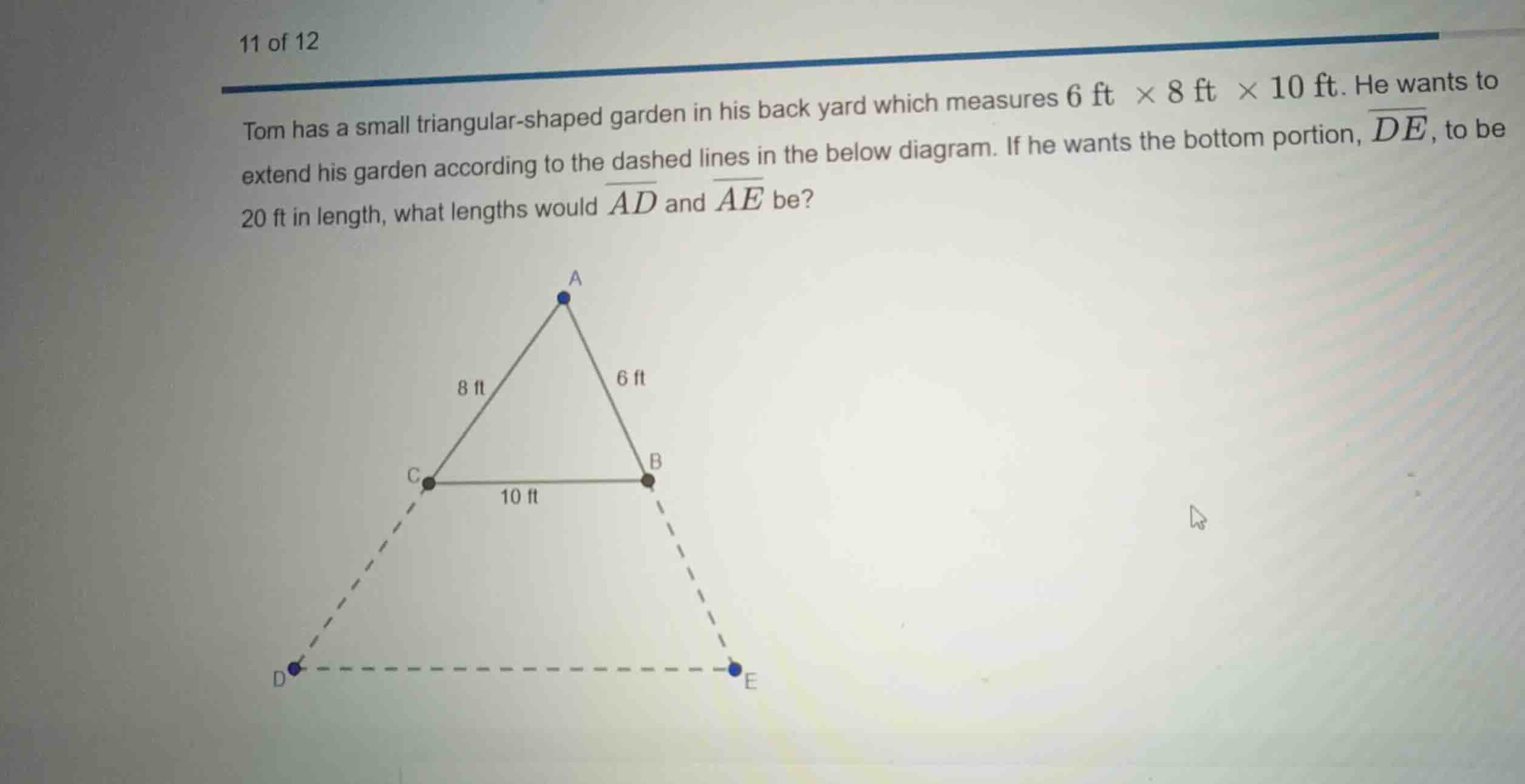
tom has a small triangular-shaped garden in his back yard which measures \\(6\text{ ft} \times 8\text{ ft} \times 10\text{ ft}\\). he wants to extend his garden according to the dashed lines in the below diagram. if he wants the bottom portion, \\(\overline{de}\\), to be \\(20\text{ ft}\\) in length, what lengths would \\(\overline{ad}\\) and \\(\overline{ae}\\) be?
Identify similar triangles
The diagram shows a smaller triangular garden \(\triangle ACB\) with side lengths \(AC = 8\text{ ft}\), \(AB = 6\text{ ft}\), and \(CB = 10\text{ ft}\). The garden is extended along the dashed lines to form a larger triangle \(\triangle ADE\). Since the bottom portion \(\overline{DE}\) is parallel to the original base \(\overline{CB}\), the corresponding angles are equal: \(\angle ADE = \angle ACB\) and \(\angle AED = \angle ABC\). Therefore, by Angle-Angle similarity, the small triangle \(\triangle ACB\) is similar to the large triangle \(\triangle ADE\):
Determine the scale factor
To find the scale factor between the two similar triangles, we compare the lengths of their corresponding bases, \(\overline{CB}\) and \(\overline{DE}\):
This means every side of the larger triangle \(\triangle ADE\) is twice the length of the corresponding side of the smaller triangle \(\triangle ACB\).
Calculate the length of AD
Using the scale factor, we find the length of the side \(\overline{AD}\) corresponding to side \(\overline{AC}\):
Calculate the length of AE
Similarly, we find the length of the side \(\overline{AE}\) corresponding to side \(\overline{AB}\):

Snap & solve any problem in the app
Get step-by-step solutions on Sovi AI
Photo-based solutions with guided steps
Explore more problems and detailed explanations
\(AD = 16\text{ ft}\) and \(AE = 12\text{ ft}\)