QUESTION IMAGE
Question
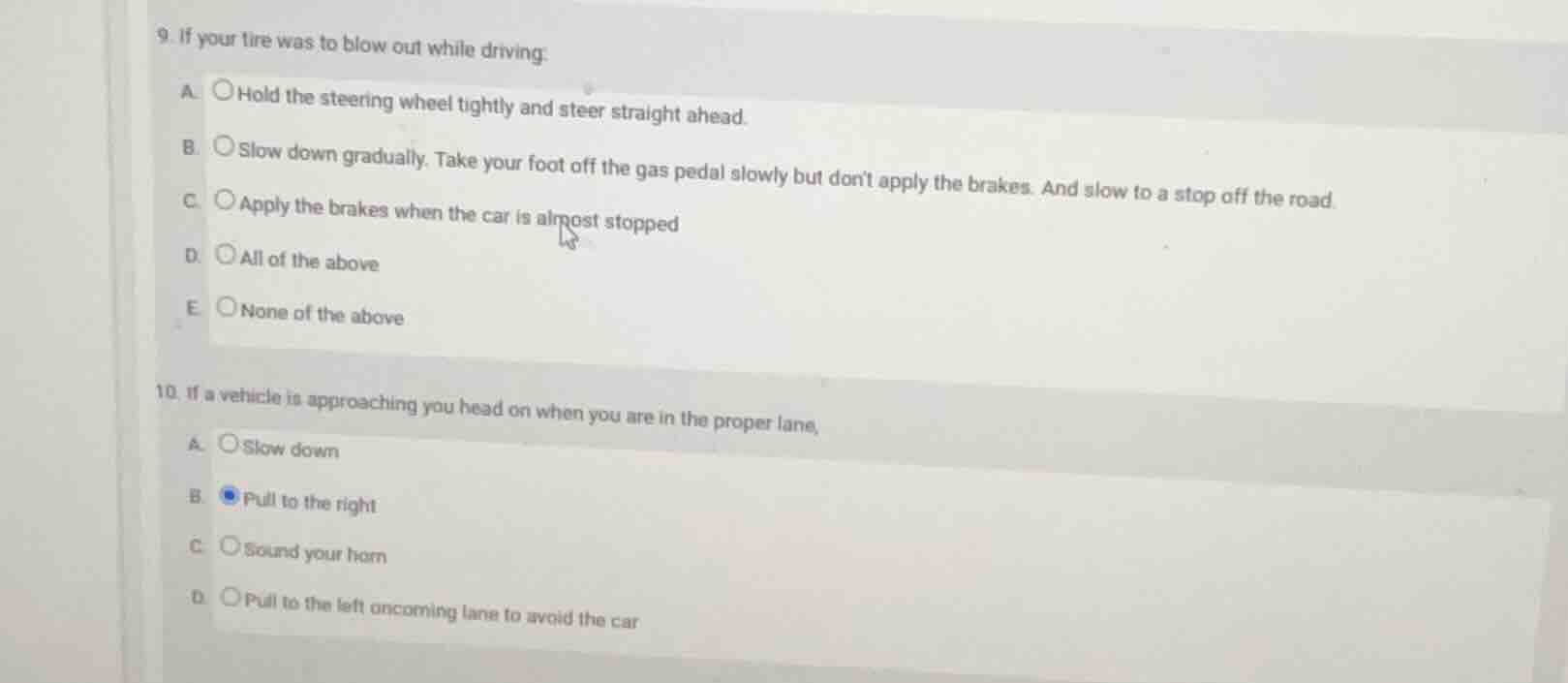
- if your tire was to blow out while driving:
a. hold the steering wheel tightly and steer straight ahead.
b. slow down gradually. take your foot off the gas pedal slowly but dont apply the brakes. and slow to a stop off the road.
c. apply the brakes when the car is almost stopped
d. all of the above
e. none of the above
- if a vehicle is approaching you head on when you are in the proper lane,
a. slow down
b. pull to the right
c. sound your horn
d. pull to the left oncoming lane to avoid the car
Analyze Question 9
This question asks for the correct procedure when a tire blows out while driving.
- Option A states: "Hold the steering wheel tightly and steer straight ahead." This is a critical first step to maintain control of the vehicle.
- Option B states: "Slow down gradually. Take your foot off the gas pedal slowly but don't apply the brakes. And slow to a stop off the road." This prevents a sudden loss of control or spin that hard braking would cause.
- Option C states: "Apply the brakes when the car is almost stopped." This is safe because the vehicle is already under control and moving very slowly.
- Since all three actions are correct and recommended safety procedures under Safe Driving Practices, Option D ("All of the above") is the correct choice.
Analyze Question 10
This question asks for the best actions to take if an oncoming vehicle is approaching you head-on while you are in your proper lane.
- Option A ("Slow down") reduces the force of any potential impact and gives more time to react.
- Option B ("Pull to the right") is the standard defensive driving maneuver because pulling to the left might lead to a collision if the oncoming driver tries to return to their lane.
- Option C ("Sound your horn") warns the oncoming driver of the danger.
- Option D ("Pull to the left oncoming lane to avoid the car") is highly dangerous and incorrect.
- Looking at the options, the image shows a selected radio button next to Option B. However, standard defensive driving guidelines (such as the DMV handbook) emphasize that you should do all of the safe actions (slowing down, pulling to the right, and sounding your horn) to avoid a head-on crash. If we must choose the single best physical steering response to avoid a head-on collision, pulling to the right (Option B) is the critical directional rule to avoid steering into the oncoming vehicle's path. Let's evaluate the standard single-answer key. Pulling to the right is the most critical steering action to avoid a head-on collision.

Snap & solve any problem in the app
Get step-by-step solutions on Sovi AI
Photo-based solutions with guided steps
Explore more problems and detailed explanations
Question 9
- (A) Hold the steering wheel tightly and steer straight ahead.
- (B) Slow down gradually. Take your foot off the gas pedal slowly but don't apply the brakes. And slow to a stop off the road.
- (C) Apply the brakes when the car is almost stopped
- (D) All of the above (Correct answer)
- (E) None of the above
Question 10
- (A) Slow down
- (B) Pull to the right (Correct answer)
- (C) Sound your horn
- (D) Pull to the left oncoming lane to avoid the car