QUESTION IMAGE
Question
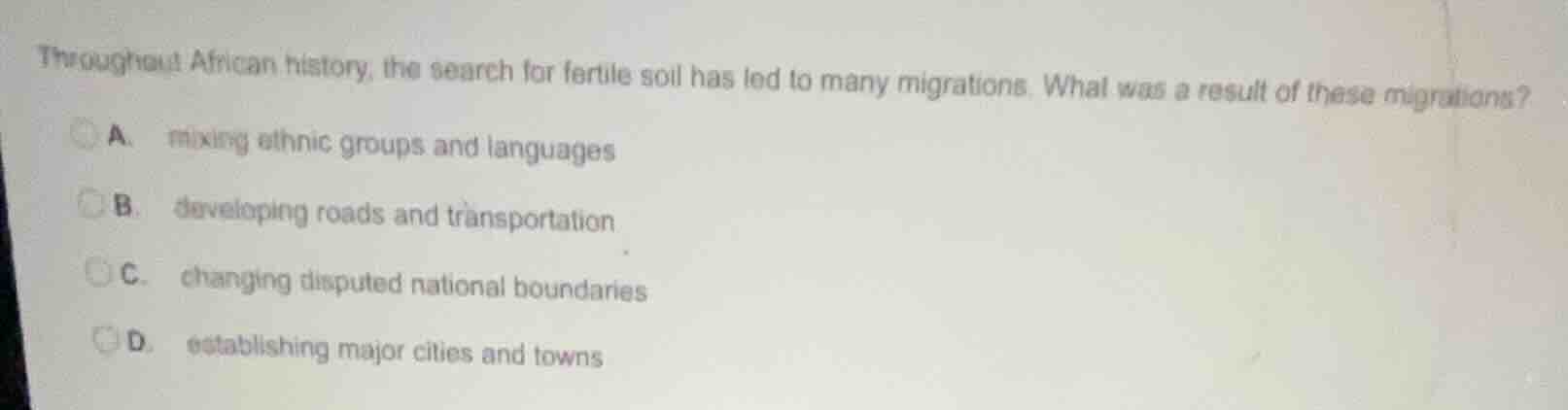
throughout african history, the search for fertile soil has led to many migrations. what was a result of these migrations?
a. mixing ethnic groups and languages
b. developing roads and transportation
c. changing disputed national boundaries
d. establishing major cities and towns
<pre_analysis>
{
"quality": "clear",
"question_count": 1,
"skills_matched": [
"direct_cot",
"multiple_choice_formatter",
"explain_then_answer",
"tutor"
],
"needs_drawing": false,
"concepts_used": [
"Historical Evidence"
],
"new_concepts": [
"Bantu Migrations",
"African History"
],
"current_concepts": [
"Historical Evidence",
"Bantu Migrations",
"African History"
]
}
</pre_analysis>
<reasoning>
Analyze the historical context of African migrations
The question refers to migrations throughout African history driven by the search for fertile soil. Historically, the most significant of these movements is the Bantu migrations, which began around 3000 BCE. As Bantu-speaking peoples migrated southward and eastward across the continent in search of arable land for agriculture, they encountered various other indigenous populations.
Evaluate the consequences of these migrations
Using Historical Evidence, we can analyze the long-term cultural and social impacts of these movements:
- As different groups migrated and settled in new areas, they interacted with existing populations.
- This interaction led to the sharing of agricultural techniques, ironworking technologies, and cultural practices.
- Crucially, it resulted in the intermarrying of different peoples and the blending of languages, which spread the Bantu language family across central, eastern, and southern Africa.
Assess the given multiple-choice options
- A. mixing ethnic groups and languages: This directly aligns with the historical outcomes of the migrations, where cultural diffusion and linguistic blending occurred.
- B. developing roads and transportation: Large-scale paved road networks were not a primary direct result of these ancient agricultural migrations.
- C. changing disputed national boundaries: Modern national boundaries in Africa were largely drawn much later during European colonization, not by ancient soil-seeking migrations.
- D. establishing major cities and towns: While settlements grew, the primary, most widespread continental impact was cultural and linguistic integration rather than urban planning.
Therefore, option A is the most accurate historical consequence.
</reasoning>
<answer>
<mcq-correct>(A) mixing ethnic groups and languages</mcq-correct>
<mcq-option>(B) developing roads and transportation</mcq-option>
<mcq-option>(C) changing disputed national boundaries</mcq-option>
<mcq-option>(D) establishing major cities and towns</mcq-option>
</answer>
<post_analysis>
{
"subject": "Social Science",
"question_type": "Multiple Choice",
"knowledge_point": [
"Social Science",
"History",
"African History"
]
}
</post_analysis>
Snap & solve any problem in the app
Get step-by-step solutions on Sovi AI
Photo-based solutions with guided steps
Explore more problems and detailed explanations
<pre_analysis>
{
"quality": "clear",
"question_count": 1,
"skills_matched": [
"direct_cot",
"multiple_choice_formatter",
"explain_then_answer",
"tutor"
],
"needs_drawing": false,
"concepts_used": [
"Historical Evidence"
],
"new_concepts": [
"Bantu Migrations",
"African History"
],
"current_concepts": [
"Historical Evidence",
"Bantu Migrations",
"African History"
]
}
</pre_analysis>
<reasoning>
Analyze the historical context of African migrations
The question refers to migrations throughout African history driven by the search for fertile soil. Historically, the most significant of these movements is the Bantu migrations, which began around 3000 BCE. As Bantu-speaking peoples migrated southward and eastward across the continent in search of arable land for agriculture, they encountered various other indigenous populations.
Evaluate the consequences of these migrations
Using Historical Evidence, we can analyze the long-term cultural and social impacts of these movements:
- As different groups migrated and settled in new areas, they interacted with existing populations.
- This interaction led to the sharing of agricultural techniques, ironworking technologies, and cultural practices.
- Crucially, it resulted in the intermarrying of different peoples and the blending of languages, which spread the Bantu language family across central, eastern, and southern Africa.
Assess the given multiple-choice options
- A. mixing ethnic groups and languages: This directly aligns with the historical outcomes of the migrations, where cultural diffusion and linguistic blending occurred.
- B. developing roads and transportation: Large-scale paved road networks were not a primary direct result of these ancient agricultural migrations.
- C. changing disputed national boundaries: Modern national boundaries in Africa were largely drawn much later during European colonization, not by ancient soil-seeking migrations.
- D. establishing major cities and towns: While settlements grew, the primary, most widespread continental impact was cultural and linguistic integration rather than urban planning.
Therefore, option A is the most accurate historical consequence.
</reasoning>
<answer>
<mcq-correct>(A) mixing ethnic groups and languages</mcq-correct>
<mcq-option>(B) developing roads and transportation</mcq-option>
<mcq-option>(C) changing disputed national boundaries</mcq-option>
<mcq-option>(D) establishing major cities and towns</mcq-option>
</answer>
<post_analysis>
{
"subject": "Social Science",
"question_type": "Multiple Choice",
"knowledge_point": [
"Social Science",
"History",
"African History"
]
}
</post_analysis>