QUESTION IMAGE
Question
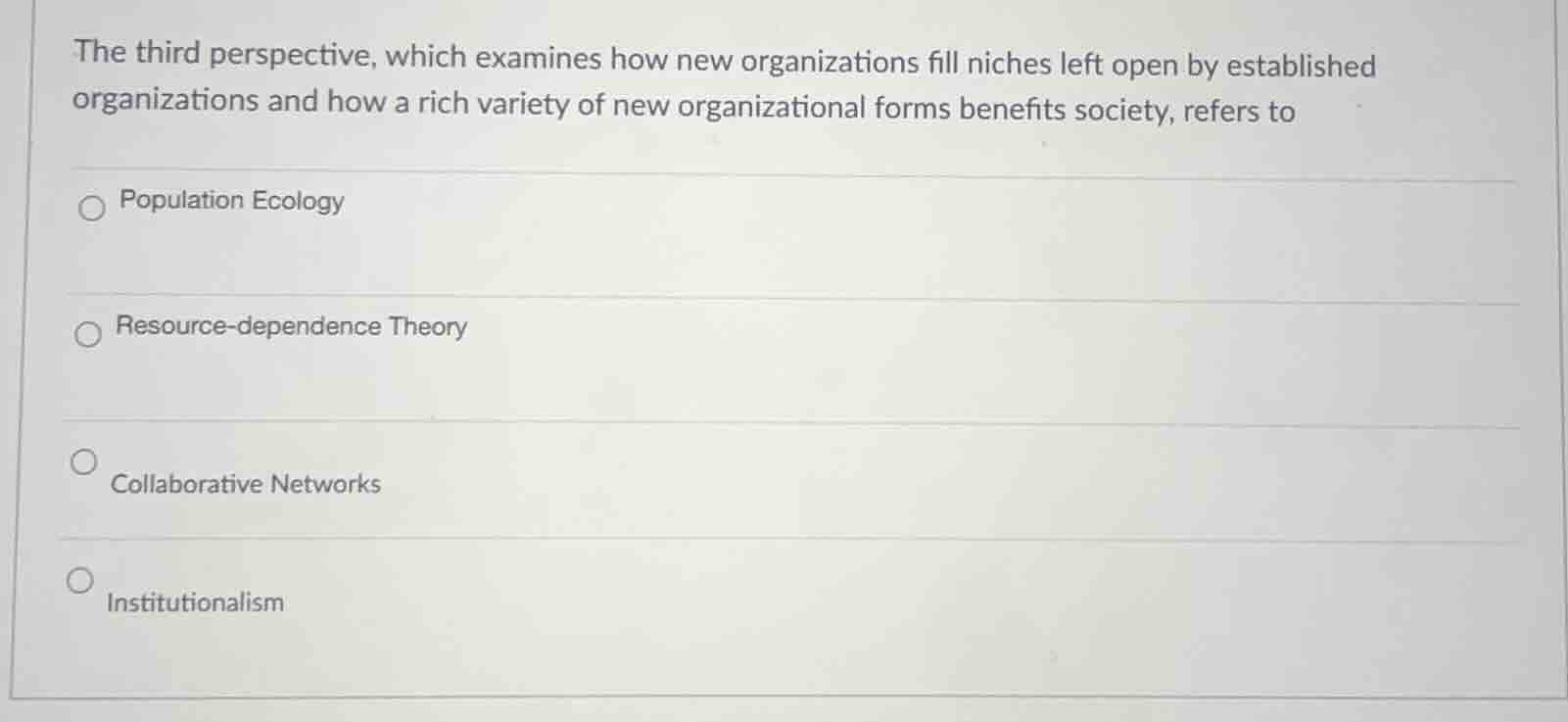
the third perspective, which examines how new organizations fill niches left open by established organizations and how a rich variety of new organizational forms benefits society, refers to
population ecology
resource-dependence theory
collaborative networks
institutionalism
🆕 New Concept Discovered: Organizational Ecosystem Perspectives
How organizations interact, compete, and survive like biological species.
Step 1: Analyze the key terms in the question
The question describes a perspective that focuses on:
- How new organizations fill niches left open by established organizations.
- How a rich variety of organizational forms benefits society.
The terms "niches" and "variety" (or diversity) are concepts borrowed directly from biology and ecology to describe populations of organizations.
Step 2: Evaluate the given options
- Population Ecology: This perspective applies biological concepts of selection, survival, and niches to populations of organizations. It explains how new organizational forms emerge to fill vacant environmental niches and how diversity in organizational forms helps the overall system adapt. This matches the definition perfectly.
- Resource-dependence Theory: This theory focuses on how individual organizations manage transactions and relationships with their environment to secure scarce resources.
- Collaborative Networks: This perspective looks at how organizations join together to share resources and achieve common goals.
- Institutionalism: This perspective explains how organizations adopt structures and practices because they are perceived as legitimate and socially acceptable, rather than purely for efficiency.
Step 3: Select the correct perspective
Based on the ecological language ("niches", "variety") and the focus on how populations of organizations change over time, the correct perspective is Population Ecology.

Snap & solve any problem in the app
Get step-by-step solutions on Sovi AI
Photo-based solutions with guided steps
Explore more problems and detailed explanations
Population Ecology