QUESTION IMAGE
Question
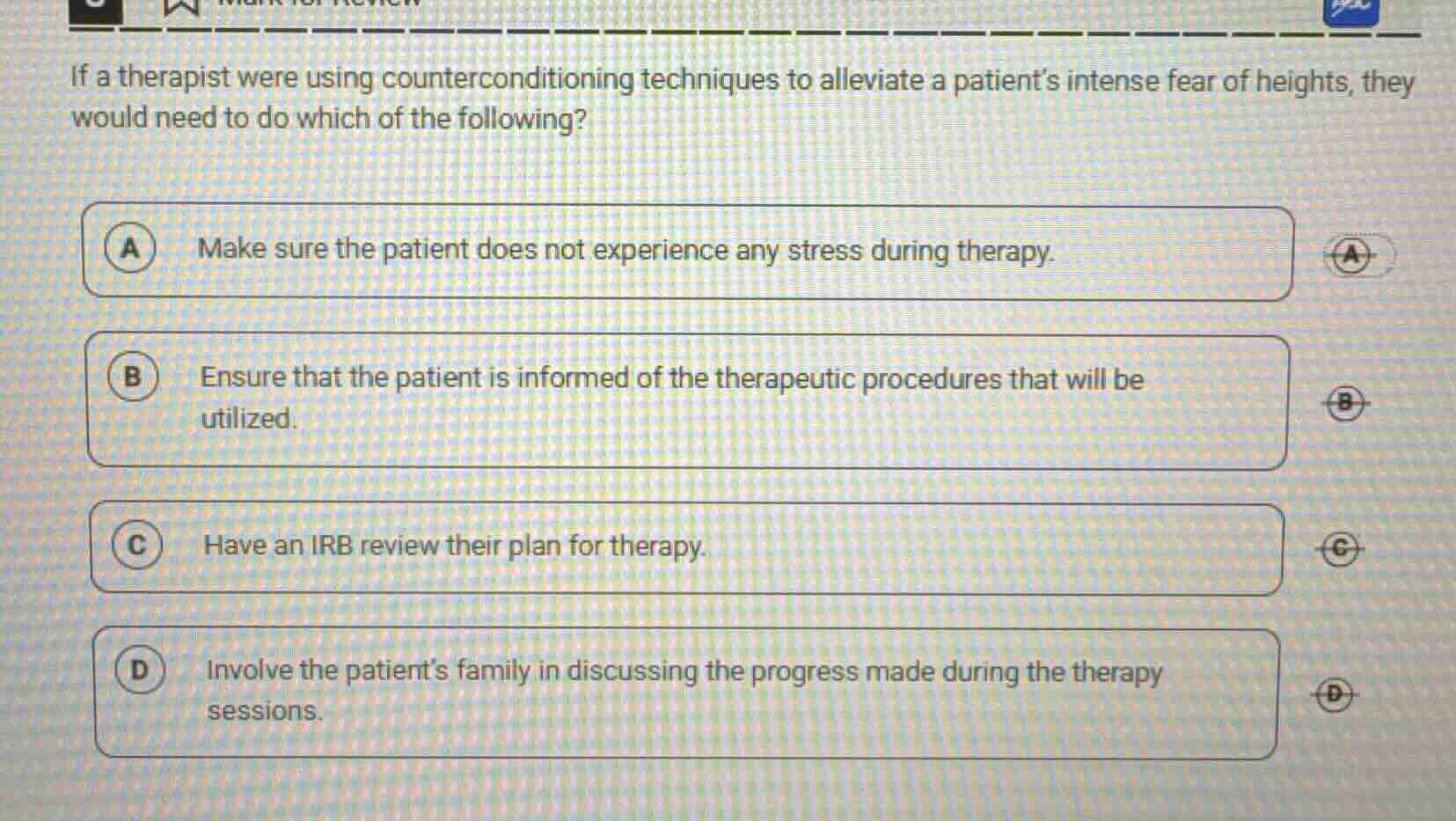
if a therapist were using counterconditioning techniques to alleviate a patient’s intense fear of heights, they would need to do which of the following?
a make sure the patient does not experience any stress during therapy.
b ensure that the patient is informed of the therapeutic procedures that will be utilized.
c have an irb review their plan for therapy.
d involve the patient’s family in discussing the progress made during the therapy sessions.
Brief Explanations
To solve this, we analyze each option:
- Option A: Counterconditioning (like systematic desensitization) involves exposing the patient to the feared stimulus (heights) in a graded way, which may involve some stress as part of the process. So avoiding all stress is incorrect.
- Option B: Informed consent is a key ethical principle in therapy. Before using counterconditioning techniques, the therapist should inform the patient about the procedures (like what exposure to heights will involve, the steps of counterconditioning) so the patient can give informed consent. This is a standard practice.
- Option C: IRB (Institutional Review Board) review is typically for research studies, not routine clinical therapy. So this is not applicable here.
- Option D: Involving the family in discussing progress is not a necessary part of counterconditioning for alleviating fear of heights. The therapy is focused on the patient's learning and conditioning, not family involvement in this context.

Snap & solve any problem in the app
Get step-by-step solutions on Sovi AI
Photo-based solutions with guided steps
Explore more problems and detailed explanations
B. Ensure that the patient is informed of the therapeutic procedures that will be utilized.