QUESTION IMAGE
Question
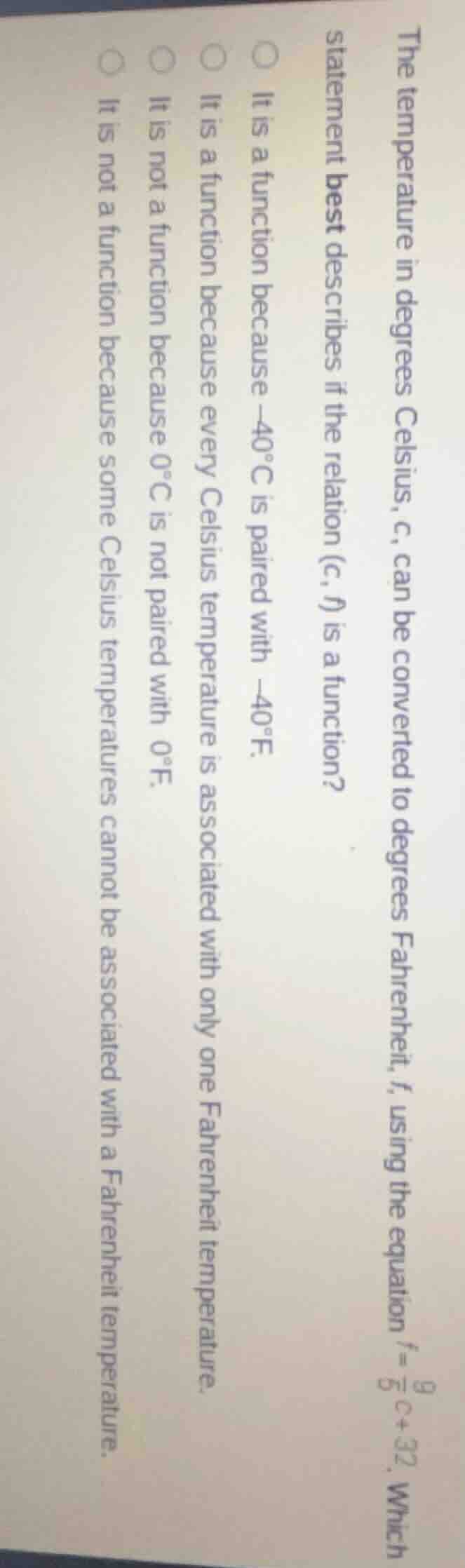
the temperature in degrees celsius, \\(c\\), can be converted to degrees fahrenheit, \\(f\\), using the equation \\(f = \frac{9}{5}c + 32\\). which statement best describes if the relation \\((c, f)\\) is a function?
- it is a function because \\(-40^\circ\text{c}\\) is paired with \\(-40^\circ\text{f}\\).
- it is a function because every celsius temperature is associated with only one fahrenheit temperature.
- it is not a function because \\(0^\circ\text{c}\\) is not paired with \\(0^\circ\text{f}\\).
- it is not a function because some celsius temperatures cannot be associated with a fahrenheit temperature.
Analyze the given relation
Using the Function Definition knowledge point
$$
f = \frac{9}{5}c + 32
$$
This equation defines a unique output \(f\) for each input \(c\).
Apply the definition of a function
Using the Function Definition knowledge point
A relation is a function if each input value maps to exactly one output value. Here, every Celsius temperature \(c\) corresponds to exactly one Fahrenheit temperature \(f\).
Evaluate the given options
Using the Function Definition knowledge point
- Option 1: Focuses on a single point \(-40^\circ\text{C}\), which does not define the entire relation.
- Option 2: Correctly states it is a function because each Celsius temperature is associated with only one Fahrenheit temperature.
- Option 3: Incorrectly claims it is not a function based on a single point.
- Option 4: Incorrectly claims it is not a function.

Snap & solve any problem in the app
Get step-by-step solutions on Sovi AI
Photo-based solutions with guided steps
Explore more problems and detailed explanations
- (A) It is a function because \(-40^\circ\text{C}\) is paired with \(-40^\circ\text{F}\).
- (B) It is a function because every Celsius temperature is associated with only one Fahrenheit temperature. (Correct answer)
- (C) It is not a function because \(0^\circ\text{C}\) is not paired with \(0^\circ\text{F}\).
- (D) It is not a function because some Celsius temperatures cannot be associated with a Fahrenheit temperature.