Sovi.AI - AI Math Tutor

Scan to solve math questions

QUESTION IMAGE

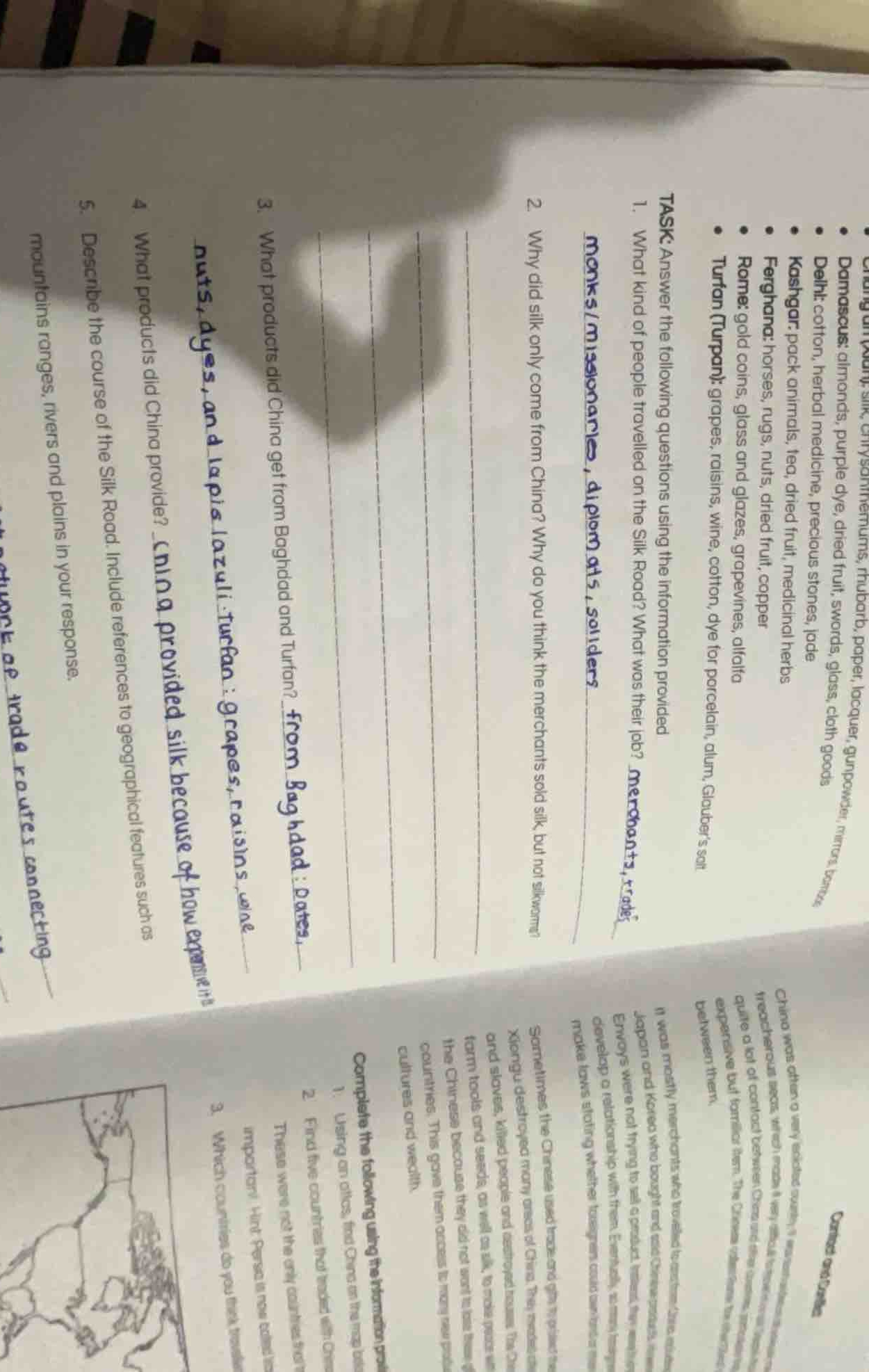
task: answer the following questions using the information provided 1. …

Question

task: answer the following questions using the information provided

  1. what kind of people travelled on the silk road? what was their job?
  2. why did silk only come from china? why do you think the merchants sold silk, but not silkworms?
  3. what products did china get from baghdad and turfan?
  4. what products did china provide?
  5. describe the course of the silk road. include references to geographical features such as mountains ranges, rivers and plains in your response.

Explanation:

Response

<pre_analysis>
{
"quality": "clear",
"question_count": 5,
"skills_matched": [
"direct_cot",
"explain_then_answer",
"tutor"
],
"needs_drawing": false,
"concepts_used": [
"Textual Analysis"
],
"new_concepts": [
"Silk Road Trade",
"Geographical Barriers",
"Ancient Commerce"
],
"current_concepts": [
"Textual Analysis",
"Silk Road Trade",
"Geographical Barriers",
"Ancient Commerce"
]
}
</pre_analysis>

<reasoning>

Analyze the travelers on the Silk Road

Using the Textual Analysis knowledge point, we examine the text and handwritten answers. The text mentions merchants, and the handwritten notes list "merchants, traders, monks/missionaries, diplomats, soldiers."

Explain the Chinese silk monopoly

The text explains China was isolated by treacherous seas and mountains. The Chinese kept the secret of silk-making protected, trading only the finished product to maintain their highly profitable monopoly.

Identify products from Baghdad and Turfan

We scan the list of cities and products:

  • Baghdad (noted in handwriting as providing dates, nuts, dyes, and lapis lazuli).
  • Turfan (listed as providing grapes, raisins, wine, cotton, dye for porcelain, alum, Glauber's salt).

Identify products provided by China

According to the text and handwritten notes, China provided silk, paper, lacquer, gunpowder, mirrors, and bronze. Silk was highly prized because of its expensive and secret production process.

Describe the course of the Silk Road

The Silk Road was a vast network of trade routes. It crossed harsh geographical features including high mountain ranges (like the Pamirs), vast deserts (like the Gobi and Taklamakan), and major rivers.
</reasoning>

<answer>

Question 1

The people who travelled on the Silk Road included merchants, traders, monks, missionaries, diplomats, and soldiers. Their jobs were to trade goods, spread religious beliefs, conduct diplomacy, and protect trade routes.

Question 2

Silk only came from China because the Chinese government kept the process of silk production (sericulture) a closely guarded secret. Merchants sold silk instead of silkworms because finished silk was highly valuable, and keeping the silkworms secret preserved China's lucrative trade monopoly.

Question 3

  • From Baghdad: Dates, nuts, dyes, and lapis lazuli.
  • From Turfan: Grapes, raisins, wine, cotton, dye for porcelain, alum, and Glauber's salt.

Question 4

China provided silk, paper, lacquer, gunpowder, mirrors, and bronze. Silk was especially prized because of its high quality, beauty, and the secrecy of its production.

Question 5

The Silk Road was a vast network of interconnected trade routes spanning thousands of miles. It traversed challenging geographical features, including formidable mountain ranges (such as the Pamir and Tian Shan mountains), treacherous deserts (such as the Gobi and Taklamakan), and major river valleys, connecting East Asia with the Mediterranean world.
</answer>

<post_analysis>
{
"subject": "Social Science",
"question_type": "Multi-part",
"knowledge_point": [
"Social Science",
"History",
"Silk Road Trade"
]
}
</post_analysis>

Answer:

<pre_analysis>
{
"quality": "clear",
"question_count": 5,
"skills_matched": [
"direct_cot",
"explain_then_answer",
"tutor"
],
"needs_drawing": false,
"concepts_used": [
"Textual Analysis"
],
"new_concepts": [
"Silk Road Trade",
"Geographical Barriers",
"Ancient Commerce"
],
"current_concepts": [
"Textual Analysis",
"Silk Road Trade",
"Geographical Barriers",
"Ancient Commerce"
]
}
</pre_analysis>

<reasoning>

Analyze the travelers on the Silk Road

Using the Textual Analysis knowledge point, we examine the text and handwritten answers. The text mentions merchants, and the handwritten notes list "merchants, traders, monks/missionaries, diplomats, soldiers."

Explain the Chinese silk monopoly

The text explains China was isolated by treacherous seas and mountains. The Chinese kept the secret of silk-making protected, trading only the finished product to maintain their highly profitable monopoly.

Identify products from Baghdad and Turfan

We scan the list of cities and products:

  • Baghdad (noted in handwriting as providing dates, nuts, dyes, and lapis lazuli).
  • Turfan (listed as providing grapes, raisins, wine, cotton, dye for porcelain, alum, Glauber's salt).

Identify products provided by China

According to the text and handwritten notes, China provided silk, paper, lacquer, gunpowder, mirrors, and bronze. Silk was highly prized because of its expensive and secret production process.

Describe the course of the Silk Road

The Silk Road was a vast network of trade routes. It crossed harsh geographical features including high mountain ranges (like the Pamirs), vast deserts (like the Gobi and Taklamakan), and major rivers.
</reasoning>

<answer>

Question 1

The people who travelled on the Silk Road included merchants, traders, monks, missionaries, diplomats, and soldiers. Their jobs were to trade goods, spread religious beliefs, conduct diplomacy, and protect trade routes.

Question 2

Silk only came from China because the Chinese government kept the process of silk production (sericulture) a closely guarded secret. Merchants sold silk instead of silkworms because finished silk was highly valuable, and keeping the silkworms secret preserved China's lucrative trade monopoly.

Question 3

  • From Baghdad: Dates, nuts, dyes, and lapis lazuli.
  • From Turfan: Grapes, raisins, wine, cotton, dye for porcelain, alum, and Glauber's salt.

Question 4

China provided silk, paper, lacquer, gunpowder, mirrors, and bronze. Silk was especially prized because of its high quality, beauty, and the secrecy of its production.

Question 5

The Silk Road was a vast network of interconnected trade routes spanning thousands of miles. It traversed challenging geographical features, including formidable mountain ranges (such as the Pamir and Tian Shan mountains), treacherous deserts (such as the Gobi and Taklamakan), and major river valleys, connecting East Asia with the Mediterranean world.
</answer>

<post_analysis>
{
"subject": "Social Science",
"question_type": "Multi-part",
"knowledge_point": [
"Social Science",
"History",
"Silk Road Trade"
]
}
</post_analysis>