QUESTION IMAGE
Question
systems of inequalities: mastery test
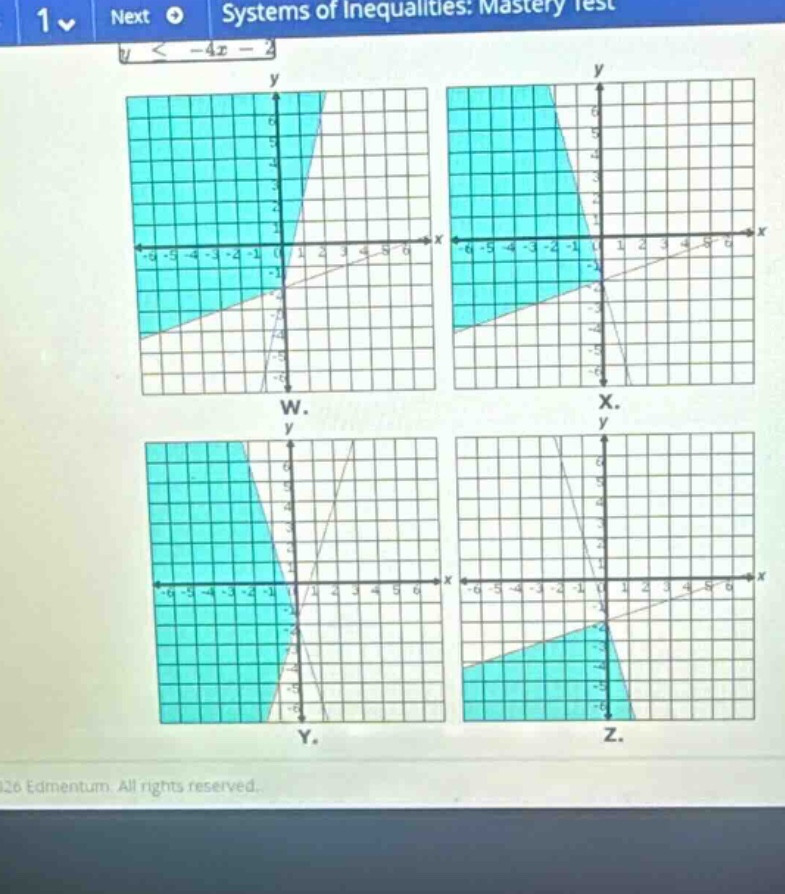
\\(y \le -4x - 2\\)
which graph represents the solution to the system of inequalities?
w.
x.
y.
z.
🆕 New Concept Discovered: Graphing Systems of Linear Inequalities
Finding where shaded regions overlap on a coordinate plane
Step 1: Identify the visible inequality
From the top of the image, one of the inequalities in the system is:
This inequality tells us two things about its boundary line:
- The \(y\)-intercept is \(-2\), meaning the line passes through \((0, -2)\).
- The slope is \(-4\), meaning the line goes down steeply from left to right (for every \(1\) unit right, it goes down \(4\) units).
Since the inequality symbol is \(\le\) (less than or equal to), the boundary line must be solid, and the shaded region must be below/to the left of this line.
Step 2: Identify the second boundary line from the graphs
All four graphs show a second boundary line. Let's find its equation by looking at its key features:
- It passes through the \(y\)-intercept at \((0, -2)\).
- It passes through the \(x\)-intercept at \((6, 0)\).
We can find the slope (\(m\)) of this second line:
So, the equation of the second boundary line is:
Step 3: Analyze the shaded regions for each option
A system of inequalities represents the region where the individual shaded areas of both inequalities overlap. Let's test a point in the shaded region for each graph to see which system it represents.
- For Graph Y:
The shaded region is to the left of both lines. Let's test the point \((-3, 0)\), which lies clearly inside the shaded region of Graph Y:
- Test in \(y \le -4x - 2\):
- Test in the second boundary line relation. Since the shaded region is above the line \(y = \frac{1}{3}x - 2\), the second inequality is likely \(y \ge \frac{1}{3}x - 2\):
Since both conditions are true, the shaded region in Graph Y represents the solution set for the system:

Snap & solve any problem in the app
Get step-by-step solutions on Sovi AI
Photo-based solutions with guided steps
Explore more problems and detailed explanations
Y