QUESTION IMAGE
Question
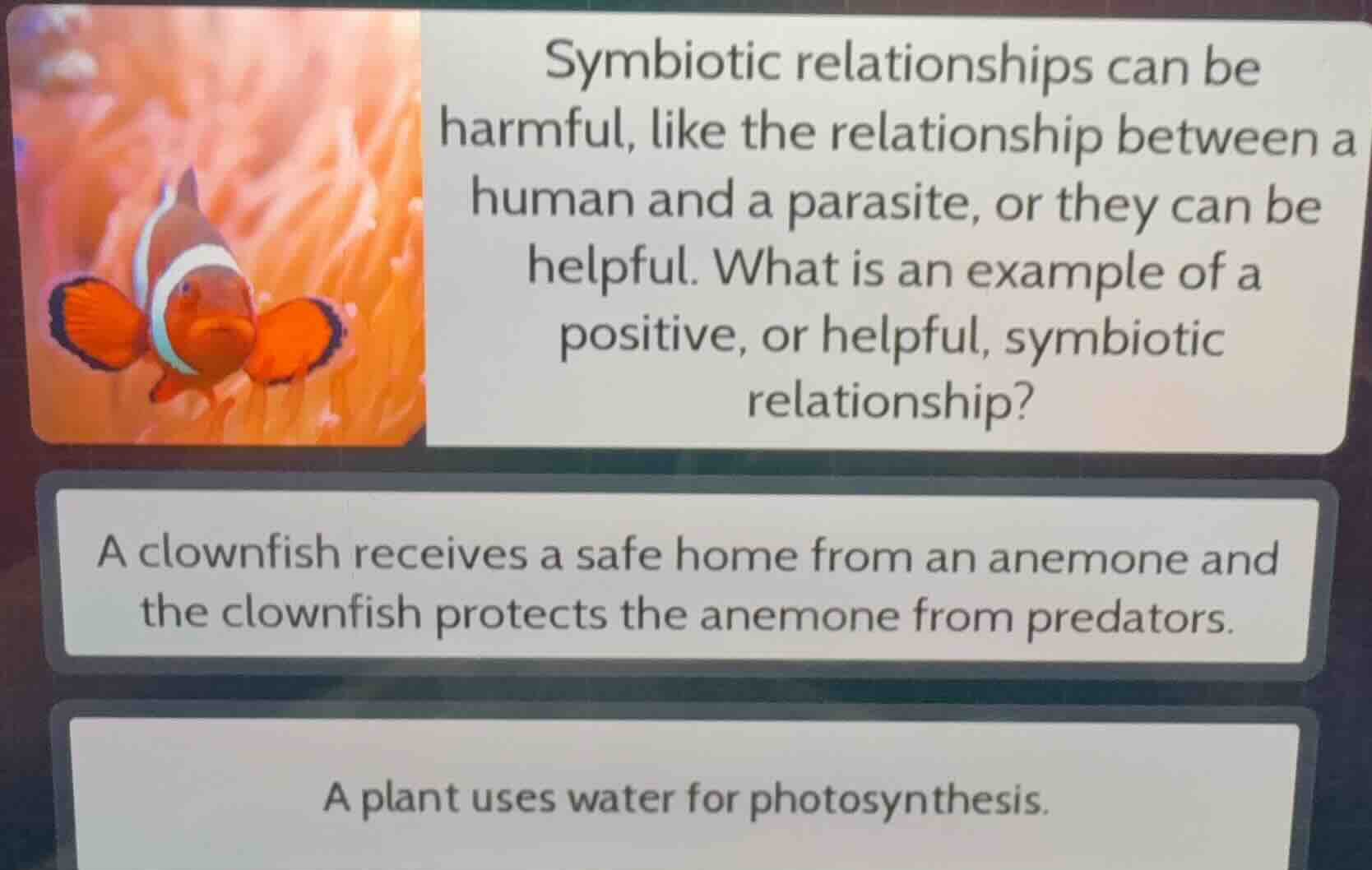
symbiotic relationships can be harmful, like the relationship between a human and a parasite, or they can be helpful. what is an example of a positive, or helpful, symbiotic relationship?
- a clownfish receives a safe home from an anemone and the clownfish protects the anemone from predators.
- a plant uses water for photosynthesis.
🆕 New Concept Discovered: Ecological Symbiotic Relationships
How different species live and interact together.
Step 1: Understand Symbiotic Relationships
A symbiotic relationship is a close, long-term interaction between two different biological species. For a relationship to be symbiotic, it must involve two living organisms.
- Positive/Helpful (Mutualism): Both species benefit from the interaction.
- Harmful (Parasitism): One species benefits while the other is harmed.
Step 2: Analyze the Options
- Option 1: "A clownfish receives a safe home from an anemone and the clownfish protects the anemone from predators."
- This involves two different living species (clownfish and anemone).
- Both organisms benefit: the clownfish gets shelter, and the anemone gets protection. This is a positive, helpful symbiotic relationship (specifically, mutualism).
- Option 2: "A plant uses water for photosynthesis."
- This describes an organism interacting with an abiotic (non-living) resource (water). Because water is not a living organism, this is not a symbiotic relationship between species.

Snap & solve any problem in the app
Get step-by-step solutions on Sovi AI
Photo-based solutions with guided steps
Explore more problems and detailed explanations
A clownfish receives a safe home from an anemone and the clownfish protects the anemone from predators.