QUESTION IMAGE
Question
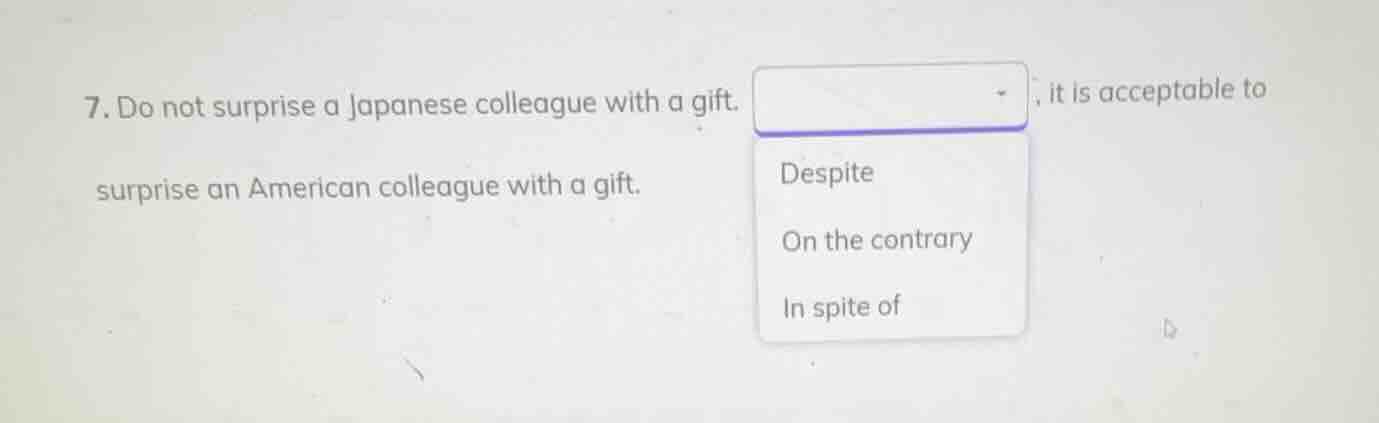
- do not surprise a japanese colleague with a gift. dropdown, it is acceptable to surprise an american colleague with a gift.
options in dropdown:
despite
on the contrary
in spite of
🆕 New Concept Discovered: Contrast Connectors
Linking opposing ideas using correct grammatical structures
Step 1: Analyze the sentence structure
The text consists of two complete independent clauses separated by a punctuation mark and a transition word:
- "Do not surprise a Japanese colleague with a gift." (Independent clause)
- "[Transition], it is acceptable to surprise an American colleague with a gift." (Independent clause)
Because the transition word starts a new independent clause followed by a comma, we need a conjunctive adverb (transition word) that can connect two independent sentences showing contrast.
Step 2: Evaluate the grammatical rules for each option
- "Despite" and "In spite of" are prepositions. They must be followed by a noun, pronoun, or gerund (e.g., "Despite the difference..." or "In spite of being different..."). They cannot directly introduce a new independent clause with a comma in this position.
- "On the contrary" is a transitional phrase (conjunctive adverb) used to connect two independent ideas, showing a direct contrast or contradiction between the first statement and the second statement. It is grammatically correct to place it at the beginning of the second sentence followed by a comma.
Step 3: Verify the meaning
The first sentence states a negative rule ("Do not surprise..."), while the second sentence presents the opposite, positive rule ("it is acceptable to surprise..."). "On the contrary" perfectly highlights this direct opposition between the two cultural norms.

Snap & solve any problem in the app
Get step-by-step solutions on Sovi AI
Photo-based solutions with guided steps
Explore more problems and detailed explanations
On the contrary