QUESTION IMAGE
Question
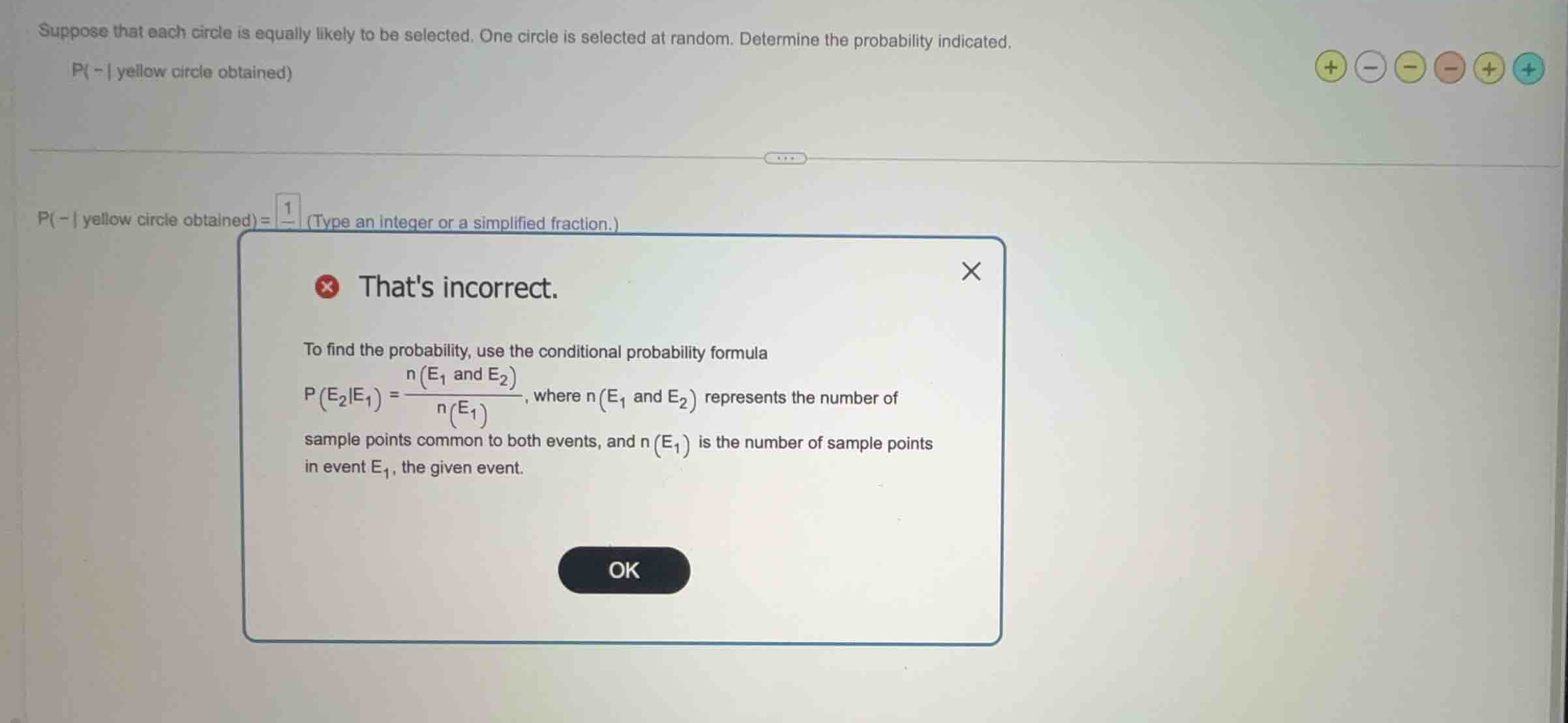
suppose that each circle is equally likely to be selected. one circle is selected at random. determine the probability indicated.
\\(p(-\mid \text{yellow circle obtained})\\)
Identify the sample space and given condition
Using the Conditional Probability knowledge point
- Total circles shown in the top right: 6 circles.
- The circles are:
- Yellow with a plus sign: 2 circles
- Yellow with a minus sign: 2 circles
- Blue with a plus sign: 2 circles
- Given condition \(E_1\): "yellow circle obtained".
- Number of yellow circles, \(n(E_1) = 4\).
Identify the target event
Using the Conditional Probability knowledge point
- Target event \(E_2\): "minus sign obtained" (indicated by the minus sign in the numerator-like position \(P(-\,|\,\text{yellow circle obtained})\)).
- We need to find the number of circles that are both yellow and have a minus sign: \(n(E_1 \text{ and } E_2)\).
- Looking at the yellow circles, 2 of them have a minus sign: \(n(E_1 \text{ and } E_2) = 2\).
Calculate the conditional probability
Using the Conditional Probability knowledge point
$$
P(-\,|\,\text{yellow circle obtained}) = \frac{n(E_1 \text{ and } E_2)}{n(E_1)} = \frac{2}{4}
$$
Simplify the fraction
Using the Fraction Simplification knowledge point
$$
\frac{2}{4} = \frac{1}{2}
$$

Snap & solve any problem in the app
Get step-by-step solutions on Sovi AI
Photo-based solutions with guided steps
Explore more problems and detailed explanations
Suppose that each circle is equally likely to be selected. One circle is selected at random. Determine the probability indicated.
\(P(-\,|\,\text{yellow circle obtained}) =\) <blank>\(\frac{1}{2}\)</blank>