QUESTION IMAGE
Question
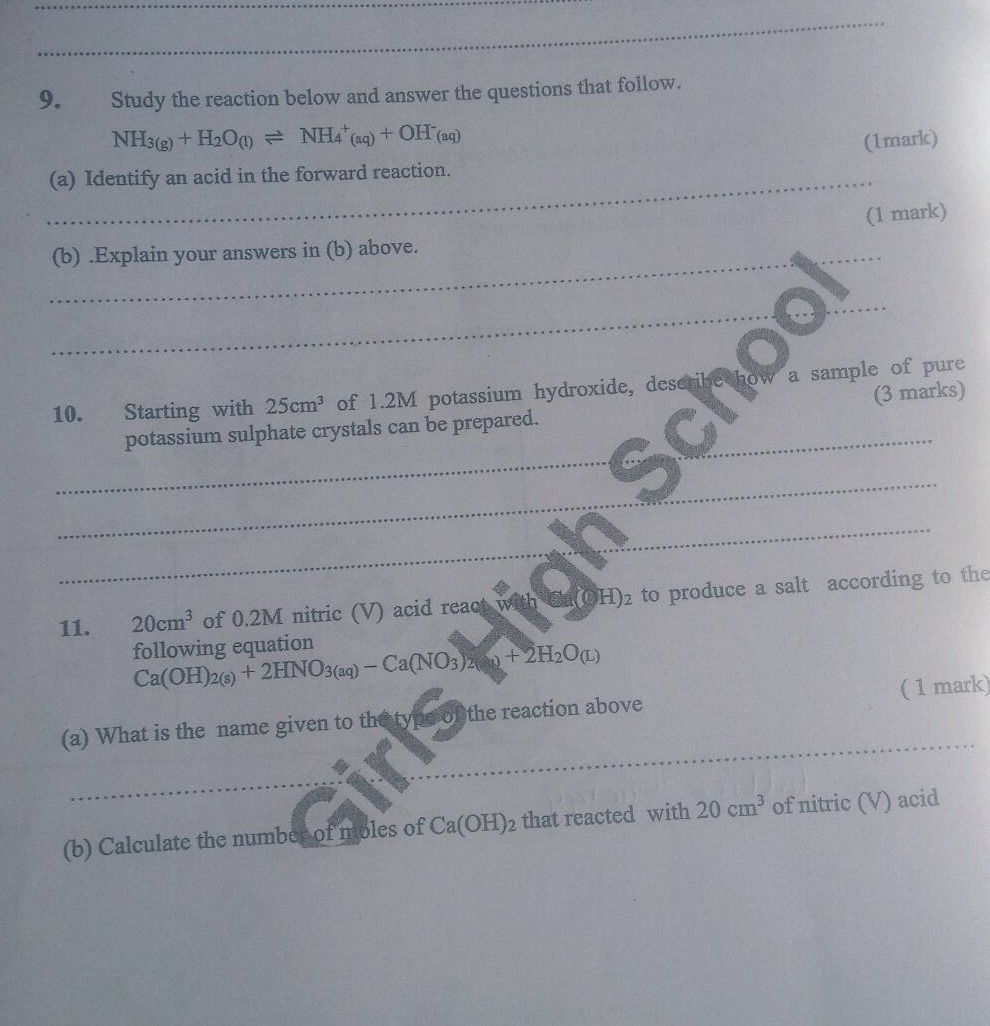
- study the reaction below and answer the questions that follow.
\\(\text{nh}_{3(\text{g})} + \text{h}_2\text{o}_{(\text{l})} \
ightleftharpoons \text{nh}_{4(\text{aq})}^+ + \text{oh}_{(\text{aq})}^-\\)
(a) identify an acid in the forward reaction. (1 mark)
(b) explain your answers in (b) above. (1 mark)
- starting with \\(25\text{ cm}^3\\) of \\(1.2\text{m}\\) potassium hydroxide, describe how a sample of pure potassium sulphate crystals can be prepared. (3 marks)
- \\(20\text{ cm}^3\\) of \\(0.2\text{m}\\) nitric (v) acid react with \\(\text{ca(oh)}_2\\) to produce a salt according to the following equation
\\(\text{ca(oh)}_{2(\text{s})} + 2\text{hno}_{3(\text{aq})} \
ightarrow \text{ca(no}_3)_{2(\text{aq})} + 2\text{h}_2\text{o}_{(\text{l})}\\)
(a) what is the name given to the type of the reaction above (1 mark)
(b) calculate the number of moles of \\(\text{ca(oh)}_2\\) that reacted with \\(20\text{ cm}^3\\) of nitric (v) acid
🆕 New Concept Discovered: Brønsted-Lowry Acid-Base Theory
Acids donate protons, bases accept them
Step 1: Identify the acid in the forward reaction (9a)
According to the Brønsted-Lowry theory, an acid is a substance that donates a proton (\(\text{H}^+\)) to another substance.
Looking at the forward reaction:
- \(\text{H}_2\text{O}\) loses a hydrogen ion (\(\text{H}^+\)) to become \(\text{OH}^-\).
- \(\text{NH}_3\) gains a hydrogen ion (\(\text{H}^+\)) to become \(\text{NH}_4^+\).
Since \(\text{H}_2\text{O}\) donates the proton, it acts as the acid in the forward reaction.
Step 2: Explain the choice of acid (9b)
An acid is defined as a proton (\(\text{H}^+\)) donor. In this reaction, water (\(\text{H}_2\text{O}\)) donates a proton (\(\text{H}^+\)) to the ammonia molecule (\(\text{NH}_3\)) to form the ammonium ion (\(\text{NH}_4^+\)) and a hydroxide ion (\(\text{OH}^-\)).
---
Step 3: Describe the preparation of potassium sulphate crystals (10)
To prepare pure crystals of a soluble salt like potassium sulphate (\(\text{K}_2\text{SO}_4\)) from a soluble base (potassium hydroxide, \(\text{KOH}\)) and an acid (dilute sulfuric acid, \(\text{H}_2\text{SO}_4\)), we use the titration method:
- Titration to find exact volumes: Pipette \(25\text{ cm}^3\) of \(1.2\text{ M}\) \(\text{KOH}\) into a conical flask. Add a few drops of an indicator (such as phenolphthalein). Titrate with dilute sulfuric acid (\(\text{H}_2\text{SO}_4\)) from a burette until the indicator changes color (from pink to colorless), and record the volume of acid used.
- Preparation of salt solution without indicator: Repeat the procedure using the same volumes of \(1.2\text{ M}\) \(\text{KOH}\) and dilute \(\text{H}_2\text{SO}_4\), but without adding the indicator to ensure the final salt is pure and uncontaminated.
- Crystallization: Heat the resulting neutral mixture in an evaporating dish to concentrate it (until the crystallization point is reached). Allow the hot saturated solution to cool slowly so that potassium sulphate crystals form.
- Isolation and drying: Filter off the crystals, wash them with a small amount of cold distilled water to remove any surface impurities, and dry them between pieces of filter paper.
---
Step 4: Identify the type of reaction (11a)
The reaction is:
This is a reaction between a base (\(\text{Ca(OH)}_2\)) and an acid (\(\text{HNO}_3\)) to produce a salt (\(\text{Ca(NO}_3)_2\)) and water (\(\text{H}_2\text{O}\)). This type of reaction is called a neutralization reaction.
---
Step 5: Calculate the moles of nitric acid (11b)
First, calculate the number of moles of nitric(V) acid (\(\text{HNO}_3\)) used:
---
Step 6: Calculate the moles of calcium hydroxide reacted (11b continued)
From the balanced chemical equation:
Therefore, the mole ratio of \(\text{Ca(OH)}_2 : \text{HNO}_3\) is \(1 : 2\).
\[ \text{Moles of…

Snap & solve any problem in the app
Get step-by-step solutions on Sovi AI
Photo-based solutions with guided steps
Explore more problems and detailed explanations
9.
- (a) \(\text{H}_2\text{O}_{(\text{l})}\) (Water)
- (b) Water acts as a proton (\(\text{H}^+\)) donor, donating an \(\text{H}^+\) ion to \(\text{NH}_3\) to form \(\text{NH}_4^+\).
10.
- Titrate \(25\text{ cm}^3\) of \(1.2\text{ M}\) \(\text{KOH}\) with dilute sulfuric acid (\(\text{H}_2\text{SO}_4\)) using phenolphthalein indicator to determine the exact volume of acid required for complete neutralization.
- Mix the same volume of \(\text{KOH}\) and the determined volume of \(\text{H}_2\text{SO}_4\) without adding any indicator.
- Heat the resulting solution to concentrate it, then leave it to cool so that potassium sulphate crystals form.
- Filter the crystals, rinse them with a small amount of cold distilled water, and dry them between filter papers.
11.
- (a) Neutralization reaction
- (b) \(0.002\text{ moles}\)