QUESTION IMAGE
Question
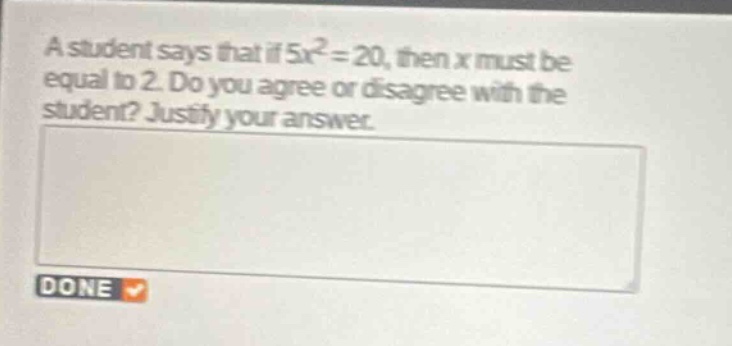
a student says that if (5x^2 = 20), then (x) must be equal to 2. do you agree or disagree with the student? justify your answer.
🆕 New Concept Discovered: Solving Quadratic Equations by Finding Square Roots
When taking a square root to solve an equation, always consider both positive and negative values.
Step 1: Isolate the squared term
To find the value of \(x\), we first isolate the \(x^2\) term by dividing both sides of the equation by \(5\):
Step 2: Solve for x by taking the square root
When we take the square root of both sides of an equation to solve for \(x\), we must account for both the positive and negative roots. This is because both a positive number and its negative counterpart yield the same positive result when squared:
Step 3: Evaluate the student's claim
The student claims that \(x\) must be equal to \(2\). While \(2\) is indeed a valid solution, it is not the only possible solution. Because \(x = -2\) is also a solution (since \(5(-2)^2 = 5(4) = 20\)), the student's statement is incorrect because it overlooks the negative root.

Snap & solve any problem in the app
Get step-by-step solutions on Sovi AI
Photo-based solutions with guided steps
Explore more problems and detailed explanations
Disagree. While \(x = 2\) is a solution, it is not the only solution. Solving \(5x^2 = 20\) gives \(x^2 = 4\), which has two solutions: \(x = 2\) and \(x = -2\). Therefore, \(x\) does not must be equal to \(2\).