Sovi.AI - AI Math Tutor

Scan to solve math questions

QUESTION IMAGE

state what postulate proves that the two triangles are congruent. if no…

Question

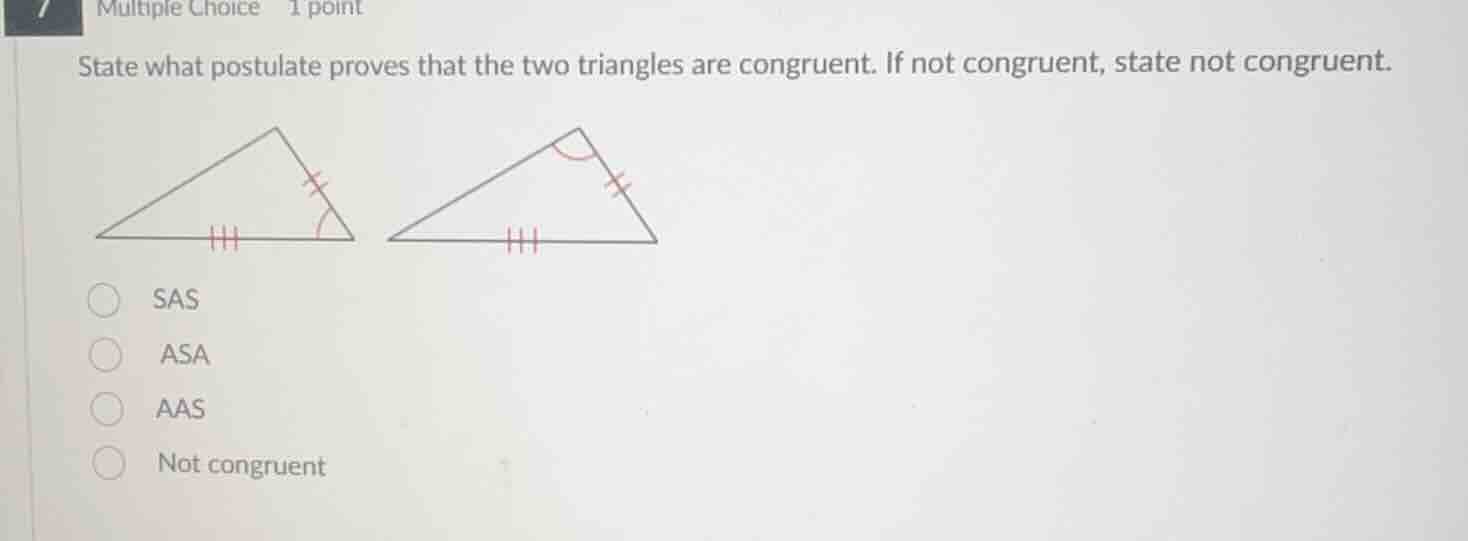
state what postulate proves that the two triangles are congruent. if not congruent, state not congruent.

sas
asa
aas
not congruent

Explanation:

Response

<pre_analysis>
{
"quality": "clear",
"question_count": 1,
"skills_matched": [
"direct_cot",
"multiple_choice_formatter",
"explain_then_answer",
"tutor"
],
"needs_drawing": false,
"concepts_used": [],
"new_concepts": [
"Triangle Congruence Postulates",
"SAS Congruence",
"SSA Ambiguity"
],
"current_concepts": [
"Triangle Congruence Postulates",
"SAS Congruence",
"SSA Ambiguity"
]
}
</pre_analysis>

<reasoning>

Analyze the markings on the first triangle

The first triangle has:

  • A side marked with two tick marks.
  • An adjacent angle marked with an arc.
  • A side marked with three tick marks adjacent to that angle.

This represents a Side-Angle-Side (SAS) configuration where the angle is included between the two marked sides.

Analyze the markings on the second triangle

The second triangle has:

  • A side marked with two tick marks.
  • An angle marked with an arc that is NOT between the two marked sides.
  • A side marked with three tick marks.

This represents a Side-Side-Angle (SSA) configuration.

Compare the configurations

For two triangles to be congruent by a postulate, their corresponding marked parts must match the same postulate structure.

  • The first triangle has the marked angle included between the two marked sides (SAS).
  • The second triangle has the marked angle opposite to one of the marked sides (SSA).
  • Since the corresponding parts do not share the same relative positions, we cannot prove congruence.
  • Furthermore, SSA (Side-Side-Angle) is not a valid congruence postulate.

Determine the final conclusion

Because the marked parts do not correspond in a way that satisfies any valid congruence postulate (such as SAS, ASA, AAS, or SSS), the triangles cannot be proven congruent.
Thus, the correct choice is "Not congruent".
</reasoning>

<answer>
<mcq-option>(A) SAS</mcq-option>
<mcq-option>(B) ASA</mcq-option>
<mcq-option>(C) AAS</mcq-option>
<mcq-correct>(D) Not congruent</mcq-correct>
</answer>

<post_analysis>
{
"subject": "Mathematics",
"question_type": "Multiple Choice",
"knowledge_point": [
"Mathematics",
"Geometry",
"Triangle Congruence Postulates"
]
}
</post_analysis>

Answer:

<pre_analysis>
{
"quality": "clear",
"question_count": 1,
"skills_matched": [
"direct_cot",
"multiple_choice_formatter",
"explain_then_answer",
"tutor"
],
"needs_drawing": false,
"concepts_used": [],
"new_concepts": [
"Triangle Congruence Postulates",
"SAS Congruence",
"SSA Ambiguity"
],
"current_concepts": [
"Triangle Congruence Postulates",
"SAS Congruence",
"SSA Ambiguity"
]
}
</pre_analysis>

<reasoning>

Analyze the markings on the first triangle

The first triangle has:

  • A side marked with two tick marks.
  • An adjacent angle marked with an arc.
  • A side marked with three tick marks adjacent to that angle.

This represents a Side-Angle-Side (SAS) configuration where the angle is included between the two marked sides.

Analyze the markings on the second triangle

The second triangle has:

  • A side marked with two tick marks.
  • An angle marked with an arc that is NOT between the two marked sides.
  • A side marked with three tick marks.

This represents a Side-Side-Angle (SSA) configuration.

Compare the configurations

For two triangles to be congruent by a postulate, their corresponding marked parts must match the same postulate structure.

  • The first triangle has the marked angle included between the two marked sides (SAS).
  • The second triangle has the marked angle opposite to one of the marked sides (SSA).
  • Since the corresponding parts do not share the same relative positions, we cannot prove congruence.
  • Furthermore, SSA (Side-Side-Angle) is not a valid congruence postulate.

Determine the final conclusion

Because the marked parts do not correspond in a way that satisfies any valid congruence postulate (such as SAS, ASA, AAS, or SSS), the triangles cannot be proven congruent.
Thus, the correct choice is "Not congruent".
</reasoning>

<answer>
<mcq-option>(A) SAS</mcq-option>
<mcq-option>(B) ASA</mcq-option>
<mcq-option>(C) AAS</mcq-option>
<mcq-correct>(D) Not congruent</mcq-correct>
</answer>

<post_analysis>
{
"subject": "Mathematics",
"question_type": "Multiple Choice",
"knowledge_point": [
"Mathematics",
"Geometry",
"Triangle Congruence Postulates"
]
}
</post_analysis>