QUESTION IMAGE
Question
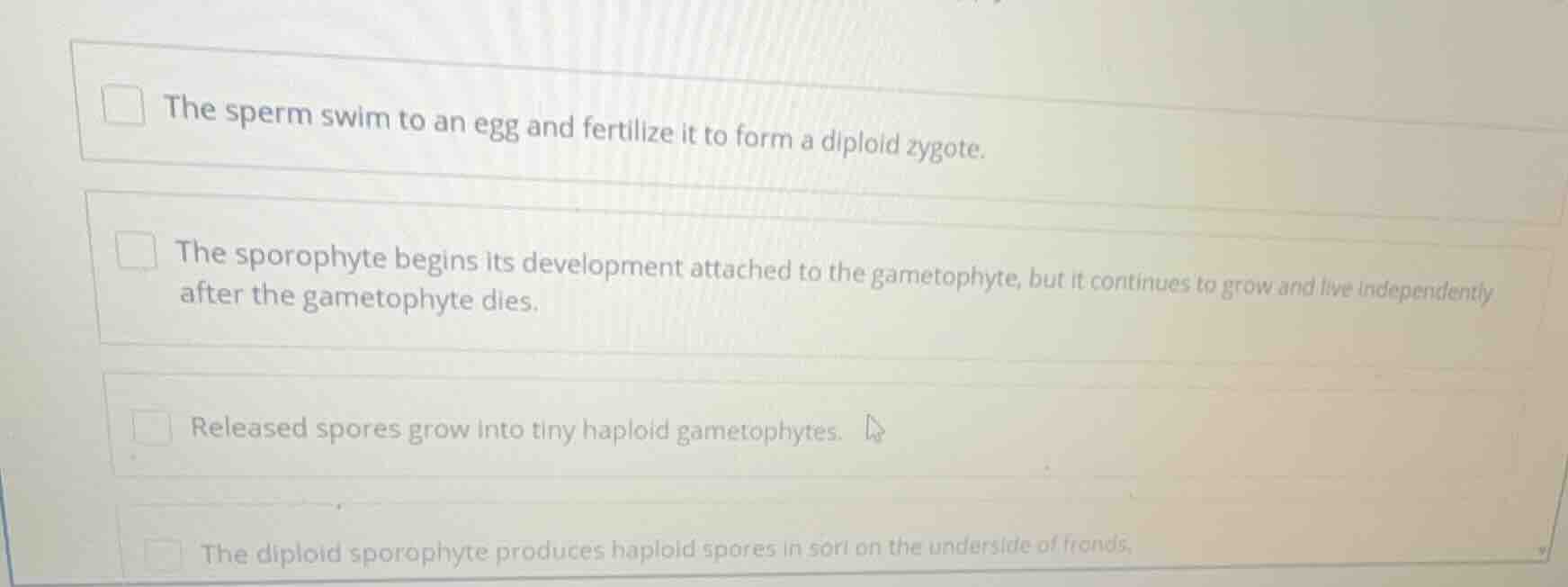
the sperm swim to an egg and fertilize it to form a diploid zygote.
the sporophyte begins its development attached to the gametophyte, but it continues to grow and live independently after the gametophyte dies.
released spores grow into tiny haploid gametophytes.
the diploid sporophyte produces haploid spores in sori on the underside of fronds.
Identify the plant group
The options describe a life cycle with flagellated sperm swimming to an egg, a sporophyte that starts attached to the gametophyte but becomes independent, spores produced in sori on the underside of fronds, and spores growing into tiny haploid gametophytes. The presence of "fronds" and "sori" specifically identifies this organism as a fern (pteridophyte).
Analyze the role of water in fertilization
Ferns are seedless vascular plants. Like bryophytes, they have flagellated sperm that require a film of external water to swim from the antheridium to the archegonium to fertilize the egg. This makes water a critical environmental requirement for their sexual reproduction.
Evaluate the given options
We look for the statement that explains why these plants are restricted to moist environments:
- The first option, "The sperm swim to an egg and fertilize it to form a diploid zygote," directly highlights the requirement of water for fertilization. Without moisture, the flagellated sperm cannot reach the egg, preventing reproduction.
- The other options describe development, spore dispersal, and spore production, which do not directly explain the strict requirement for wet/moist habitats for fertilization.
Connect to mastered concepts
Using the Plant Life Cycles and Sporophyte and Gametophyte knowledge points, we know that seedless plants rely on water for flagellated sperm transport, which limits their active reproduction to damp habitats.

Snap & solve any problem in the app
Get step-by-step solutions on Sovi AI
Photo-based solutions with guided steps
Explore more problems and detailed explanations
- (A) The sperm swim to an egg and fertilize it to form a diploid zygote. (Correct answer)
- (B) The sporophyte begins its development attached to the gametophyte, but it continues to grow and live independently after the gametophyte dies.
- (C) Released spores grow into tiny haploid gametophytes.
- (D) The diploid sporophyte produces haploid spores in sori on the underside of fronds.