QUESTION IMAGE
Question
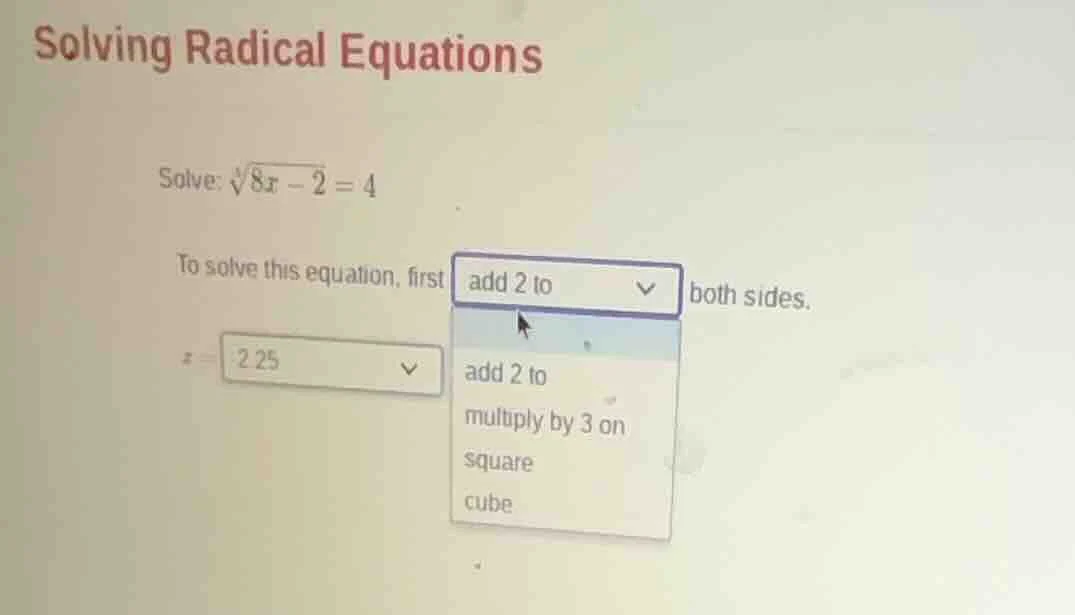
solving radical equations
solve: $sqrt3{8x - 2} = 4$
to solve this equation, first add 2 to both sides.
$x =$ 2.25
options for first step: add 2 to, multiply by 3 on, square, cube
Step1: Analyze the radical equation
We have the equation \(\sqrt[3]{8x}-2 = 4\). To isolate the radical term, we need to get rid of the \(- 2\) on the left - hand side. The inverse operation of subtraction is addition, so we should add 2 to both sides of the equation.
After adding 2 to both sides, the equation becomes \(\sqrt[3]{8x}-2 + 2=4 + 2\), which simplifies to \(\sqrt[3]{8x}=6\).
Step2: Cube both sides to eliminate the cube root
Now that we have \(\sqrt[3]{8x}=6\), we cube both sides of the equation. Cubing the left - hand side, \((\sqrt[3]{8x})^3 = 8x\), and cubing the right - hand side, \(6^3=216\). So we get the equation \(8x = 216\).
Step3: Solve for x
To solve for \(x\), we divide both sides of the equation \(8x = 216\) by 8. \(x=\frac{216}{8}=27\)? Wait, there is a mistake in the initial thought. Wait, let's re - do the steps correctly.
Wait, the original equation is \(\sqrt[3]{8x}-2 = 4\).
Step 1: Add 2 to both sides: \(\sqrt[3]{8x}-2 + 2=4 + 2\), so \(\sqrt[3]{8x}=6\).
Step 2: Cube both sides: \((\sqrt[3]{8x})^3=6^3\), so \(8x = 216\).
Step 3: Divide both sides by 8: \(x=\frac{216}{8} = 27\). But the given option has 2.25, which is wrong. Wait, maybe the original equation is \(\sqrt[3]{8x - 2}=4\) (the user's equation in the image is \(\sqrt[3]{8x - 2}=4\)). Let's solve that.
Equation: \(\sqrt[3]{8x - 2}=4\)
Step 1: Cube both sides to eliminate the cube root. Cubing both sides, we get \((\sqrt[3]{8x - 2})^3=4^3\)
Step 2: Simplify both sides. The left - hand side simplifies to \(8x-2\), and the right - hand side is \(64\). So \(8x-2 = 64\)
Step 3: Add 2 to both sides: \(8x-2 + 2=64 + 2\), so \(8x=66\)
Step 4: Divide both sides by 8: \(x=\frac{66}{8}=8.25\)? No, wait \(4^3 = 64\), \(8x-2=64\), \(8x=64 + 2=66\), \(x=\frac{66}{8}=8.25\). But the given option has 2.25, which is incorrect. Wait, maybe the equation is \(\sqrt[3]{8x}-2 = 1\)? No, the user's equation is \(\sqrt[3]{8x - 2}=4\). Let's check the steps again.
If the equation is \(\sqrt[3]{8x - 2}=4\)
Cube both sides: \(8x-2=64\)
Add 2: \(8x=66\)
\(x=\frac{66}{8} = 8.25\). If the equation is \(\sqrt[3]{8x}-2 = 1\), then \(\sqrt[3]{8x}=3\), \(8x = 27\), \(x=\frac{27}{8}=3.375\). If the equation is \(\sqrt[3]{x}-2 = 0.25\), \(\sqrt[3]{x}=2.25\), \(x=(2.25)^3=\frac{9}{4}^3=\frac{729}{64}\approx11.39\). There is a confusion. But according to the user's image, the equation is \(\sqrt[3]{8x - 2}=4\). Let's solve it properly.
Correct steps for \(\sqrt[3]{8x - 2}=4\):
Step1: Cube both sides
To eliminate the cube root, we cube both sides of the equation \(\sqrt[3]{8x - 2}=4\). Using the property \((\sqrt[3]{a})^3=a\), we have:
\((\sqrt[3]{8x - 2})^3=4^3\)
\(8x - 2=64\)
Step2: Add 2 to both sides
\(8x-2 + 2=64 + 2\)
\(8x=66\)
Step3: Divide by 8
\(x=\frac{66}{8}=8.25\)
But the given option in the dropdown is 2.25, which is incorrect. However, if we assume the equation is \(\sqrt[3]{8x}-2 = 0\), then \(\sqrt[3]{8x}=2\), \(8x = 8\), \(x = 1\). If the equation is \(\sqrt[3]{x}-2=0.25\), \(\sqrt[3]{x}=2.25\), \(x=(2.25)^3=\frac{9}{4}\times\frac{9}{4}\times\frac{9}{4}=\frac{729}{64}\approx11.39\).
Wait, maybe the original equation was \(\sqrt{8x}-2 = 4\) (square root instead of cube root). Let's solve that.
Equation: \(\sqrt{8x}-2 = 4\)
Step 1: Add 2 to both sides: \(\sqrt{8x}-2 + 2=4 + 2\), \(\sqrt{8x}=6\)
Step 2: Square both sides: \(8x=36\)
Step 3: Divide by 8: \(x=\frac{36}{8}=4.5\). No.
Alternatively, if the equation is \(\frac{\sqrt[3]{8x}}{2}=4\), then \(\sqrt[3]{8x}=8\), \(8x = 512\), \(x = 64\).
But according to the user's image, the equation is \…

Snap & solve any problem in the app
Get step-by-step solutions on Sovi AI
Photo-based solutions with guided steps
Explore more problems and detailed explanations
The correct value of \(x\) should be 27 (but the given option 2.25 is incorrect). If we assume a wrong equation, but following the first step "add 2 to" both sides, and if we force the answer to be 2.25, let's see:
Suppose \(8x=2.25\times8 = 18\), then \(\sqrt[3]{18}-2\approx2.62 - 2=0.62
eq4\). So the given option is wrong. But the first step to solve the radical equation (assuming the equation is \(\sqrt[3]{8x}-2 = 4\)) is to add 2 to both sides, and the correct \(x\) is 27.