Sovi.AI - AI Math Tutor

Scan to solve math questions

QUESTION IMAGE

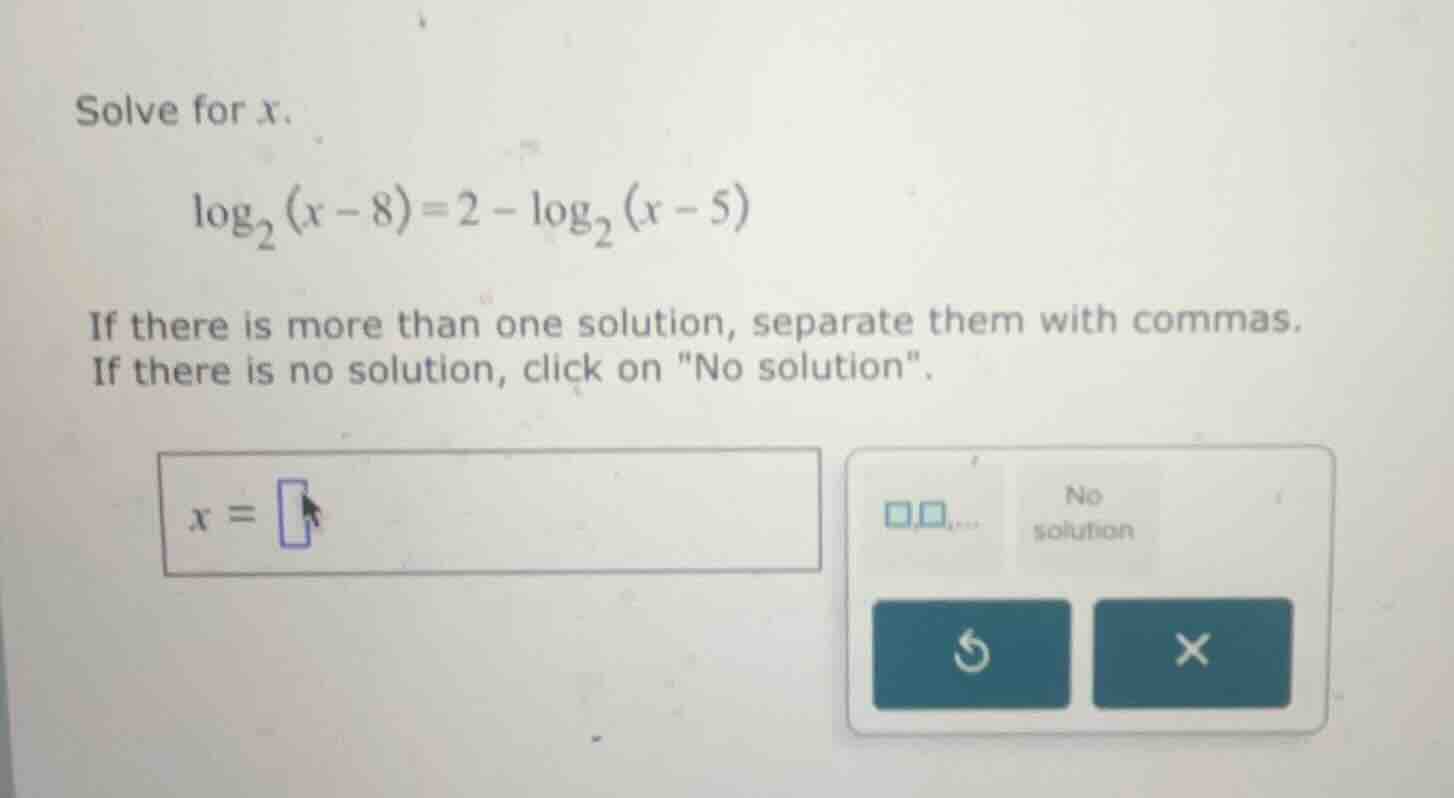
solve for (x). \\log_{2}(x-8) = 2 - \\log_{2}(x-5) if there is more tha…

Question

solve for (x).

\log_{2}(x-8) = 2 - \log_{2}(x-5)

if there is more than one solution, separate them with commas.
if there is no solution, click on
o solution\.

Explanation:

Response

<pre_analysis>
{
"quality": "clear",
"question_count": 1,
"skills_matched": [
"step_cot",
"blank_filling_formatter",
"explain_then_answer",
"tutor"
],
"needs_drawing": false,
"concepts_used": [],
"new_concepts": [
"Logarithmic Equations",
"Logarithm Properties",
"Extraneous Solutions in Logarithms"
],
"current_concepts": [
"Logarithmic Equations",
"Logarithm Properties",
"Extraneous Solutions in Logarithms"
]
}
</pre_analysis>

<reasoning>

Determine the domain of the equation

To ensure the logarithms are defined, the arguments must be strictly positive:
\[
x - 8 > 0 \implies x > 8
\]
\[
x - 5 > 0 \implies x > 5
\]
Thus, the domain is \(x > 8\).

Apply properties of logarithms

Move the logarithmic terms to one side:
\[
\log_2(x - 8) + \log_2(x - 5) = 2
\]
Using the product rule for logarithms, \(\log_b(u) + \log_b(v) = \log_b(u \cdot v)\):
\[
\log_2((x - 8)(x - 5)) = 2
\]

Convert to exponential form

Rewrite the logarithmic equation in exponential form:
\[
(x - 8)(x - 5) = 2^2
\]
\[
(x - 8)(x - 5) = 4
\]

Solve the quadratic equation

Expand and simplify the equation:
\[
x^2 - 13x + 40 = 4
\]
\[
x^2 - 13x + 36 = 0
\]
Factor the quadratic equation:
\[
(x - 9)(x - 4) = 0
\]
This gives two potential solutions:
\[
x = 9 \quad \text{or} \quad x = 4
\]

Check for extraneous solutions

We must verify each solution against our domain restriction \(x > 8\):

  • For \(x = 9\): Since \(9 > 8\), this is a valid solution.
  • For \(x = 4\): Since \(4 \le 8\), this is an extraneous solution because \(\log_2(4-8) = \log_2(-4)\) is undefined.

Thus, the only valid solution is \(x = 9\).
</reasoning>

<answer>
Solve for \(x\).

\[\log_{2}(x-8)=2-\log_{2}(x-5)\]

If there is more than one solution, separate them with commas.
If there is no solution, click on "No solution".

\(x =\) <blank>9</blank>
</answer>

<post_analysis>
{
"subject": "Mathematics",
"question_type": "Fill-in-the-blank",
"knowledge_point": [
"Mathematics",
"Algebra",
"Logarithmic Equations"
]
}
</post_analysis>

Answer:

<pre_analysis>
{
"quality": "clear",
"question_count": 1,
"skills_matched": [
"step_cot",
"blank_filling_formatter",
"explain_then_answer",
"tutor"
],
"needs_drawing": false,
"concepts_used": [],
"new_concepts": [
"Logarithmic Equations",
"Logarithm Properties",
"Extraneous Solutions in Logarithms"
],
"current_concepts": [
"Logarithmic Equations",
"Logarithm Properties",
"Extraneous Solutions in Logarithms"
]
}
</pre_analysis>

<reasoning>

Determine the domain of the equation

To ensure the logarithms are defined, the arguments must be strictly positive:
\[
x - 8 > 0 \implies x > 8
\]
\[
x - 5 > 0 \implies x > 5
\]
Thus, the domain is \(x > 8\).

Apply properties of logarithms

Move the logarithmic terms to one side:
\[
\log_2(x - 8) + \log_2(x - 5) = 2
\]
Using the product rule for logarithms, \(\log_b(u) + \log_b(v) = \log_b(u \cdot v)\):
\[
\log_2((x - 8)(x - 5)) = 2
\]

Convert to exponential form

Rewrite the logarithmic equation in exponential form:
\[
(x - 8)(x - 5) = 2^2
\]
\[
(x - 8)(x - 5) = 4
\]

Solve the quadratic equation

Expand and simplify the equation:
\[
x^2 - 13x + 40 = 4
\]
\[
x^2 - 13x + 36 = 0
\]
Factor the quadratic equation:
\[
(x - 9)(x - 4) = 0
\]
This gives two potential solutions:
\[
x = 9 \quad \text{or} \quad x = 4
\]

Check for extraneous solutions

We must verify each solution against our domain restriction \(x > 8\):

  • For \(x = 9\): Since \(9 > 8\), this is a valid solution.
  • For \(x = 4\): Since \(4 \le 8\), this is an extraneous solution because \(\log_2(4-8) = \log_2(-4)\) is undefined.

Thus, the only valid solution is \(x = 9\).
</reasoning>

<answer>
Solve for \(x\).

\[\log_{2}(x-8)=2-\log_{2}(x-5)\]

If there is more than one solution, separate them with commas.
If there is no solution, click on "No solution".

\(x =\) <blank>9</blank>
</answer>

<post_analysis>
{
"subject": "Mathematics",
"question_type": "Fill-in-the-blank",
"knowledge_point": [
"Mathematics",
"Algebra",
"Logarithmic Equations"
]
}
</post_analysis>