QUESTION IMAGE
Question
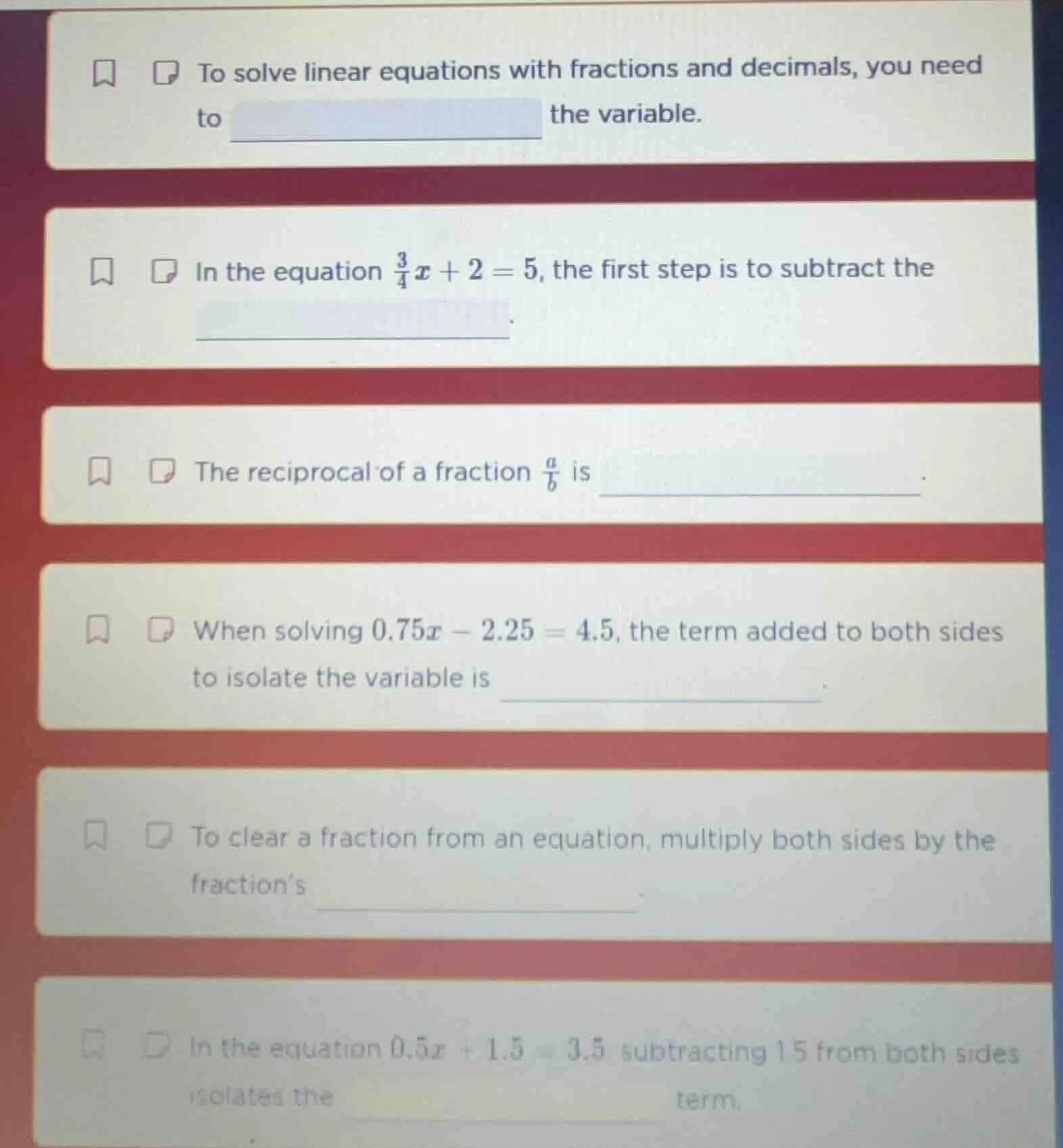
to solve linear equations with fractions and decimals, you need to the variable.
in the equation $\frac{3}{4}x + 2 = 5$, the first step is to subtract the .
the reciprocal of a fraction $\frac{a}{b}$ is .
when solving $0.75x - 2.25 = 4.5$, the term added to both sides to isolate the variable is .
to clear a fraction from an equation, multiply both sides by the fraction’s .
in the equation $0.5x + 1.5 = 3.5$ subtracting 1.5 from both sides isolates the term.
First Question:
To solve linear equations with fractions and decimals, the goal is to get the variable by itself, which means isolating it. This involves using inverse operations to move other terms away from the variable.
In the equation $\frac{3}{4}x + 2 = 5$, we follow the order of operations in reverse (undoing operations) to solve for $x$. The first step is to get rid of the constant term that is added to the term with the variable. Here, the constant term is 2, so we subtract 2 from both sides first.
The reciprocal of a fraction $\frac{a}{b}$ (where $a
eq0$ and $b
eq0$) is found by flipping the numerator and the denominator. So the reciprocal of $\frac{a}{b}$ is $\frac{b}{a}$.

Snap & solve any problem in the app
Get step-by-step solutions on Sovi AI
Photo-based solutions with guided steps
Explore more problems and detailed explanations
isolate