QUESTION IMAGE
Question
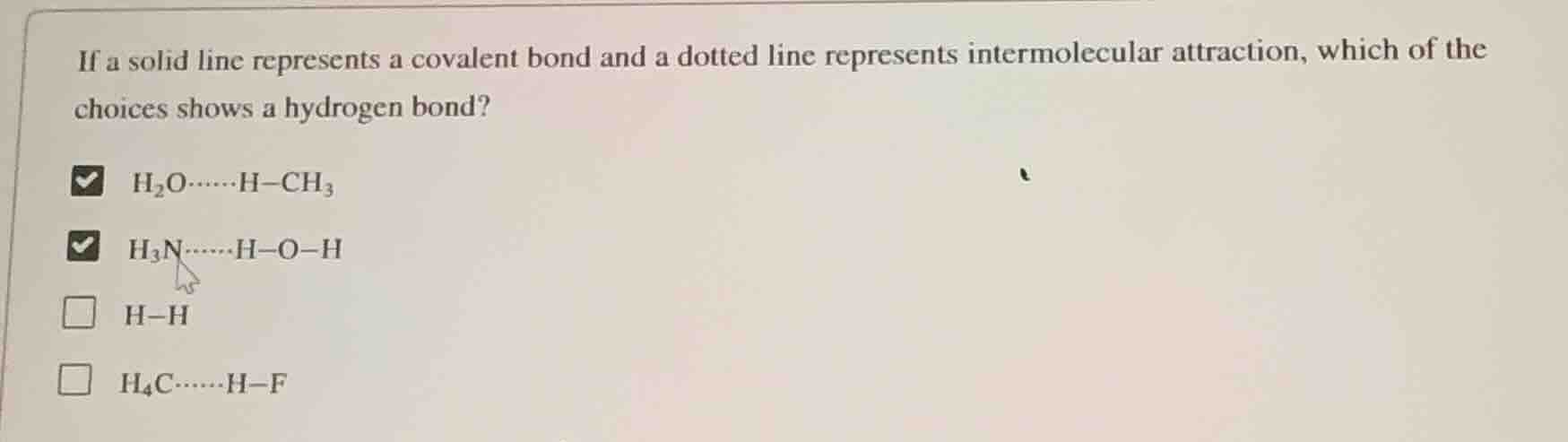
if a solid line represents a covalent bond and a dotted line represents intermolecular attraction, which of the choices shows a hydrogen bond?
\\(\text{h}_2\text{o} \cdots\cdots \text{h}-\text{ch}_3\\)
\\(\text{h}_3\text{n} \cdots\cdots \text{h}-\text{o}-\text{h}\\)
\\(\text{h}-\text{h}\\)
\\(\text{h}_4\text{c} \cdots\cdots \text{h}-\text{f}\\)
Define hydrogen bonding
A hydrogen bond is a specific type of intermolecular attraction (represented by a dotted line) between a highly electronegative atom (typically nitrogen, oxygen, or fluorine: \(\text{N}\), \(\text{O}\), or \(\text{F}\)) and a hydrogen atom that is already covalently bonded (represented by a solid line) to another highly electronegative atom (\(\text{N}\), \(\text{O}\), or \(\text{F}\)).
Analyze the first option
In \(\text{H}_2\text{O}\cdots\cdots\text{H}-\text{CH}_3\):
- The dotted line represents the intermolecular attraction between the oxygen atom in water (\(\text{H}_2\text{O}\)) and a hydrogen atom in methane (\(\text{CH}_4\), written here as \(\text{H}-\text{CH}_3\)).
- However, the hydrogen atom involved in this interaction is covalently bonded to a carbon atom (\(\text{C}\)).
- Since carbon is not highly electronegative, this interaction does not qualify as a hydrogen bond.
Analyze the second option
In \(\text{H}_3\text{N}\cdots\cdots\text{H}-\text{O}-\text{H}\):
- The dotted line represents the intermolecular attraction between the nitrogen atom in ammonia (\(\text{H}_3\text{N}\)) and a hydrogen atom in water (\(\text{H}-\text{O}-\text{H}\)).
- The nitrogen atom (\(\text{N}\)) is highly electronegative and has a lone pair.
- The hydrogen atom involved is covalently bonded to an oxygen atom (\(\text{O}\)), which is also highly electronegative.
- This satisfies all criteria for a hydrogen bond.
Analyze the third option
In \(\text{H}-\text{H}\):
- This represents a single solid line between two hydrogen atoms.
- A solid line represents a covalent bond, not an intermolecular attraction.
- Therefore, this is a nonpolar covalent bond, not a hydrogen bond.
Analyze the fourth option
In \(\text{H}_4\text{C}\cdots\cdots\text{H}-\text{F}\):
- The dotted line represents an interaction between a carbon atom in methane (\(\text{H}_4\text{C}\)) and the hydrogen atom in hydrogen fluoride (\(\text{H}-\text{F}\)).
- Although the hydrogen is bonded to a highly electronegative fluorine atom (\(\text{F}\)), the carbon atom (\(\text{C}\)) on the other side of the dotted line is not highly electronegative and lacks the necessary lone pairs to form a hydrogen bond.
- Therefore, this interaction is not a hydrogen bond.

Snap & solve any problem in the app
Get step-by-step solutions on Sovi AI
Photo-based solutions with guided steps
Explore more problems and detailed explanations
- (A) \(\text{H}_2\text{O}\cdots\cdots\text{H}-\text{CH}_3\)
- (B) \(\text{H}_3\text{N}\cdots\cdots\text{H}-\text{O}-\text{H}\) (Correct answer)
- (C) \(\text{H}-\text{H}\)
- (D) \(\text{H}_4\text{C}\cdots\cdots\text{H}-\text{F}\)