QUESTION IMAGE
Question
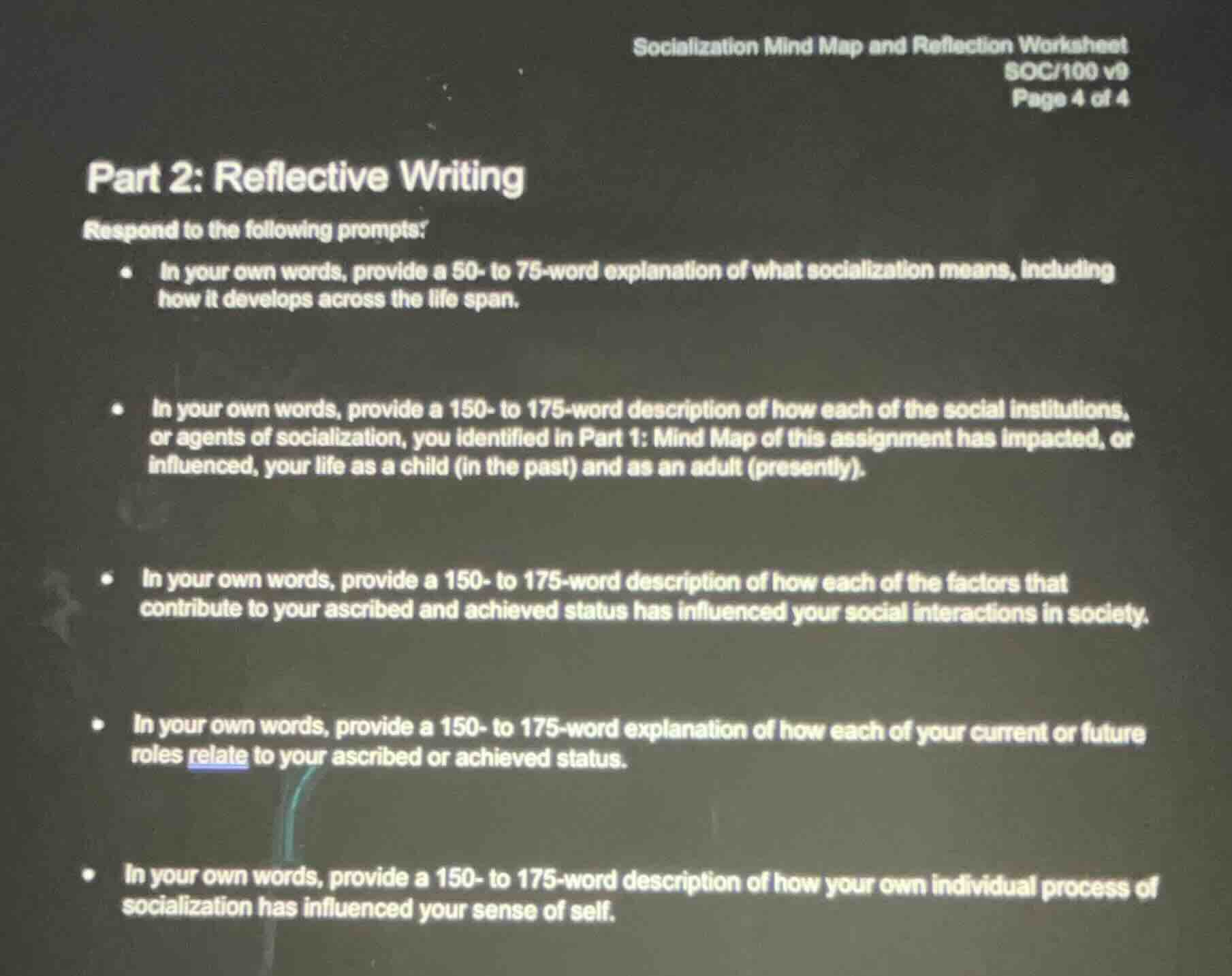
socialization mind map and reflection worksheet
soc/100 v9
page 4 of 4
part 2: reflective writing
respond to the following prompts:
- in your own words, provide a 50- to 75-word explanation of what socialization means, including how it develops across the life span.
- in your own words, provide a 150- to 175-word description of how each of the social institutions, or agents of socialization, you identified in part 1: mind map of this assignment has impacted, or influenced, your life as a child (in the past) and as an adult (presently).
- in your own words, provide a 150- to 175-word description of how each of the factors that contribute to your ascribed and achieved status has influenced your social interactions in society.
- in your own words, provide a 150- to 175-word explanation of how each of your current or future roles relate to your ascribed or achieved status.
- in your own words, provide a 150- to 175-word description of how your own individual process of socialization has influenced your sense of self.
Define socialization and its lifelong development
The first prompt asks for a 50- to 75-word explanation of socialization and its development across the life span. We will apply the concept of the Socialization Process to explain how individuals learn norms, values, and behaviors. Socialization is a lifelong process that begins in infancy with primary socialization and continues through adulthood as individuals adapt to new social environments, occupational roles, and life stages.
Analyze the impact of agents of socialization
The second prompt requires a 150- to 175-word description of how Agents of Socialization (such as family, school, peers, and media) impact life during childhood and adulthood. We will structure this by discussing how primary agents (family) shape early foundational values, while secondary agents (peers, workplace, media) guide adult behaviors, professional identity, and ongoing social adaptation.
Examine the influence of ascribed and achieved statuses
The third prompt asks for a 150- to 175-word description of how factors contributing to Ascribed Status (e.g., race, gender, family background) and Achieved Status (e.g., education, occupation) influence social interactions. We will explain how ascribed statuses set initial societal expectations and structural boundaries, while achieved statuses alter social networks, authority, and peer interactions in adult life.
Relate social roles to statuses
The fourth prompt requires a 150- to 175-word explanation of how current or future Social Roles relate to ascribed or achieved statuses. We will analyze the sociological connection: statuses are positions we occupy, whereas roles are the behaviors and expectations associated with those positions. We will illustrate this by showing how an achieved status (like being a college student or professional) dictates daily role expectations and potential role conflict.
Connect socialization to the development of self
The fifth prompt asks for a 150- to 175-word description of how the individual process of socialization has influenced the Development of Self. We will use sociological frameworks (such as Cooley's looking-glass self or Mead's stages of self-development) to explain how self-concept is constructed through social interaction, feedback from others, and internalizing societal expectations.

Snap & solve any problem in the app
Get step-by-step solutions on Sovi AI
Photo-based solutions with guided steps
Explore more problems and detailed explanations
Question 1
Socialization is the lifelong process through which individuals internalize the values, beliefs, and norms of their society, learning how to function as members of their culture. It begins in infancy with primary socialization, where family teaches foundational behaviors. Across the life span, socialization continues dynamically as individuals transition through school, careers, and aging, constantly adapting to new social expectations and environments.
Question 2
During childhood, the family serves as the primary agent of socialization, establishing foundational values, language, and emotional responses. Schooling introduces secondary socialization, teaching formal rules, authority, and peer interaction. In adulthood, the workplace and media become dominant agents. The workplace shapes professional identity, ethics, and daily routines, while media continuously influences political views, consumer habits, and cultural expectations, guiding ongoing adaptation to societal changes.
Question 3
Ascribed statuses, such as gender and race, are assigned at birth and shape early social interactions by establishing societal expectations and structural opportunities. Achieved statuses, like earning a college degree or securing a professional career, are earned through effort. Ascribed status often influences initial social positioning, while achieved status expands social networks, alters peer dynamics, and grants authority, directly shaping how others perceive and interact with an individual.
Question 4
Statuses represent social positions, while roles are the behaviors and expectations attached to them. An achieved status, such as being a university student, carries the role expectations of attending classes and studying. This status interacts with ascribed statuses, like age, which may influence peer expectations. Balancing these roles can lead to role conflict, demonstrating how societal expectations are structurally tied to our occupied social positions.
Question 5
The individual process of socialization is fundamental to shaping the self-concept. Through social interactions, individuals receive feedback from others, which acts as a mirror reflecting societal expectations. By internalizing these reflections and learning to take on the perspective of others, a distinct sense of identity is constructed. This ongoing feedback loop refines personal values, self-esteem, and individual agency within the broader social structure.